Robotic palletizing has become an important part of modern concrete block, paver and kerbstone production lines, especially where high production volumes, multiple product types and consistent packaging are required. After curing, concrete products need to be removed from production pallets, arranged into stable commercial packs and prepared for storage or shipment. If this stage cannot keep pace with the main production line, the dry side can become a bottleneck and eventually reduce the output of the complete factory.
A robotic palletizing system can automate a large part of this process by handling products according to predefined stacking recipes. However, selecting a robot should not be based only on maximum payload or arm speed. Product geometry, package design, gripper technology, real throughput, safety, pallet supply, downstream wrapping and the return of production pallets all need to be considered together. The objective is not simply to install a robot, but to create a balanced dry-side system that can process cured products reliably without limiting the main machine.
What Does a Robotic Palletizing System Do?
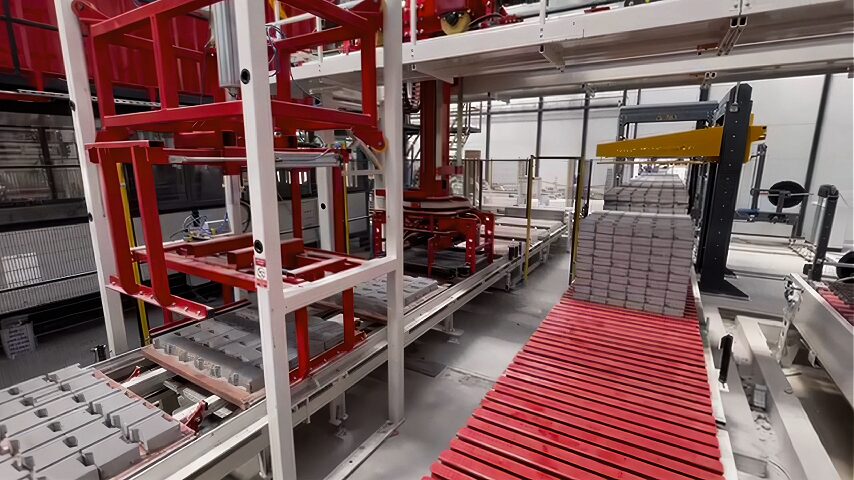
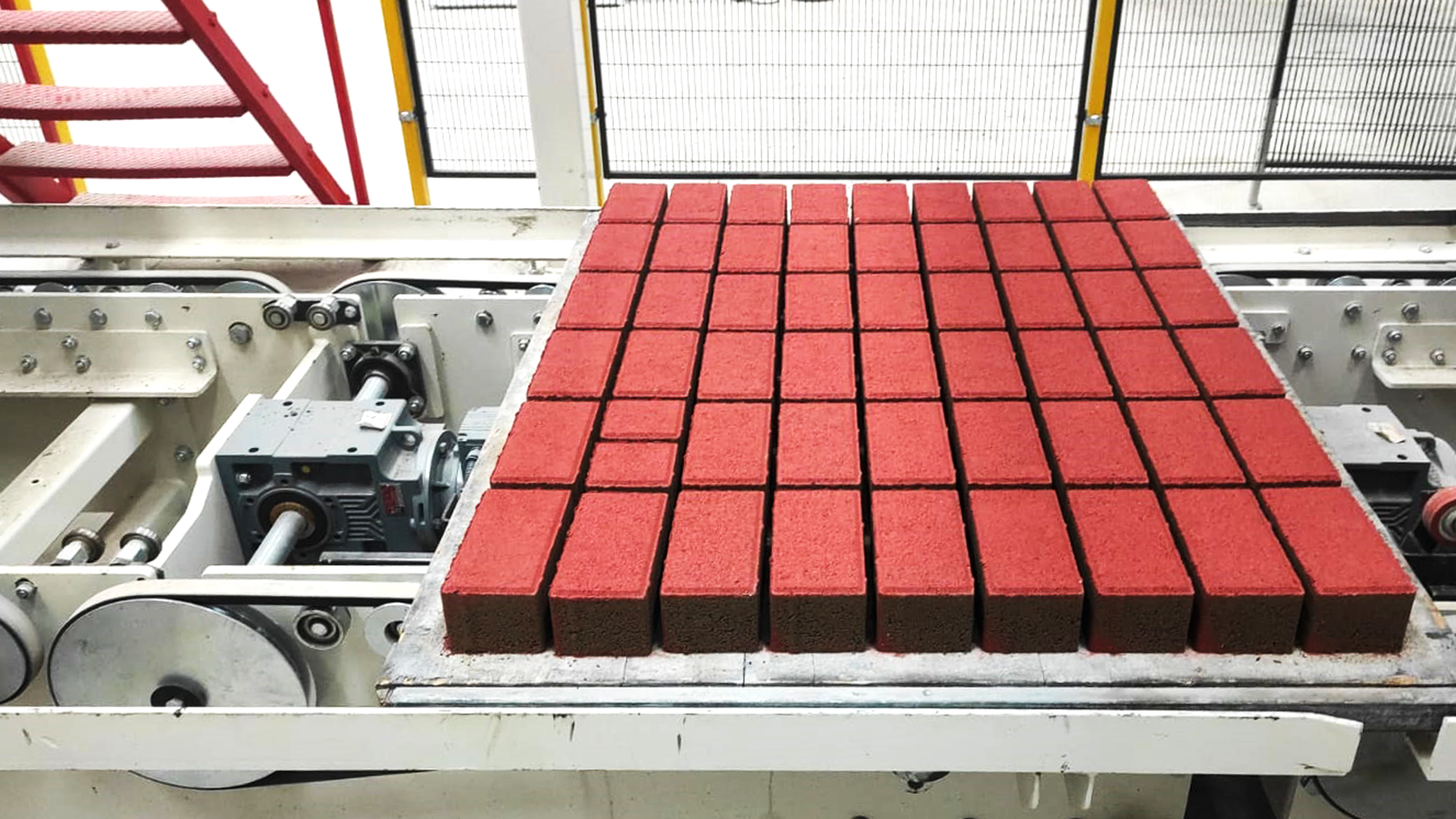
In a concrete product plant, the robotic palletizer typically operates after curing and de-stacking. Products are presented to the robot in a controlled position, picked using a dedicated gripper and placed into a defined commercial pack. Depending on the product and package design, complete product layers, partial layers or individual units may be handled.
The robot repeats the programmed stacking pattern throughout production, helping the plant maintain a more consistent package shape between shifts. The same robotic cell may also handle different products when the gripper design and automation system are suitable for the required range. This flexibility is one of the main reasons robotic systems are increasingly considered in plants producing more than one block or paver family.
Dry-Side Capacity Can Limit the Complete Plant
A high-capacity main machine has limited value if cured products cannot be processed quickly enough. When the dry side falls behind, products begin to accumulate and empty production pallets return to the main machine more slowly. If this continues, production on the wet side may eventually need to slow down or stop.
For this reason, robotic palletizing should be evaluated as part of the overall capacity chain. The main machine, curing system, de-stacking section, robot, packaging equipment and forklift removal need to support a similar production target. A fast robot does not automatically create a fast production line if the equipment before or after it cannot maintain the same flow.
Robot Speed Is Not the Same as Real Palletizing Capacity
Robot manufacturers may provide impressive movement speeds, but empty robot speed does not represent actual production capacity. The complete cycle includes product positioning, gripper movement, picking, transfer, placement and return. Commercial pallet feeding and product orientation may also add time.
The real capacity should therefore be calculated using the actual concrete product and required pack design. A standard hollow block can behave very differently from a paving stone, large kerbstone or irregular landscape product. The most useful comparison is based on complete finished packs per hour or the real square metres or units processed per shift.
The Gripper Is One of the Most Important Components
The robot itself is only one part of the palletizing system. The gripper determines how the concrete product is picked, supported and released, so its design has a direct effect on both capacity and product damage.
Different concrete products may require different gripping concepts. A block with strong vertical faces may allow a different solution from a decorative paver with sensitive finished surfaces. Large products may require additional support, while some package designs need complete layers to be handled at once.
The gripper must apply enough force to handle the product securely without creating marks, cracks or edge damage. For this reason, a well-designed gripper can be more important to successful palletizing than a higher robot payload specification.
Product Geometry Should Be Evaluated Before Robot Selection
Concrete plants often manufacture several products using the same main machine. Standard blocks, pavers, grass stones, kerbstones and special products may all require different handling methods. If the robotic cell is designed around only one product, future flexibility can become limited.
Before selecting the system, the buyer should identify the current and expected future product portfolio. Product dimensions, weight, orientation and surface sensitivity should be reviewed together with the required pack designs. This makes it possible to determine whether one universal gripper can handle the range or whether automatic or manual gripper changes will be needed.
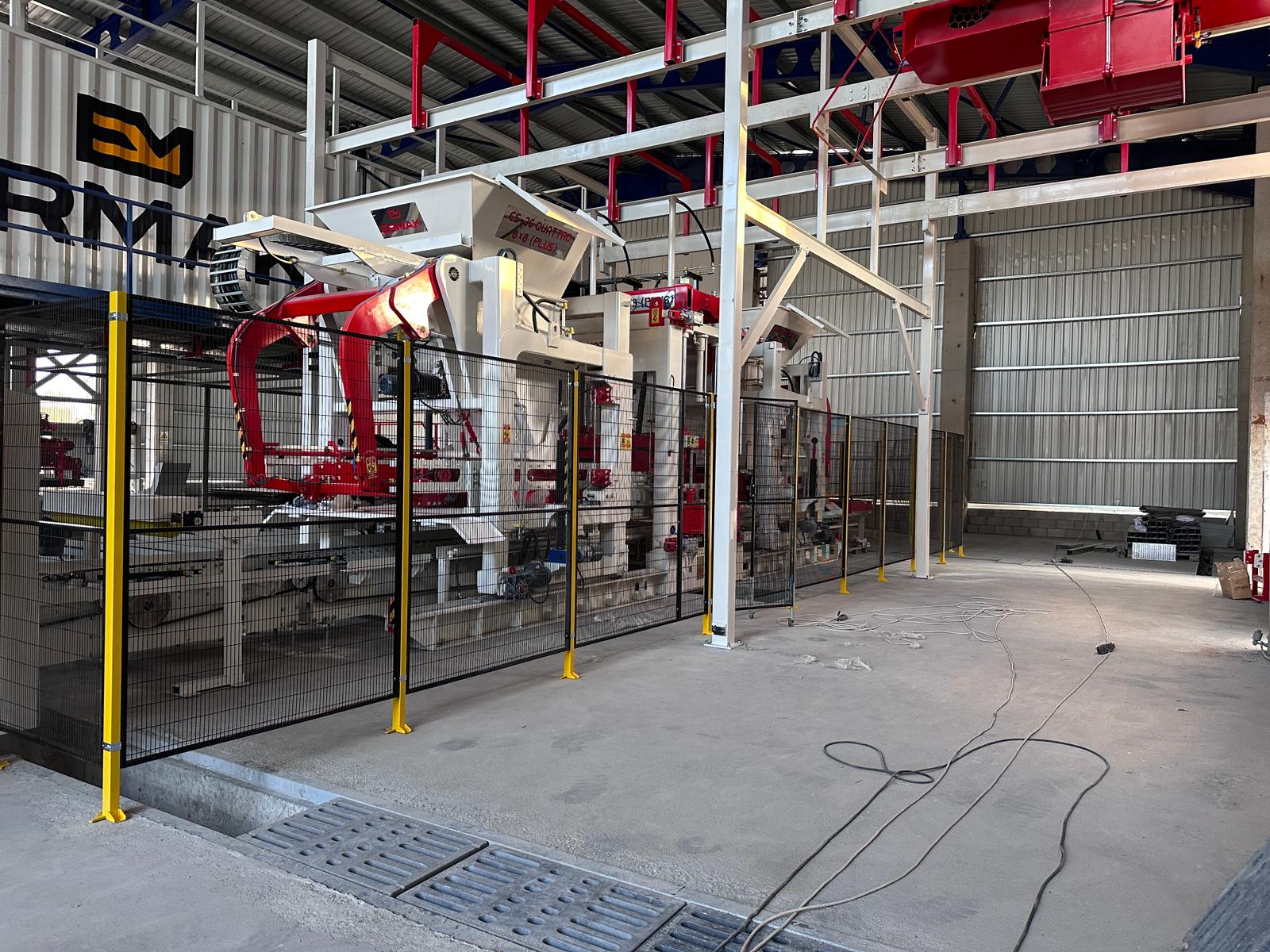
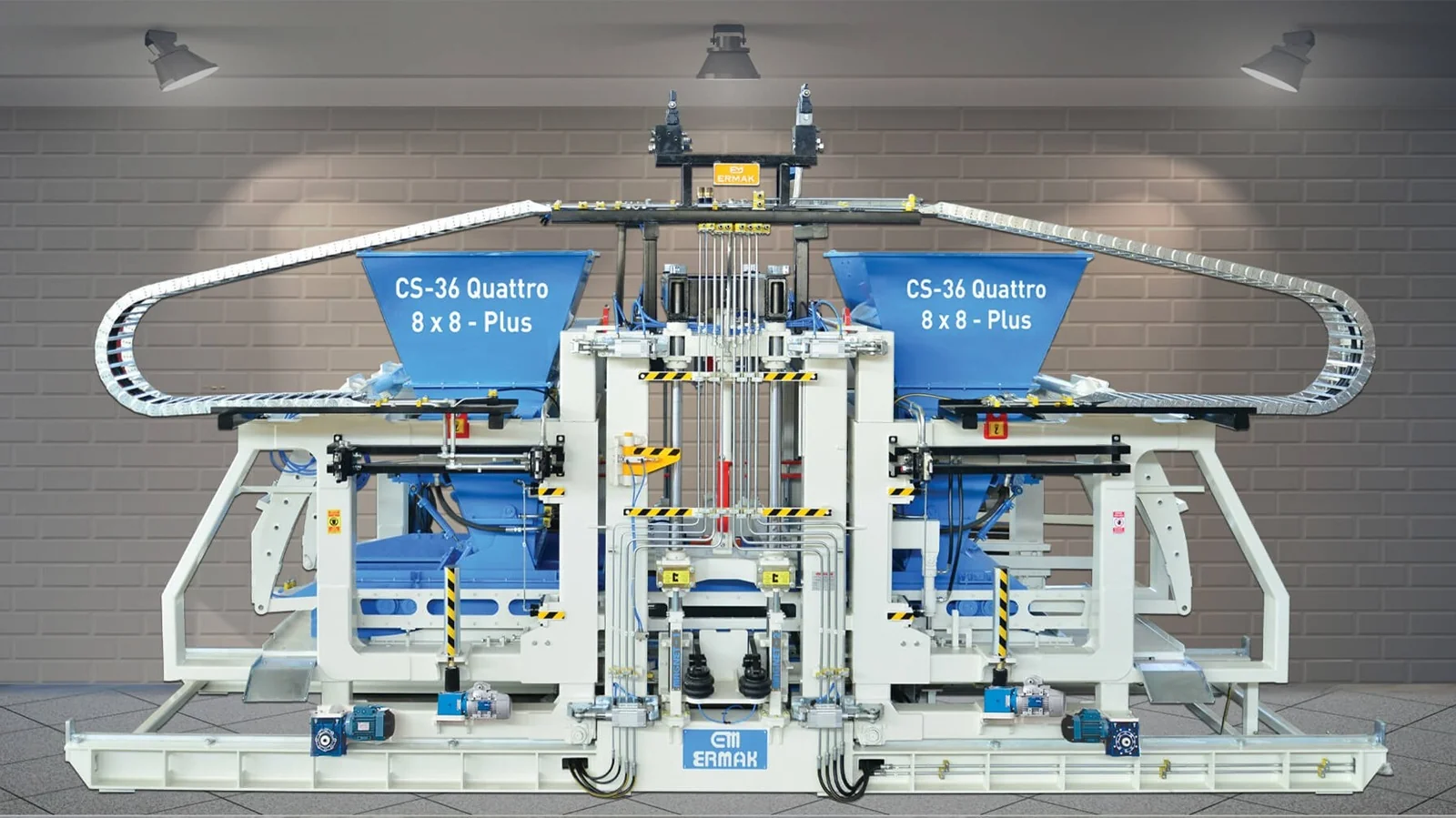
For factories planning flexible, high-capacity production with systems such as the Quattro 8X8 Plus concrete block machine, the dry-side automation should be selected with the same level of product flexibility as the main machine.
Palletizing Recipes Improve Product Changeovers
One of the advantages of robotic systems is the ability to store different stacking patterns as production recipes. When the plant changes from one product to another, the relevant palletizing program can be selected rather than rebuilding the stacking logic manually.
This can reduce product changeover time and improve repeatability. The recipe may define layer arrangement, rotation, commercial pallet dimensions and other handling parameters. A clear HMI interface can make this process easier for operators and reduce the risk of selecting the wrong package pattern.
The robot still needs to receive correctly oriented products, so recipe management should be coordinated with the conveyors and product-handling equipment around the cell.
Layer Rotation Can Improve Package Stability
Some concrete products can be stacked directly in the same orientation on every layer, while others benefit from alternate layer rotation. Changing orientation can improve package stability during forklift handling and road transport, depending on the product geometry.
The robot can perform these different stacking patterns automatically if the cell has been designed accordingly. This is an important advantage over simpler fixed mechanical systems, particularly for plants with a broad product range.
Package stability should be tested under real handling conditions rather than judged only by appearance. A pack that looks correct at the palletizing station still needs to tolerate forklift movement, storage and transportation.
Production Pallets and Commercial Pallets Are Different
A concrete block plant normally uses production pallets inside the manufacturing process. These pallets circulate between the main machine, curing system and dry side and are repeatedly reused.
Commercial pallets, when used, are different. They remain under the finished product package and may leave the factory with the customer shipment. Robotic palletizing systems therefore need to coordinate product removal from the production pallet with the creation of the final commercial package.
This distinction is important when planning the dry-side layout. Empty production pallets need to return quickly to the main machine while commercial pallets need to be supplied to the robot cell at the required rate.
Commercial Pallet Supply Can Become a Bottleneck
Even a fast robotic cell can stop if no empty commercial pallet is available. Pallet feeding should therefore be planned as part of the automated process rather than treated as a manual detail.
Depending on the factory, pallets can be supplied manually, through a magazine or by an automated handling system. The correct solution depends on production volume and labour strategy.
The pallet supply area should also be easy to replenish without interfering with robot operation or forklift traffic. Small logistics problems around the cell can reduce the value of otherwise advanced automation.
Robotic Palletizing Can Reduce Heavy Manual Handling
Concrete products are repetitive and often heavy, which makes manual stacking physically demanding. A robotic palletizing system can remove a large portion of this repetitive lifting from the production process.
This does not mean the dry side becomes completely labour-free. Operators may still be required for quality control, packaging material supply, forklift movement and supervision. Maintenance personnel are also needed to support the automation.
The main change is that labour moves away from repetitive heavy handling toward monitoring and process control. This can be especially valuable in markets where labour availability or occupational workload is an important concern.
Labour Savings Are Only Part of the Economic Benefit
Robotic palletizing investments are sometimes justified only by calculating the number of operators that can be reduced. This is too narrow an approach.
A robot can also help maintain stable output across long shifts, standardize package quality and reduce some forms of handling damage. If the existing manual process is already limiting the main line, the largest financial benefit may come from recovering lost production capacity rather than reducing headcount.
The economic analysis should therefore include labour, production availability, package consistency, product damage and multi-shift operation together.
Product Damage Must Be Controlled
Cured concrete products are stronger than fresh products, but they can still be damaged by poor handling. Corners and decorative surfaces may be particularly sensitive.
The robotic system should avoid excessive gripping pressure, hard placement or unnecessary product-to-product impact. Gripper movement, acceleration and release height should be optimized according to the product.
A robotic system can help reduce variation caused by manual handling because it repeats the same controlled motion. However, incorrect settings will also be repeated consistently. Proper commissioning is therefore essential.
Decorative Pavers Need Special Handling
Shotblasted, washed or otherwise surface-treated pavers may require more careful handling than standard blocks. Their finished surface carries a higher commercial value, so scratches, chips or pressure marks can create unnecessary rejects.
The gripper should be designed so that contact occurs in suitable areas and does not damage the decorative face. Package patterns should also avoid unnecessary rubbing between products where possible.
This is another reason why robotic palletizing should be selected according to actual product families rather than generic robot capacity alone.
Quality Control Should Come Before Final Packaging
Automation should not simply package every product that reaches the robot. The dry side is one of the final opportunities to identify visibly damaged or unacceptable products before shipment.
Depending on the plant, quality control may be performed by operators or supported by automated inspection technologies. The objective is to prevent rejected products from being hidden inside otherwise good packages.
A high-speed palletizing line that efficiently packages defective products does not create useful production. Net saleable output should remain the main performance target.
Automatic Cubing and Robotic Palletizing Are Not Always the Same
The terms cubing and palletizing are sometimes used interchangeably, but the equipment can be quite different. Mechanical cubing systems may be highly efficient for standardized high-volume products, while robots may offer greater flexibility for multiple product geometries and stacking patterns.
Neither technology is universally better. The correct choice depends on product variety, required capacity, package structure, labour model and future flexibility.
A factory producing one standardized block continuously may benefit from a different solution than a plant changing products several times per week. The decision should therefore be based on production requirements rather than the technology label.
High Product Variety Can Strengthen the Case for Robotics
Robotic palletizing becomes particularly attractive when the factory produces many different products and package arrangements. Software-based stacking recipes allow product changes without rebuilding the entire mechanical system.
This flexibility may also support future products that were not part of the original production plan. If the robot payload, reach and gripper strategy provide sufficient reserve, new stacking patterns can sometimes be introduced through programming and limited mechanical adaptation.
The buyer should still avoid oversizing the robot excessively. Flexibility has value, but unused capacity also increases investment cost.
Capacity Reserve Should Be Planned Carefully
A robotic palletizer should not be selected to operate continuously at its absolute maximum limit. Normal production includes variation in product arrival, quality-control interventions and short stops, so some capacity reserve is useful.
At the same time, purchasing a robot cell with several times the required throughput may not provide an economic return. The correct reserve depends on expected plant growth, product mix and shift pattern.
The objective is to provide enough margin for stable operation and reasonable future development without creating unnecessary capital cost.
Multi-Shift Production Changes the Investment Case
A robotic cell used for one short shift each day has a different economic profile from the same system operating continuously across two or three shifts. The more hours the system is used, the more production volume the investment cost can be distributed across.
Labour savings also accumulate more strongly in multi-shift plants. For this reason, factories planning long daily operating hours often have a stronger economic case for dry-side automation.
The investment should be evaluated using annual working hours rather than simply comparing the price of the robot with one operator’s salary.
Integration with Strapping and Wrapping Should Be Planned
Palletizing creates the product package, but many plants require additional stabilization before shipment. Strapping, stretch wrapping or other packaging methods may be used depending on the product and transport conditions.
These systems need to match the output of the robot. If the robot completes packages faster than the strapping machine can process them, a new bottleneck is created immediately after palletizing.
The complete packaging section should therefore be sized as one flow. Finished packs should move from palletizing through stabilization and toward forklift pickup without unnecessary accumulation.
Forklift Removal Is Still Part of the Production Flow
Automation can extend through palletizing and wrapping, but completed packages still need to leave the line. In many factories this is done by forklift.
If the finished-pack area is too small or the forklift cannot remove packages quickly enough, the automatic line may stop even though every machine is technically functioning correctly.
The layout should therefore provide adequate pickup space and clear traffic routes. Ideally, forklift movement should not interfere with operators or other production flows.
Safety Is a Major Part of Robot Cell Design
Industrial robots can move heavy loads quickly through a large working envelope. The cell therefore requires an appropriate safety concept that prevents unintended human access during automatic operation.
Guards, safety doors, interlocks and emergency-stop functions should be designed as part of the complete cell. The robot’s operating area and nearby conveyors need to be considered together because product transfer points can cross equipment boundaries.
Maintenance and setup access should also be included in the safety concept. The objective is to allow necessary technical work without creating uncontrolled exposure to robot movement.
Safe Restart Logic Is Important
When a safety door is opened or an emergency stop is activated, the system should enter the intended safe condition. After the issue has been resolved, the robot should not simply restart automatically without the required reset and operating sequence.
This is particularly important in automated cells because an operator may be inside or near the working area during troubleshooting.
Safety functions should be verified during factory testing and again after site installation where relevant. The complete behaviour of the cell is more important than the presence of individual safety components.
PLC and HMI Integration Should Be Clear
Operators should be able to understand what the robot cell is doing and why it has stopped. The HMI should display useful information such as current product recipe, pallet status, active alarms and major machine conditions.
The robot controller and line PLC also need to communicate reliably with surrounding conveyors, cubing equipment and packaging systems. If one system stops, the others should respond in a controlled way rather than continuing to feed products into a blocked area.
Good automation therefore turns the robot into part of the production line rather than an isolated machine.
Alarm History Can Support Maintenance
Short robot or conveyor interruptions may occur intermittently and disappear before maintenance personnel reach the cell. Alarm history can help identify these repeating problems.
If the same gripper sensor or pallet-positioning alarm appears dozens of times each week, the issue may create significant production loss even if each individual stop lasts only a short time.
This data can be used for preventive maintenance and root-cause analysis. The goal is not simply to reset alarms faster, but to reduce how often they occur.
Preventive Maintenance Is Essential for Reliable Robotics
Robotic systems are capable of highly repetitive operation, but they still require regular maintenance. The robot, gripper, sensors, conveyor components and safety devices should all be inspected according to an appropriate schedule.
The gripper deserves particular attention because it interacts directly with abrasive concrete products. Contact surfaces and moving elements may wear and gradually change handling behaviour.
Preventive inspection can identify these changes before they begin creating damaged products or unplanned stoppages.
Critical Spare Parts Should Be Identified
A robotic palletizing cell can stop because of a relatively small component. Sensors, gripper components or certain automation parts may therefore be critical despite having relatively low purchase cost.
The spare parts strategy should consider local availability and delivery time. Standard industrial parts may be sourced locally, while specialized gripper or machine-specific components may justify on-site stock.
The objective is to prevent an inexpensive part from creating several days of lost production.
Robotic Palletizing Can Support Better OEE
If manual dry-side handling is limiting output, introducing robotic palletizing can improve overall plant availability and performance. The main machine may experience fewer dry-side waiting periods, and package production can become more consistent.
However, the robot itself also becomes a critical piece of production equipment. Poor integration or unreliable operation can simply move the bottleneck from manual handling to automation.
The effect on OEE therefore depends on the quality of the entire robotic cell and its integration into the complete line.
Production Data Can Reveal Dry-Side Bottlenecks
Robot cycle time, completed pack count, waiting time and alarm history can be collected as production data. These values help plant managers understand whether the dry side is genuinely matching the main machine.
For example, the robot may have enough theoretical capacity but spend large amounts of time waiting for product. This would suggest the bottleneck lies upstream. If products continuously accumulate before the cell, the robot or packaging section may be too slow.
Data makes it easier to improve the correct section instead of guessing where capacity is being lost.
Retrofit Projects Require Careful Layout Analysis
Robotic palletizing can often be added to an existing concrete product plant, but the project requires more than finding enough floor space for the robot. Product flow, commercial pallet feeding, safety fencing, packaging and forklift access all need to be reconsidered.
Existing conveyors may require modification, and the production pallet return route must remain unobstructed. The buyer should also check whether the building has enough clear height and maintenance access for the selected robot.
A good retrofit begins by mapping the current dry-side process before selecting equipment.
New Plants Can Integrate Robotics More Efficiently
New factories have the advantage of designing the dry side around automation from the beginning. Product conveyors, robot cells, pallet magazines, wrapping systems and forklift pickup areas can all be positioned according to the intended flow.
This can reduce unnecessary transfers and manual handling. It also makes safety zoning and maintenance access easier to plan.
Investors evaluating a new complete line can review our concrete block machine and production line catalogs to compare different main machine capacities and supporting production systems before finalizing dry-side automation.
Total Cost of Ownership Should Be Considered
The robot purchase price is only one part of the investment. Grippers, safety systems, conveyors, programming, maintenance and critical spare parts all contribute to the total cost.
The buyer should compare these costs with the expected benefits: reduced manual handling, recovered production capacity, more consistent packaging and lower product damage where applicable.
The useful financial measure is not simply “How many workers does the robot replace?” but how the complete system affects the cost per saleable packaged product over several years.
When Does Robotic Palletizing Make the Most Sense?
Robotic palletizing is particularly attractive for high-volume plants, multi-shift operation, heavy products and factories with frequent product changes. It can also be valuable where consistent commercial packaging is important for export or automated warehousing.
For lower-capacity factories producing only one simple product, a less complex mechanical or semi-automatic solution may provide better economics. Technology should therefore match the real business model.
The best automation investment is the one that removes an actual production limitation rather than simply increasing the technical sophistication of the factory.
Ermak Makine’s Approach to Robotic Palletizing
At Ermak Makine, robotic palletizing is considered within the complete dry-side production flow. The capacity of the main machine, curing system, product de-stacking, robotic handling, commercial pallet supply and final packaging all need to be balanced around the same output target.
Product range is equally important. The gripper and stacking recipes should support the concrete products the customer actually plans to manufacture, while leaving reasonable flexibility for future product development. The objective is to create an automation system that supports the main production line instead of becoming another capacity restriction.
Companies planning a new concrete block, paver or kerbstone line, or considering dry-side automation for an existing facility, can contact Ermak Makine to discuss product types, target capacity and complete plant configuration.
The Real Value of Robotic Palletizing
The value of robotic palletizing does not come from having a robot inside the factory. It comes from what the system changes in daily production. A properly designed cell can standardize stacking, reduce heavy repetitive handling, support different package recipes and help the dry side maintain the output required by a high-capacity main machine.
The system needs the correct gripper, sufficient real throughput, good safety engineering and proper integration with packaging and logistics. If one of these areas is ignored, an expensive robot can still become the next bottleneck in the production line.
For concrete product manufacturers, the strongest robotic palletizing solution is therefore the one that handles the real product range safely, maintains consistent package quality and supports the complete production line without limiting net saleable output.
Frequently Asked Questions
What is robotic palletizing in a concrete product plant?
It is an automated system that picks cured concrete products and arranges them into defined commercial packs or onto shipping pallets.
Is robotic palletizing the same as automatic cubing?
Not always. Mechanical cubing systems and robotic palletizers can perform similar packaging functions but use different technologies and may offer different levels of flexibility.
Why is the gripper important?
The gripper directly contacts the product. Its design affects handling security, capacity and the risk of cracks, chips or surface damage.
Can one robot handle different products?
Often yes, provided the robot, gripper and automation system are designed for the required range of product dimensions, weights and stacking patterns.
Can stacking patterns be stored as recipes?
Yes. Robotic palletizing systems can store different pack configurations so operators can select the appropriate recipe during product changes.
Is the fastest robot always the best choice?
No. Real capacity depends on product positioning, gripping, stacking, pallet supply and downstream packaging. Empty robot speed alone is not a useful production measure.
Does robotic palletizing reduce labour?
It can reduce repetitive heavy manual handling, although operators, maintenance personnel, quality-control staff and forklift drivers may still be required.
Can a robot reduce product damage?
Controlled and repeatable handling can reduce certain forms of manual handling damage, provided the gripper and motion settings are correct.
Are decorative pavers suitable for robotic palletizing?
Yes, but gripper contact and movement settings should protect finished surfaces and sensitive edges.
Does the robot need to match the main machine capacity?
The complete dry-side system should be capable of supporting the main production target. Robot capacity should therefore be evaluated together with curing, conveyors and packaging.
Why is commercial pallet supply important?
The robot cannot complete palletized packages if empty shipping pallets are not available at the correct time, so pallet feeding is part of the automation flow.
Can a palletizing robot be added to an existing plant?
In many cases, yes. Floor space, product flow, conveyors, safety zones, pallet supply, packaging and forklift access need to be evaluated first.
What maintenance does a robotic palletizing system require?
Routine inspection typically includes the robot, gripper, sensors, conveyors, safety systems and other moving components according to the system design and maintenance plan.
Does robotic palletizing improve OEE?
It can help improve plant OEE if dry-side manual handling is a major source of waiting or performance loss, but the robotic cell itself must also operate reliably.
What is the most important factor when selecting a robotic palletizing system?
The most important factor is the ability to handle the actual product range and package formats at the required sustainable capacity while protecting product quality and integrating properly with the rest of the dry-side production line.