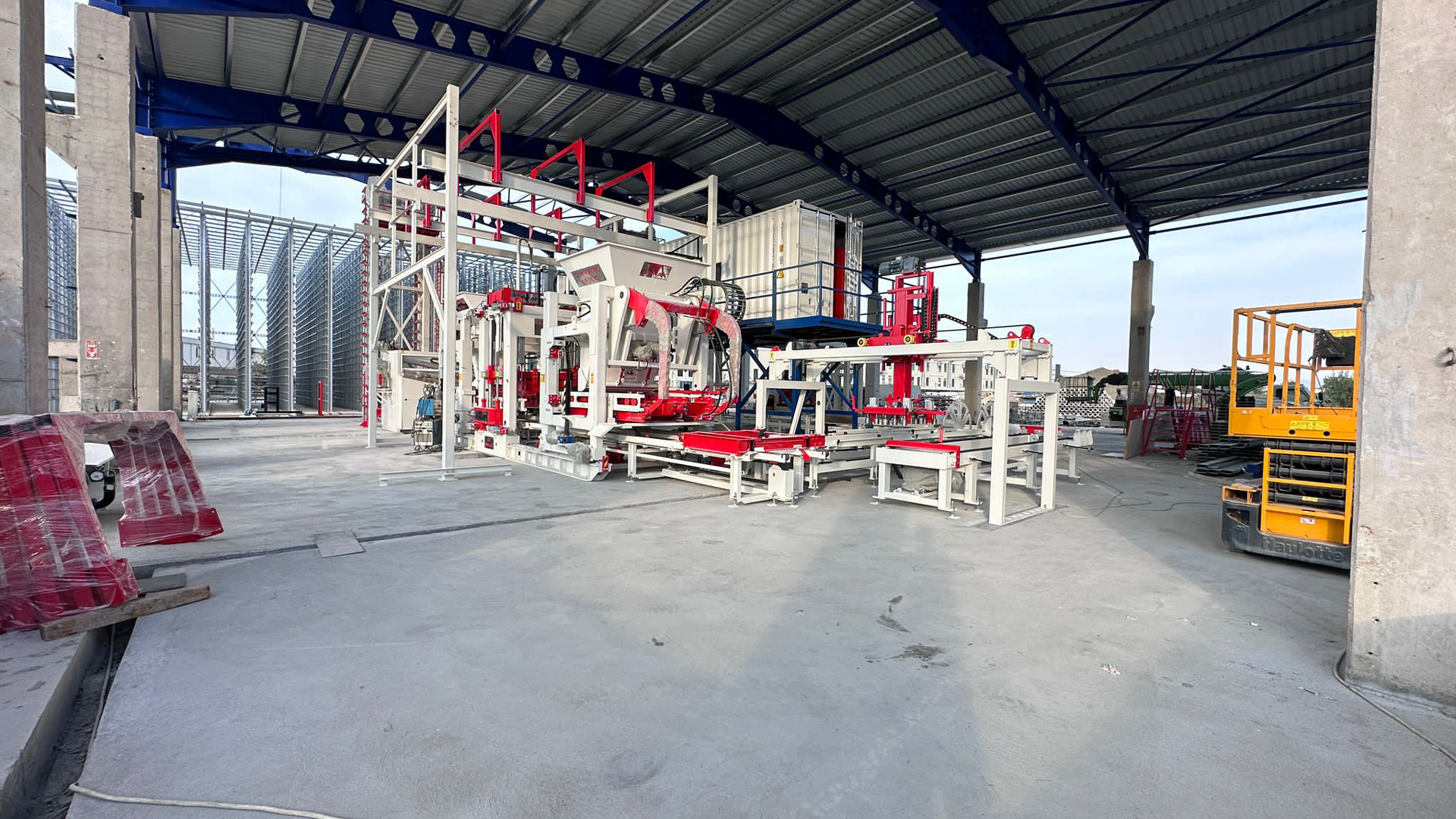
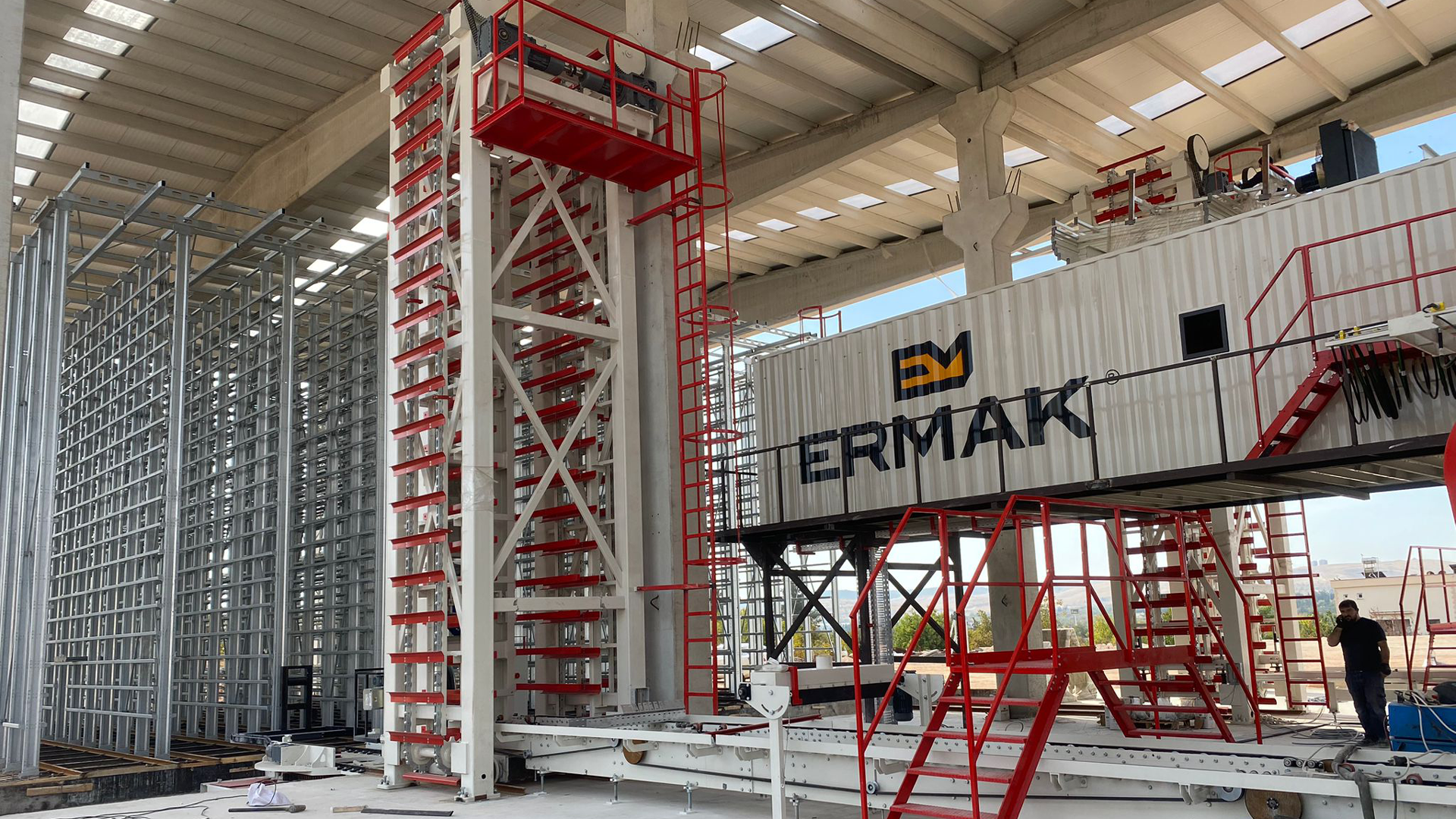
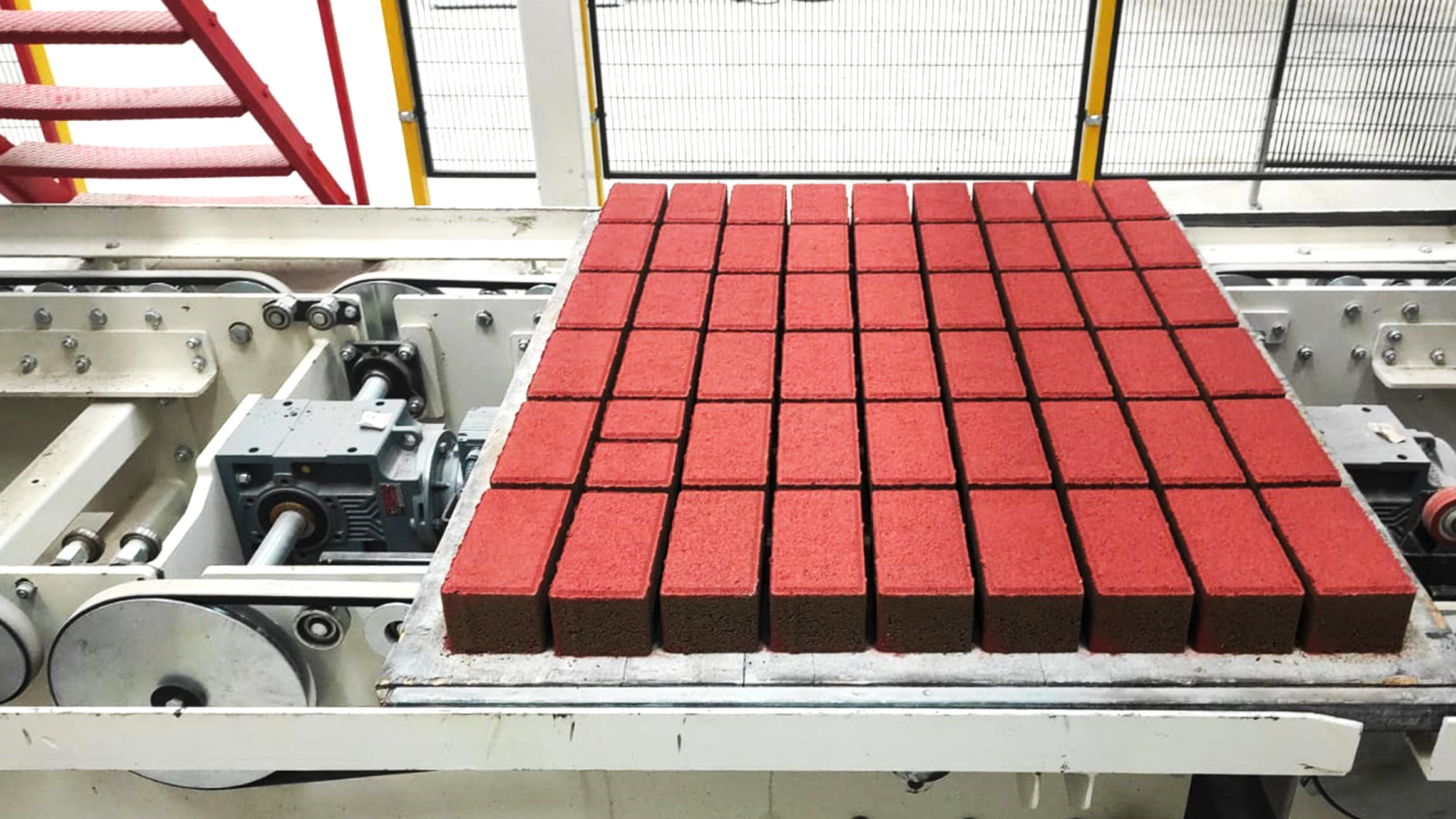
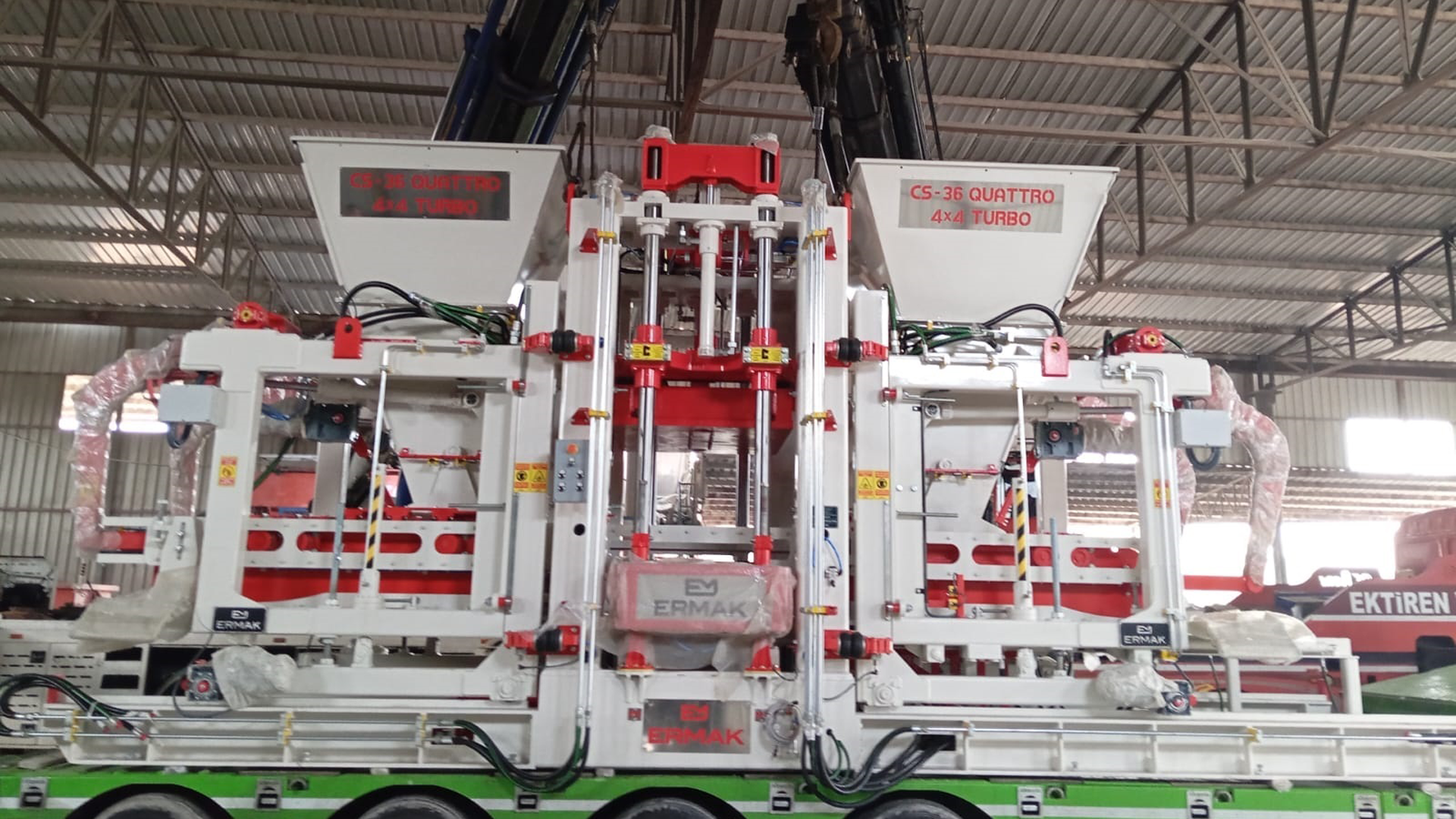
In modern concrete block production, vibration technology is not simply an additional machine feature.
It is one of the central systems that determines how effectively relatively dry concrete is compacted inside the mould.
A concrete block machine may have:
- High hydraulic power
- Fast cycle times
- Advanced automation
- Large production pallets
- High-capacity moulds
but if the concrete is not compacted consistently across the entire mould area, the finished products may show variations in:
- Density
- Surface quality
- Edge definition
- Product height
- Mechanical performance
- Reject rate
This is why vibration should be evaluated as part of the complete production process rather than only as a motor specification.
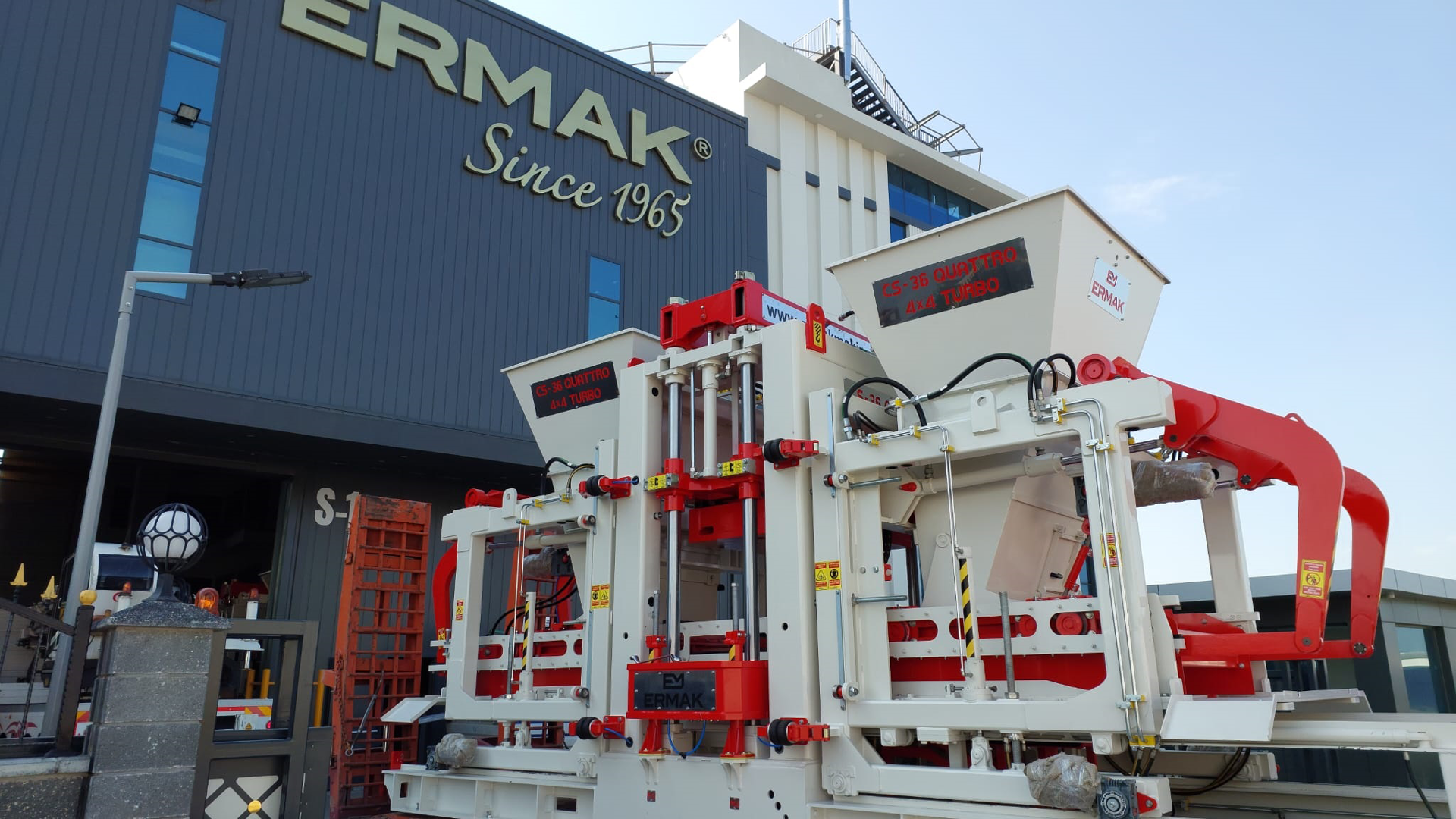
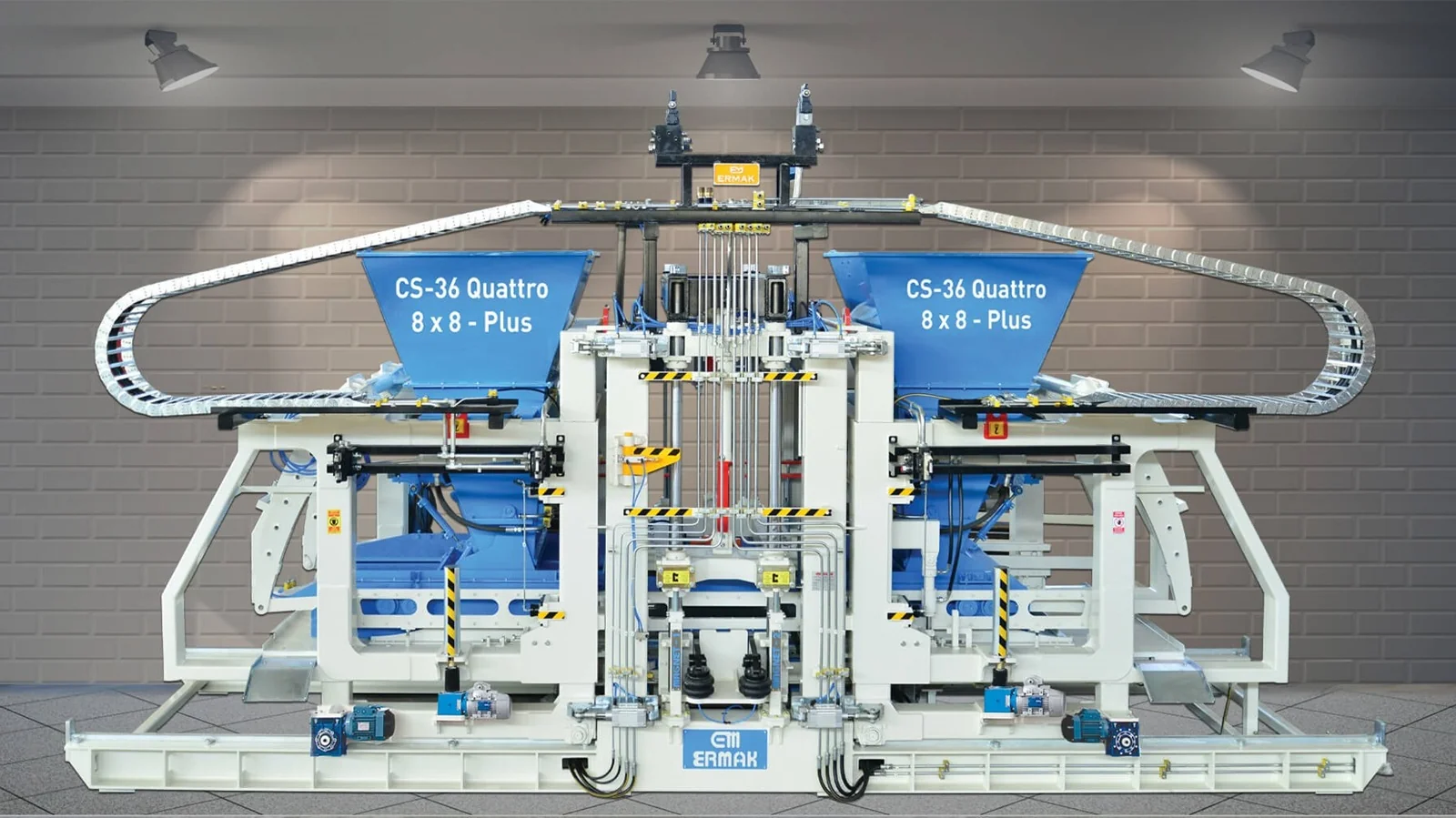
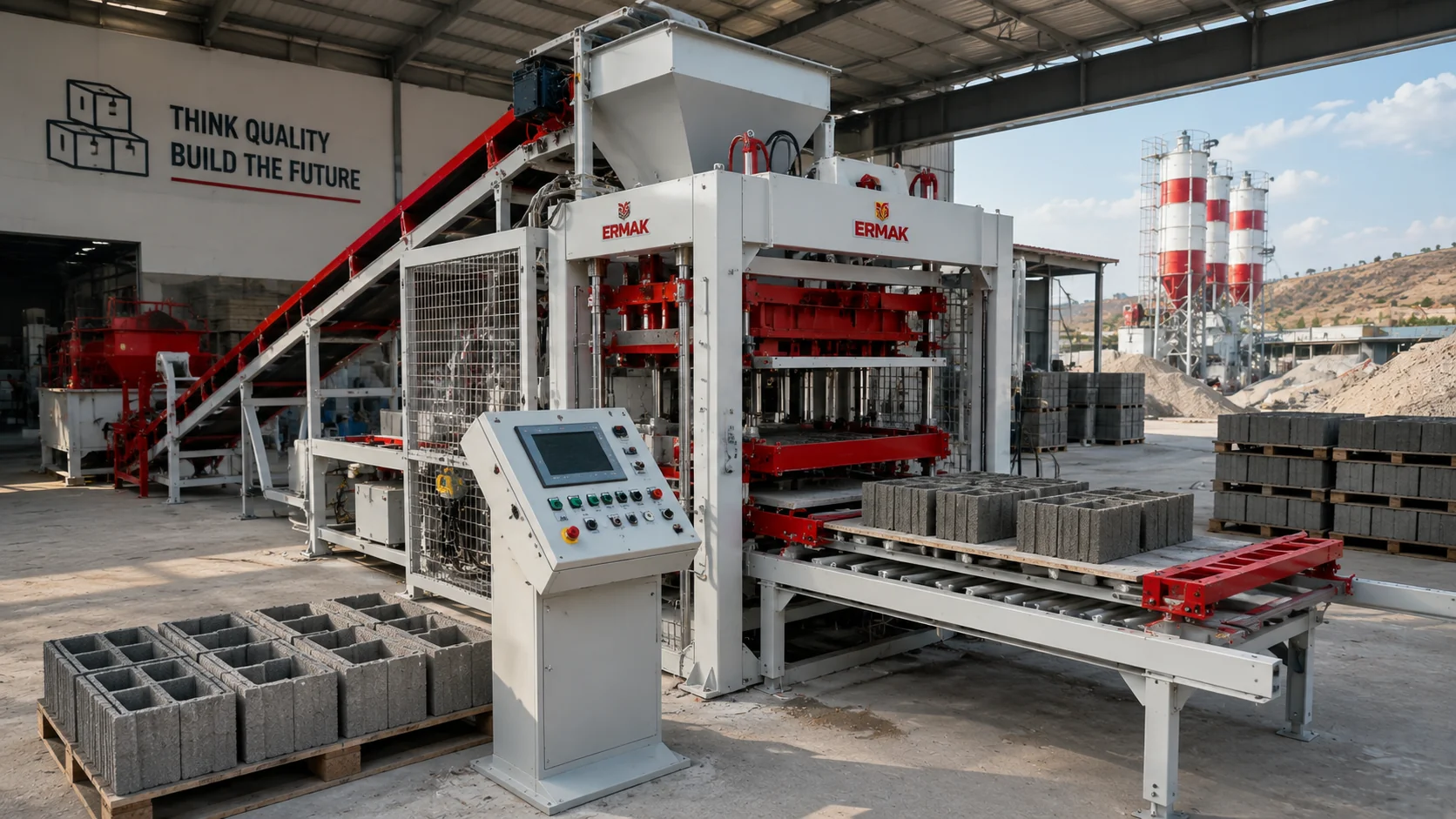
Ermak’s current turnkey plant guidance identifies vibration as one of the key technologies affecting concrete distribution, density, surface finish, edge quality, dimensional consistency, production cycle and rejection rate. Its Quattro 8X8 Plus machines use the VIBRO-180 system, which Ermak currently specifies at 180 kN vibration force with automatic lubrication.
The correct question is therefore not:
“How powerful is the vibration motor?”
A better question is:
“How efficiently and consistently does the vibration system compact concrete across the entire mould?”
Why Is Vibration Necessary in Concrete Block Production?
Concrete used for vibro-pressed blocks and paving stones is generally much stiffer than conventional flowing concrete.
The mixture must be dry enough for the product to maintain its geometry immediately after mould release.
However, dry concrete does not naturally flow and compact throughout the mould.
When the concrete enters the mould, it can contain:
- Voids
- Irregularly positioned aggregate
- Areas with different density
- Incomplete filling near corners and walls
Vibration creates controlled movement within the concrete mixture.
This helps particles rearrange into a denser structure while the tamper head applies pressure from above.
The objective is to convert relatively loose concrete into a compact, repeatable product within a short production cycle.
Vibration and Pressing Work Together
Concrete blocks are not normally formed by vibration alone.
The production process typically combines:
Concrete feeding + vibration + pressure
A simplified cycle may include:
- Production pallet enters the machine.
- Mould is positioned.
- Concrete enters the mould.
- Feeding equipment distributes the material.
- Vibration begins.
- Tamper head applies pressure.
- Concrete reaches the required compaction and height.
- Mould is lifted.
- Fresh products leave the machine on the pallet.
Vibration helps the concrete settle and rearrange.
Pressure helps complete the compaction and control product height.
The timing between these systems is critical.
Too little vibration may leave the concrete insufficiently compacted.
Too much vibration may unnecessarily extend cycle time or increase mechanical loading without producing additional useful compaction.
1. Vibration Directly Influences Product Density
One of the most important functions of vibration is improving the density consistency of the finished concrete product.
Without adequate compaction, excessive voids can remain inside the product.
This may contribute to:
- Lower mechanical performance
- Weak edges
- Rough surfaces
- Higher variability between products
Effective vibration helps aggregate particles settle closer together and reduces unnecessary internal voids.
The objective is not simply to create the heaviest possible block.
The objective is to achieve the required density consistently across every product and every production cycle.
2. Uniform Vibration Across the Pallet Is Critical
The total vibration force shown in a technical specification does not tell the whole story.
Imagine an 18-cavity hollow-block mould.
If one side of the mould receives significantly more vibration than the other, products from the same cycle may have different:
- Densities
- Surface structures
- Heights
- Strength characteristics
The system therefore needs to distribute vibration effectively across the production area.
Important design factors may include:
- Vibration-unit arrangement
- Motor positioning
- Machine-frame rigidity
- Table geometry
- Mould mounting
- Production pallet condition
This becomes increasingly important as production pallet dimensions and mould sizes increase.
Ermak’s CS-42 Quattro 8X8 Plus, for example, uses a 1350 × 1400 mm-class pallet and is specified for an 18-block configuration with production capacities of 25,000–30,000 standard 20 × 40 × 20 cm blocks per eight hours.
At this scale, uniform compaction across the mould area is essential for consistent output.
3. Vibration Affects Surface Quality
Poorly compacted concrete can produce visible defects.
Typical symptoms may include:
- Large pores
- Open surface texture
- Exposed aggregate pockets
- Weak corners
- Incomplete edges
Correctly controlled vibration helps the concrete fill the mould more uniformly and creates a more consistent surface.
This is especially important in products where appearance matters, such as:
- Paving stones
- Architectural blocks
- Coloured pavers
- Landscaping products
- Kerbstones
For these applications, product appearance can be almost as commercially important as mechanical performance.
4. Edge and Corner Quality Depend on Compaction
Corners and thin sections of a mould can be more difficult to fill effectively than large open areas.
If the concrete does not reach or compact properly in these regions, the product may show:
- Weak corners
- Broken edges
- Incomplete geometry
These defects may first appear during:
- Mould release
- Curing
- Packaging
- Transport
It is important to remember that edge breakage does not automatically mean the mould is defective.
Possible causes can include:
- Concrete that is too dry
- Poor aggregate grading
- Inadequate filling
- Incorrect vibration
- Incorrect pressing
- Worn moulds
A professional troubleshooting process therefore evaluates the complete production system.
5. Vibration Influences Product Height Consistency
Concrete distribution inside the mould influences how much material reaches each cavity.
If filling and vibration are uneven, some cavities can contain more compacted material than others.
This may create variations in:
- Product weight
- Product density
- Final height
In applications such as paving stones, dimensional consistency is particularly important because large numbers of products are installed together.
Small dimensional differences repeated across thousands of units can become visible on the finished surface.
For this reason, vibration performance should be evaluated together with:
- Feeding
- Tamper-head positioning
- Mould condition
- Pallet condition
6. More Vibration Is Not Automatically Better
One of the most common misconceptions in block production is:
“Higher vibration always produces a better block.”
Not necessarily.
The objective of vibration is to achieve the required compaction efficiently.
The system must balance:
- Vibration force
- Frequency
- Duration
- Timing
- Product geometry
- Concrete characteristics
Excessive vibration can increase:
- Cycle time
- Bearing load
- Mechanical stress
- Energy use
without necessarily producing a better product.
The correct engineering objective is:
The right vibration, applied at the right stage, for the right amount of time.
Ermak’s own turnkey guidance makes the same distinction, noting that the objective is not simply maximum vibration power but effective and controlled distribution across the mould area.
7. Vibration Force Is Only One Specification
Vibration force is an important technical parameter, but it should never be used alone when comparing machines.
Buyers should also investigate:
- How vibration is generated
- Where motors are positioned
- How the system is synchronised
- Whether frequency can be controlled
- How the table transfers vibration
- How bearings are lubricated
- How the unit is maintained
Ermak currently specifies its VIBRO-180 system at 180 kN vibration force and automatic lubrication on Quattro 8X8 Plus models. The company states that this vibration-system family has been used in its machines for around 20 years.
The practical value of such a system, however, must still be judged by its ability to produce consistent blocks and pavers under real production conditions.
8. Frequency Matters as Much as Force
Vibration frequency describes the repetitive character of the vibration applied to the concrete.
Different products can respond differently because of variations in:
- Aggregate grading
- Moisture
- Product height
- Mould geometry
- Concrete volume
A standard hollow block and a thin paving stone may therefore require different machine settings.
This is why a modern block-production process benefits from adjustable product-specific parameters rather than one fixed vibration setting for every mould.
9. Vibration Duration Directly Affects Cycle Time
Vibration is part of the production cycle.
Suppose one machine cycle takes:
15 seconds
If vibration time is unnecessarily extended by two seconds, the complete cycle may become:
17 seconds
The hourly production difference can be significant.
For example:
15-second cycle
3,600 ÷ 15 = 240 cycles/hour
17-second cycle
3,600 ÷ 17 ≈ 212 cycles/hour
Difference:
approximately 28 cycles per hour
If the mould produces 18 blocks per cycle:
28 × 18 = 504 blocks/hour
That is a substantial theoretical capacity difference.
However, shortening vibration too aggressively can increase reject rates.
The correct target is therefore not minimum vibration time.
It is the shortest vibration time that reliably achieves the required product quality.
10. Faster Production Is Valuable Only When Products Are Saleable
Imagine two machine settings.
Setting A
- Faster cycle
- 25,000 total products
- 5% reject rate
Saleable production:
23,750 products
Setting B
- Slightly slower cycle
- 24,500 total products
- 1% reject rate
Saleable production:
24,255 products
In this example, the slower setting actually produces more saleable products.
This illustrates an important production principle:
Capacity should be measured after quality losses, not before them.
Vibration technology plays an important role in achieving this balance.
11. Concrete Recipe and Vibration Must Be Developed Together
A vibration system cannot compensate for every concrete-recipe problem.
If the mixture is excessively dry:
- Mould filling may be poor.
- Compaction may require more time.
- Corners may remain weak.
If the mixture is too wet:
- Products may deform after demoulding.
- Edges may lose definition.
- Concrete may stick to the mould or tamper head.
Ermak’s own concrete-production guidance highlights moisture and recipe control as essential because too-dry and too-wet mixtures can create very different quality problems.
The correct combination is therefore:
Concrete recipe + moisture + feeding + vibration + pressing
rather than vibration alone.
12. Aggregate Grading Influences Vibration Efficiency
Concrete compaction becomes easier when aggregate particle sizes are arranged in an appropriate grading.
Poor grading can create large internal voids.
The vibration system then has to work harder to produce acceptable density.
Good grading helps:
- Smaller particles fill spaces between larger particles.
- Concrete becomes more compactable.
- Surface quality improves.
- Cement paste can be used more effectively.
This means vibration efficiency begins before the concrete even reaches the block machine.
It begins with raw-material control.
13. Moisture Changes Can Change the Required Vibration
Aggregate moisture may change during the day because of:
- Rain
- Temperature
- Storage conditions
If added water is not adjusted, concrete consistency may change even though the recipe number displayed in the batching plant remains identical.
This can cause operators to compensate by changing:
- Vibration time
- Filling time
- Pressing parameters
The actual problem, however, may be moisture variation.
This is why modern concrete block plants should ideally monitor moisture as part of recipe control. Ermak’s existing plant guidance similarly highlights aggregate moisture and water-dosing control as important for consistent production.
14. Mould Design Can Improve or Limit Vibration Performance
The mould is the point where vibration technology interacts directly with the product geometry.
A mould that is:
- Worn
- Misaligned
- Incorrectly mounted
- Poorly designed
can reduce compaction consistency.
Mould geometry also influences how easily concrete moves into:
- Narrow walls
- Corners
- Internal block sections
A powerful vibration system does not eliminate the need for high-quality mould engineering.
The machine and mould should therefore be evaluated as one compaction system.
15. Tamper-Head and Mould Alignment Matters
The tamper head applies pressure from above while vibration works from below and through the production system.
If the tamper head does not align correctly with the mould:
- Compression can become uneven.
- Product heights may vary.
- Mechanical contact may occur.
For this reason, mould change and maintenance procedures should include alignment checks.
Fast mould change has limited value if the new mould is not correctly positioned.
Ermak currently states that certain Quattro machines can begin production with a new mould in up to approximately 15 minutes using a fully automatic mould-change system.
16. Production Pallets Are Part of the Vibration System
The production pallet is not merely a platform carrying the fresh block.
It participates in the transfer of vibration between the machine and the product.
A pallet that is:
- Bent
- Worn
- Damaged
- Inconsistent in thickness
may influence vibration transmission and product geometry.
This can create production problems that look like:
- Mould problems
- Vibration problems
- Filling problems
Ermak’s current after-sales guidance specifically notes that production-pallet condition can affect product height, vibration transfer and conveying behaviour.
17. Machine-Frame Rigidity Influences Vibration Control
Vibration creates significant dynamic forces.
A machine frame has to manage these forces without creating uncontrolled movement.
If excessive vibration energy is lost into unwanted structural movement, less useful energy is available for controlled compaction.
Important engineering considerations therefore include:
- Frame rigidity
- Table support
- Bearing design
- Machine foundations
- Mould mounting
Ermak’s Quattro product pages currently list body weights around 43,000–45,000 kg depending on the model page and configuration, while emphasising strong construction and stable operation.
Machine weight alone is not proof of better vibration performance, but structural design is an important part of vibration control.
18. Vibration Technology Can Affect Cement Efficiency
In concrete production, increasing cement content is an expensive way of attempting to compensate for weak process control.
Better compaction can allow the available concrete recipe to be used more effectively.
Ermak makes a specific manufacturer claim for its Android 12 and Android 18 models: based on customer feedback, the company states that the VIBRO-180 system may allow production using approximately 15–20 kg less cement per cubic metre under relevant production conditions.
This should not be interpreted as a universal guaranteed saving.
Actual cement requirements depend on:
- Product specification
- Aggregate
- Cement type
- Moisture
- Required strength
- Curing
- Local standards
The important engineering principle is that efficient compaction can contribute to recipe optimisation, but any saving must be verified through plant trials and laboratory testing.
19. Why Small Cement Changes Matter at Industrial Scale
Consider a purely illustrative example.
Assume a factory uses:
- 100 m³ concrete/day
- 300 production days/year
and process optimisation reduces cement requirement by:
10 kg/m³
Annual cement difference:
100 × 300 × 10 = 300,000 kg
or:
300 tonnes/year
This is not an Ermak performance guarantee.
It simply illustrates why even small improvements in concrete efficiency can become economically important in high-volume production.
20. Vibration Technology Can Affect Reject Rate
A rejected block has already consumed:
- Aggregate
- Cement
- Water
- Mixer time
- Machine time
- Electricity
- Labour
Therefore, reducing reject rate is one of the most important forms of production efficiency.
Suppose a factory produces:
20,000 blocks/day
At a 5% rejection rate:
1,000 blocks/day
are lost.
At 2%:
400 blocks/day
are lost.
Difference:
600 saleable blocks/day
Over 300 production days:
180,000 blocks/year
This shows why vibration consistency can have an economic impact far greater than the price of the vibration components themselves.
21. Vibration Affects Energy Consumption Too
Vibration motors consume electricity.
Longer vibration periods therefore increase:
- Motor operating time
- Energy consumption per cycle
However, energy analysis must also consider quality.
If shorter vibration reduces electricity slightly but increases reject rate significantly, energy per saleable block may actually become worse.
A useful KPI is therefore:
kWh / 1,000 saleable blocks
rather than vibration energy alone.
22. Different Products Need Different Vibration Parameters
One machine may produce:
- Hollow blocks
- Paving stones
- Kerbstones
- Grass blocks
- Drainage products
but these products have different:
- Heights
- Concrete volumes
- Geometries
- Surface requirements
Ermak’s CS-42 Quattro 8X8 Plus is currently presented for a broad range of products, including paving stones, borders, BIMS blocks, hollow blocks, grass stones and channels.
This product flexibility makes recipe and machine-parameter management especially important.
A vibration setting that works well for a 200 mm hollow block may not be ideal for a thin paver.
23. Single-Layer and Double-Layer Pavers Require Different Process Control
Double-layer pavers typically use:
- Base concrete
- Face concrete
The two mixtures can have different:
- Aggregate grading
- Moisture
- Cement content
- Pigment
- Surface requirements
The vibration sequence must compact the complete product while preserving the required face-layer quality.
This requires careful coordination between:
- Batching
- Face-mix feeding
- Vibration
- Pressing
Quality problems in double-layer production therefore cannot be investigated through vibration settings alone.
24. Vibration Problems May First Appear as Quality Problems
A vibration-system failure does not always stop the machine immediately.
Ermak’s current after-sales guidance notes that deterioration may initially appear as:
- Different density across the pallet
- Longer compaction time
- Poor surfaces
- Higher rejection rates
- Unusual noise
- Increased bearing temperature
This is important for maintenance teams.
If product quality begins to change gradually, the cause may be machine condition rather than only the concrete recipe.
Quality-control and maintenance teams should therefore share production data.
25. Bearings Require Special Attention
Vibration systems operate under repeated dynamic loading.
Bearings may therefore be exposed to significant operating stresses.
Potential warning signs include:
- Increasing temperature
- Unusual sound
- Excessive play
- Changed vibration behaviour
Bearing failure can result from several underlying causes, including:
- Insufficient lubrication
- Contamination
- Misalignment
- Improper installation
Replacing a failed bearing without investigating why it failed may only postpone the next breakdown.
26. Automatic Lubrication Can Support Reliability
Correct lubrication is essential in heavily loaded vibration systems.
Automatic lubrication can help:
- Apply lubricant consistently
- Reduce dependence on manual routines
- Protect critical bearing points
Ermak lists automatic lubrication as one of the characteristics of its VIBRO-180 system.
Automatic lubrication does not eliminate maintenance.
The plant still needs to inspect:
- Lubricant level
- Distribution lines
- Lubrication points
- System operation
An empty automatic lubrication reservoir is still an empty lubrication reservoir.
27. Synchronisation Is an Important Engineering Detail
In systems using multiple vibration motors or shafts, synchronisation affects the resulting vibration pattern.
Poor synchronisation can create:
- Unwanted directional vibration
- Uneven compaction
- Excess mechanical movement
This is why buyers should not evaluate vibration systems only by adding motor kW ratings.
A better evaluation considers how the vibration forces work together as a system.
28. Vibration Should Be Integrated with Machine Automation
Advanced machine control can allow different products to use different process parameters.
Depending on machine configuration, stored parameters may include:
- Filling time
- Vibration duration
- Pressing time
- Product height settings
This improves repeatability when the same product is produced again.
Instead of relying entirely on one experienced operator’s memory, the factory can start from tested process settings.
This is especially valuable in plants performing frequent mould changes.
29. Vibration Performance Should Be Tested with Real Products
A technical datasheet provides useful information, but production trials provide more.
When evaluating a block machine, investors should ideally observe:
- Real concrete
- Real moulds
- Target product dimensions
- Normal operating cycle
- Product quality across the complete pallet
Questions to ask include:
- Are blocks from every cavity equally dense?
- Are surface characteristics consistent?
- Does the machine maintain quality during continuous production?
- How many rejects are produced?
- How much adjustment does the operator perform?
Reference plants are especially valuable because they show vibration performance after years of production rather than only during a new-machine demonstration.
30. Vibration Should Be Evaluated Together with Cycle Stability
A machine may occasionally achieve a very short cycle.
But industrial production requires repeating that cycle:
- Hundreds
- Thousands
- Tens of thousands
of times.
A better machine-performance question is therefore:
“Can the machine maintain the required cycle and product quality throughout the complete shift?”
Ermak’s Quattro machines are marketed around high-vibration compaction and stable operation, with the CS-36 currently listed at 16,000–20,000 standard blocks per eight hours and the CS-42 at 25,000–30,000.
The practical significance of those capacities depends on consistent cycle performance.
31. Maintenance Access Should Be Considered Before Purchase
Vibration systems require maintenance during the machine’s operating life.
Investors should inspect whether technicians can easily access:
- Bearings
- Shafts
- Motors
- Lubrication points
- Mounting components
A technically sophisticated system that requires major disassembly for routine service can increase maintenance time.
This affects Mean Time To Repair — MTTR and therefore long-term plant availability.
32. Spare Parts Availability Matters
Critical vibration components may include:
- Bearings
- Shafts
- Motors
- Lubrication components
- Mounting parts
- Synchronisation components
Ermak’s current after-sales guidance specifically identifies the vibration unit as one of the hardest-working sections of a block machine and recommends that spare-parts planning consider machine-specific vibration components.
When evaluating suppliers, ask:
- Which vibration parts should be stocked?
- What are normal delivery times?
- Which parts are standard commercial components?
- Which parts are manufacturer-specific?
- Is technical documentation available?
33. Vibration Settings Should Not Be Used to Hide Recipe Problems
Operators sometimes respond to poor product quality by simply increasing vibration time.
This may occasionally help, but it may also hide the true problem.
The root cause could be:
- Aggregate grading
- Incorrect moisture
- Mixer inconsistency
- Worn mould
- Poor feeding
If vibration must continually be increased to maintain the same product quality, the complete production process should be investigated.
Good manufacturing is based on root-cause control, not permanent compensation.
34. Vibration Performance Should Be Monitored Through Quality KPIs
Useful production indicators include:
- Reject rate
- Product weight variation
- Product height variation
- Surface defect rate
- Density variation
- Cycle time
- Vibration-system temperature
If these values change gradually over time, maintenance teams can investigate before a major failure occurs.
For example, if:
- Cycle time increases
- Bearing temperature rises
- Surface quality deteriorates
at the same time, the vibration system may deserve immediate inspection.
35. Vibration Technology and OEE
Vibration influences all three components of Overall Equipment Effectiveness — OEE.
Availability
Mechanical failures in vibration components can stop production.
Performance
Longer-than-required vibration can reduce cycle speed.
Quality
Poor vibration can increase rejects.
This makes vibration technology unusual because it can influence machine reliability, speed and product quality simultaneously.
A well-performing vibration system therefore has a direct relationship with overall factory productivity.
36. Questions to Ask When Comparing Vibration Systems
Before purchasing a concrete block machine, ask:
- What vibration force is available?
- How is the vibration generated?
- Where are the motors or vibration units positioned?
- How is vibration distributed across the mould?
- Can vibration parameters be adjusted by product?
- How is synchronisation controlled?
- Does the system use automatic lubrication?
- What bearings are used?
- What are typical maintenance intervals?
- Which vibration components are considered wear parts?
- Which spare parts should be stocked?
- How easy is maintenance access?
- Can product settings be stored?
- Can performance be verified at a reference plant?
- Is density consistency measured across the production pallet?
These questions provide far more information than simply asking for total vibration motor power.
VIBRO-180 and Ermak’s Concrete Block Machines
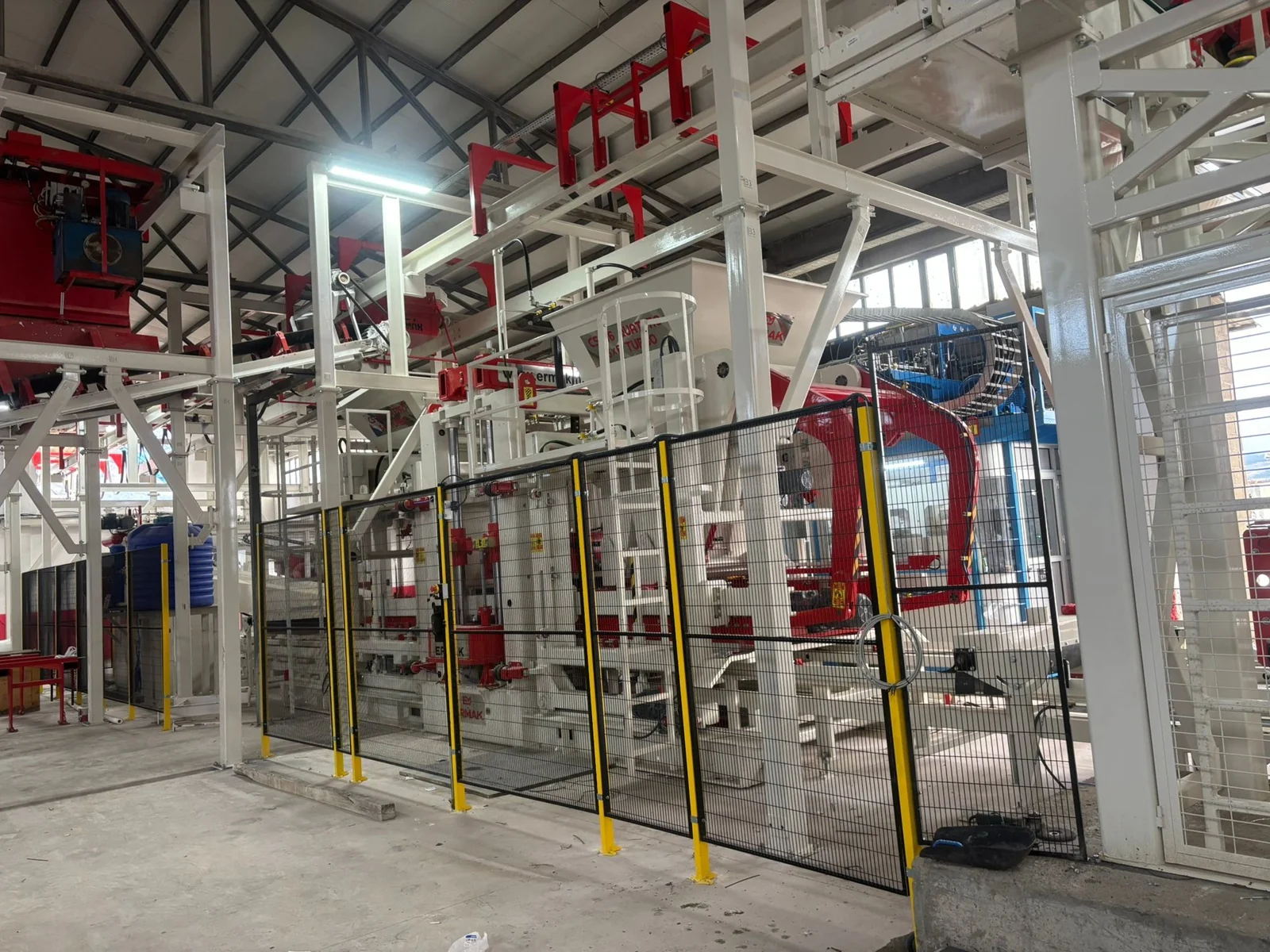
Ermak currently uses its VIBRO-180 system across multiple high-capacity block-machine models.
For the CS-36 and CS-42 Quattro 8X8 Plus, Ermak specifies:
- 180 kN vibration force
- Automatic lubrication
- High-vibration compaction
and states that the system family has been in use for approximately 20 years.
CS-36 Quattro 8X8 Plus
Current published specifications include:
- 1,400–1,600 m² pavers/8 hours
- 16,000–20,000 standard blocks/8 hours
- 1150 × 1400 mm-class pallet
- 140 kW hydraulic power
- 180–200 bar working pressure
CS-42 Quattro 8X8 Plus
Current published specifications include:
- 1,500–1,800 m² pavers/8 hours
- 25,000–30,000 standard blocks/8 hours
- 1350 × 1400 mm-class pallet
- 140 kW hydraulic power
- 180–200 bar working pressure
Ermak also uses the VIBRO-180 system in Android block-machine models. The company makes a manufacturer-specific claim, based on customer feedback, that the system may support production with 15–20 kg less cement per cubic metre in certain applications. Actual results must be validated according to the concrete recipe, product and local production conditions.
The Best Vibration System Is Not Simply the Strongest One
Concrete block production requires balance.
A successful production process combines:
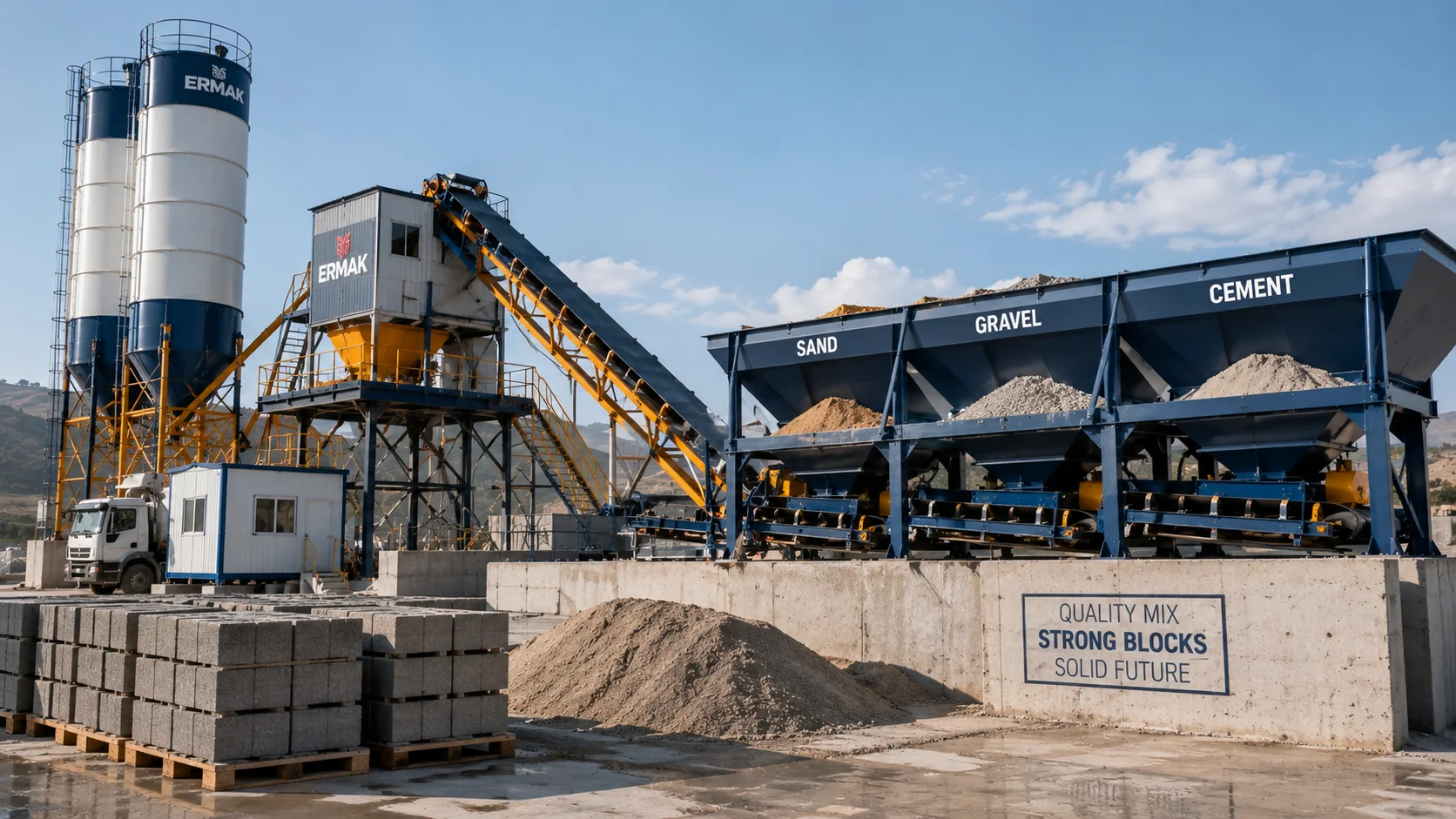
Correct aggregate + correct moisture + homogeneous mixing + accurate mould filling + effective vibration + controlled pressing + proper curing
Vibration is one of the most important links in this chain, but it cannot replace the others.
The ideal system should help the plant achieve:
- Consistent density
- Good surface quality
- Accurate dimensions
- Stable cycle times
- Low reject rates
- Controlled cement consumption
- Reliable long-term operation
Ermak’s own turnkey-production guidance similarly treats vibration as part of the complete production process rather than an isolated machine specification.
For investors evaluating a new concrete block machine, the vibration system should therefore receive the same attention as:
- Production capacity
- Mould size
- Automation
- Hydraulic system
- After-sales support
Because a block machine does not create value simply by moving quickly.
It creates value by producing saleable products consistently, cycle after cycle.
For information about Ermak concrete block machines, VIBRO-180 technology, mould configurations and complete production-line options, investors can evaluate the appropriate machine configuration according to target products and required daily capacity.
Frequently Asked Questions
Why is vibration important in concrete block production?
Vibration helps relatively dry concrete settle and compact inside the mould. It influences density, surface quality, edge definition, dimensional consistency and reject rate. Ermak’s current turnkey guidance identifies these as key effects of vibration technology.
Does higher vibration force always mean better blocks?
No. Vibration force, frequency, duration, distribution, concrete recipe and mould geometry must work together. Excessive or poorly controlled vibration is not automatically better.
What is VIBRO-180?
VIBRO-180 is Ermak’s vibration system used on various Quattro and Android concrete block machines. Ermak currently specifies it at 180 kN vibration force with automatic lubrication.
Can vibration affect block strength?
Vibration influences concrete compaction and density, which can affect product performance. However, final strength also depends on concrete recipe, cement, aggregate, moisture and curing.
Can vibration reduce reject rates?
Well-controlled and uniformly distributed vibration can help reduce defects related to poor compaction. Reject rate is also influenced by recipe, feeding, mould condition and curing.
Does longer vibration always improve quality?
No. Once sufficient compaction has been achieved, additional vibration may simply increase cycle time and mechanical loading. The goal is an optimum product-specific vibration period.
Can vibration technology reduce cement consumption?
Efficient compaction can contribute to recipe optimisation. Ermak states, based on customer feedback for its Android models, that VIBRO-180 may allow production with approximately 15–20 kg less cement per cubic metre in certain applications. This is a manufacturer-specific claim and should be validated under actual production conditions.
Why can blocks from the same mould have different densities?
Possible causes include uneven feeding, uneven vibration distribution, mould wear, production-pallet condition or tamper-head alignment.
Does the production pallet affect vibration?
Yes. A damaged or bent pallet can influence vibration transmission and product height. Ermak’s after-sales guidance specifically identifies pallet condition as a factor affecting vibration transfer.
How can I recognise a vibration-system problem?
Possible warning signs include density variation across the pallet, longer compaction time, poorer surfaces, rising reject rates, unusual noise and increased bearing temperature.
Does a vibration system require regular maintenance?
Yes. Bearings, shafts, motors, lubrication components, mountings and related parts should be inspected according to the manufacturer’s maintenance schedule.
Is automatic lubrication maintenance-free?
No. Automatic lubrication reduces dependence on manual lubrication, but lubricant levels, lines and distribution points still require inspection.
Should every product use the same vibration setting?
No. Hollow blocks, pavers, kerbstones and other products can require different filling, vibration and pressing parameters because their geometries and concrete volumes differ.
What should I compare when evaluating block-machine vibration systems?
Compare vibration force, distribution, frequency control, synchronisation, lubrication, bearing design, maintenance access, spare-parts availability and — most importantly — real product consistency at reference plants.