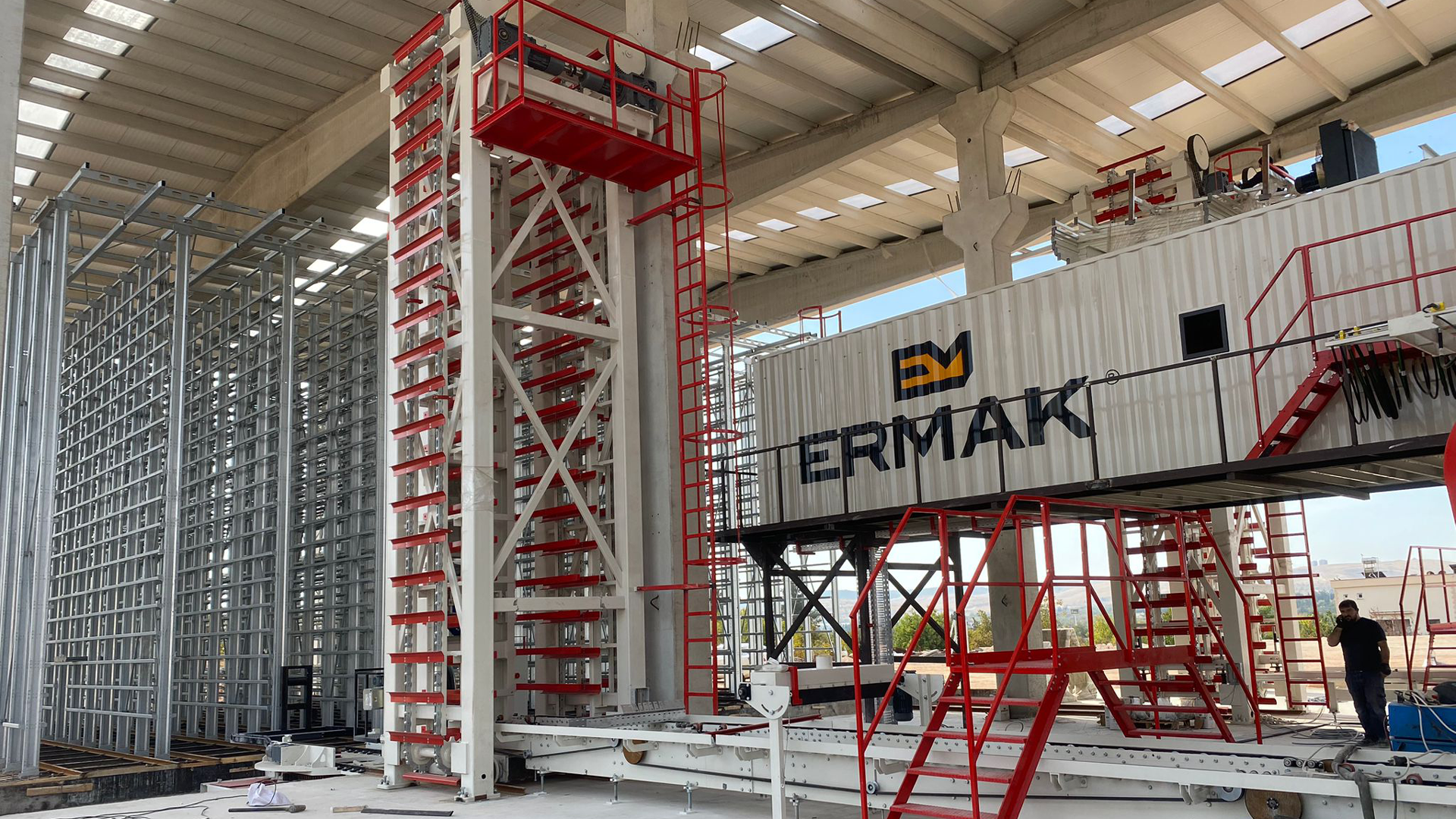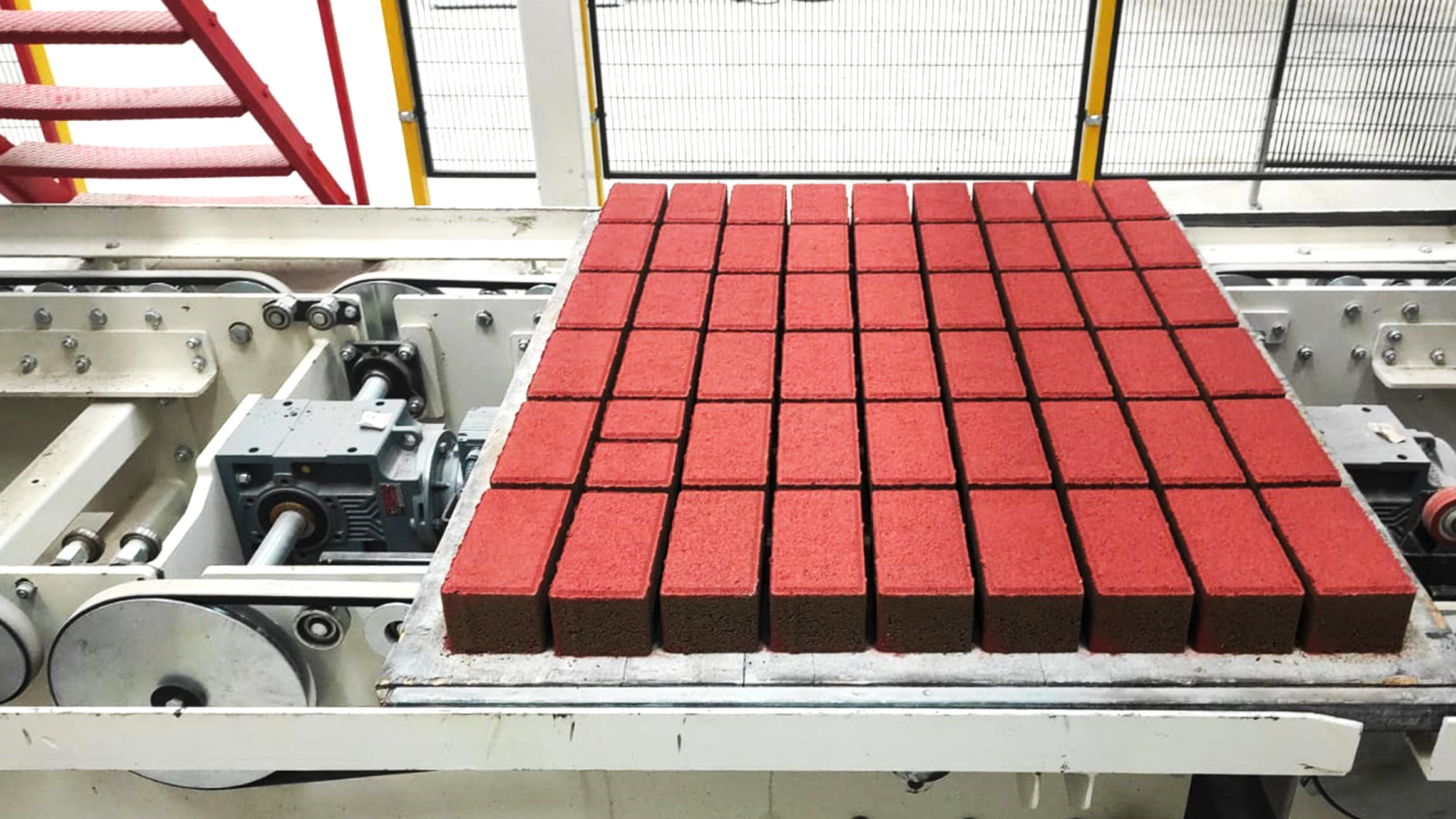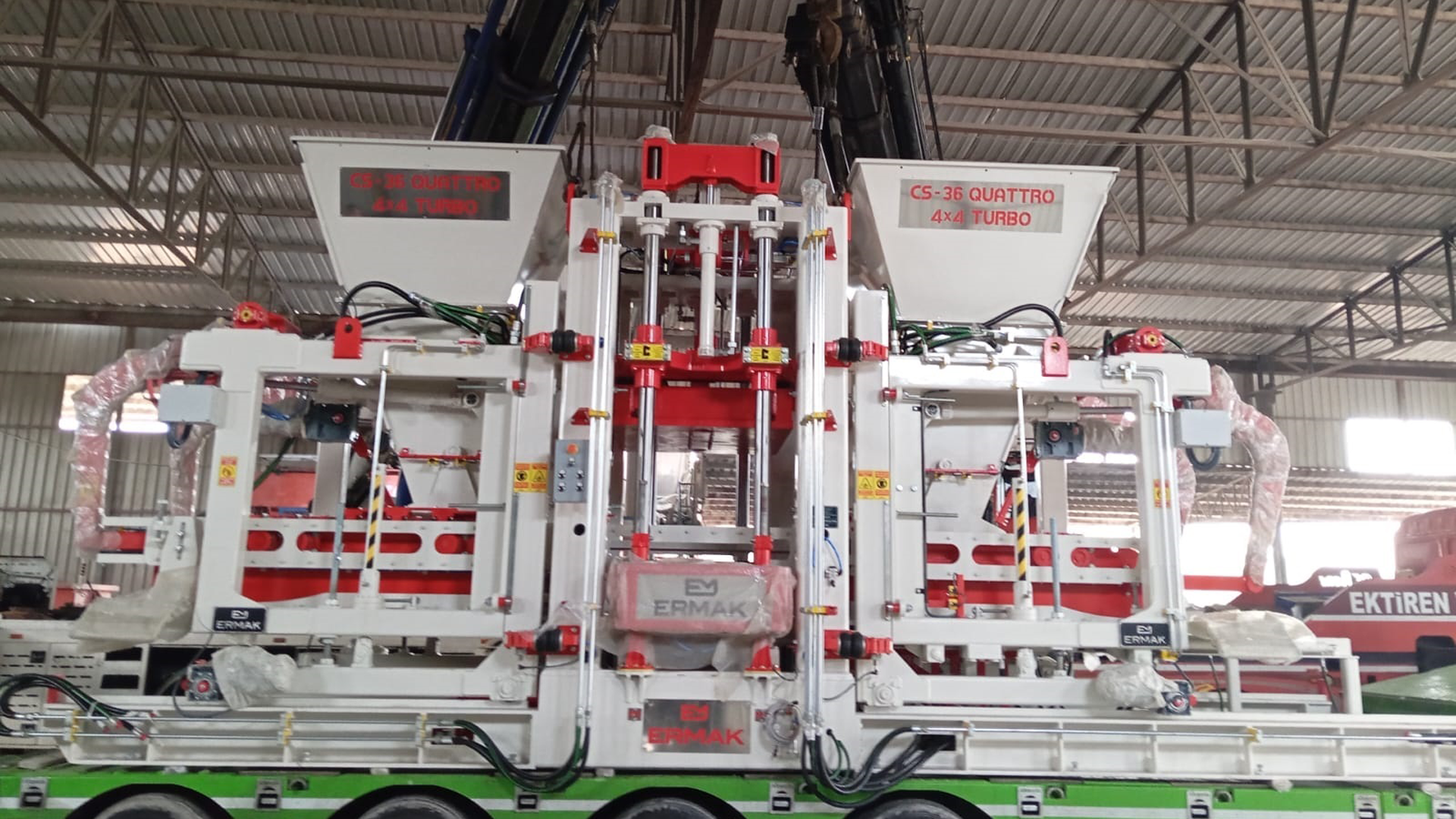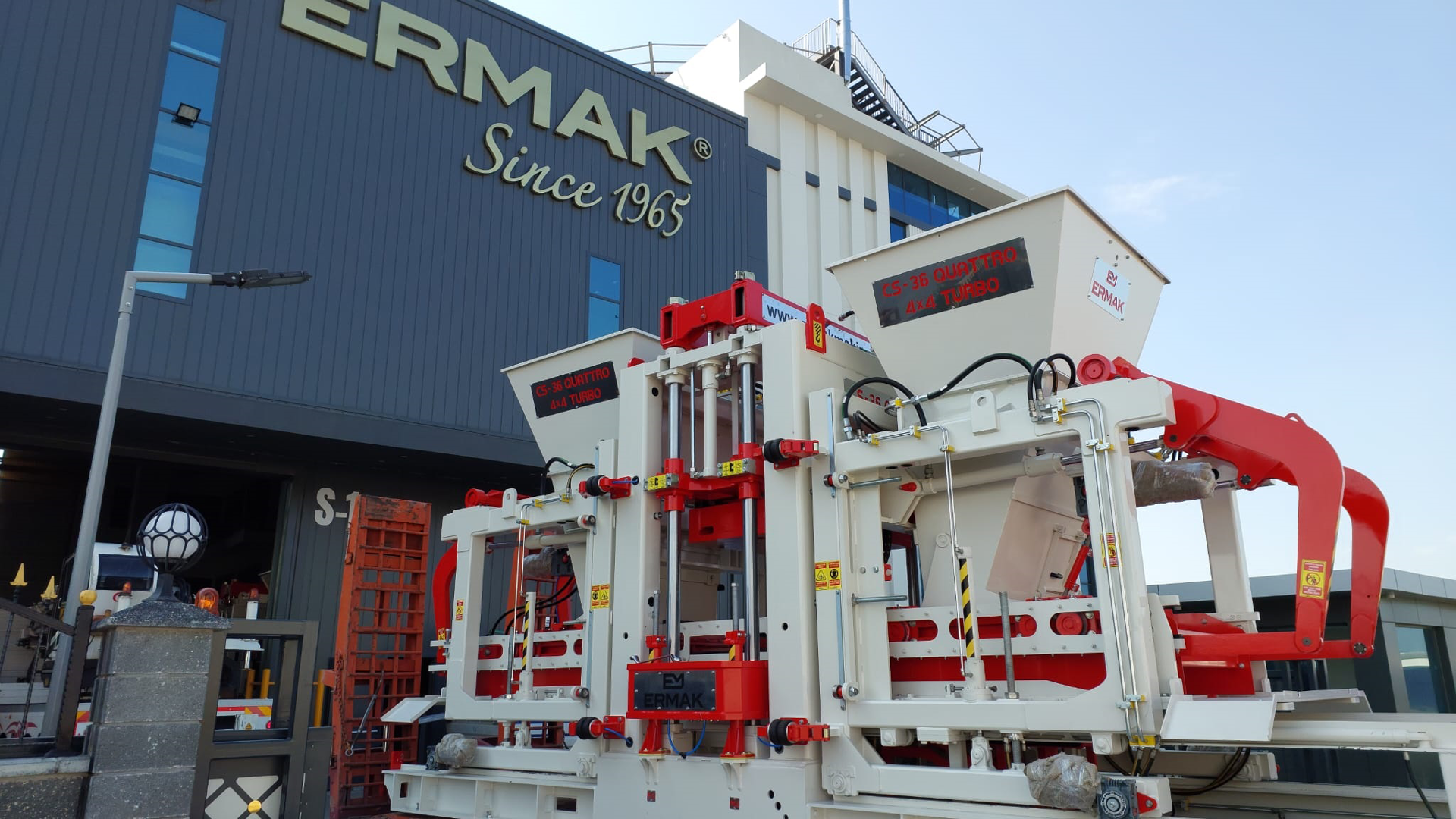
Turnkey Concrete Block Production Plant: Planning and Capacity
Building a turnkey concrete block production plant requires much more than selecting a concrete block machine and installing it inside a factory.
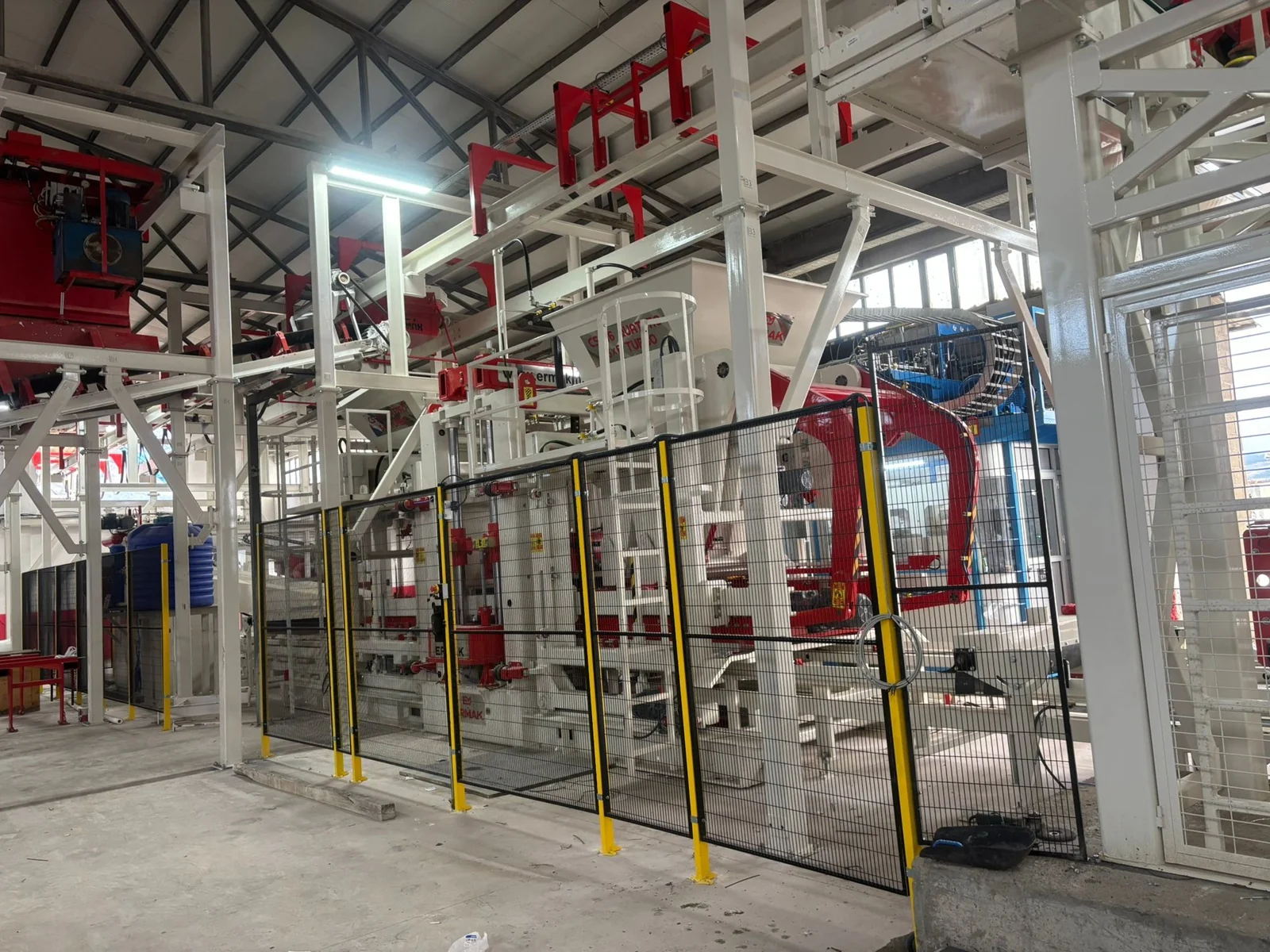
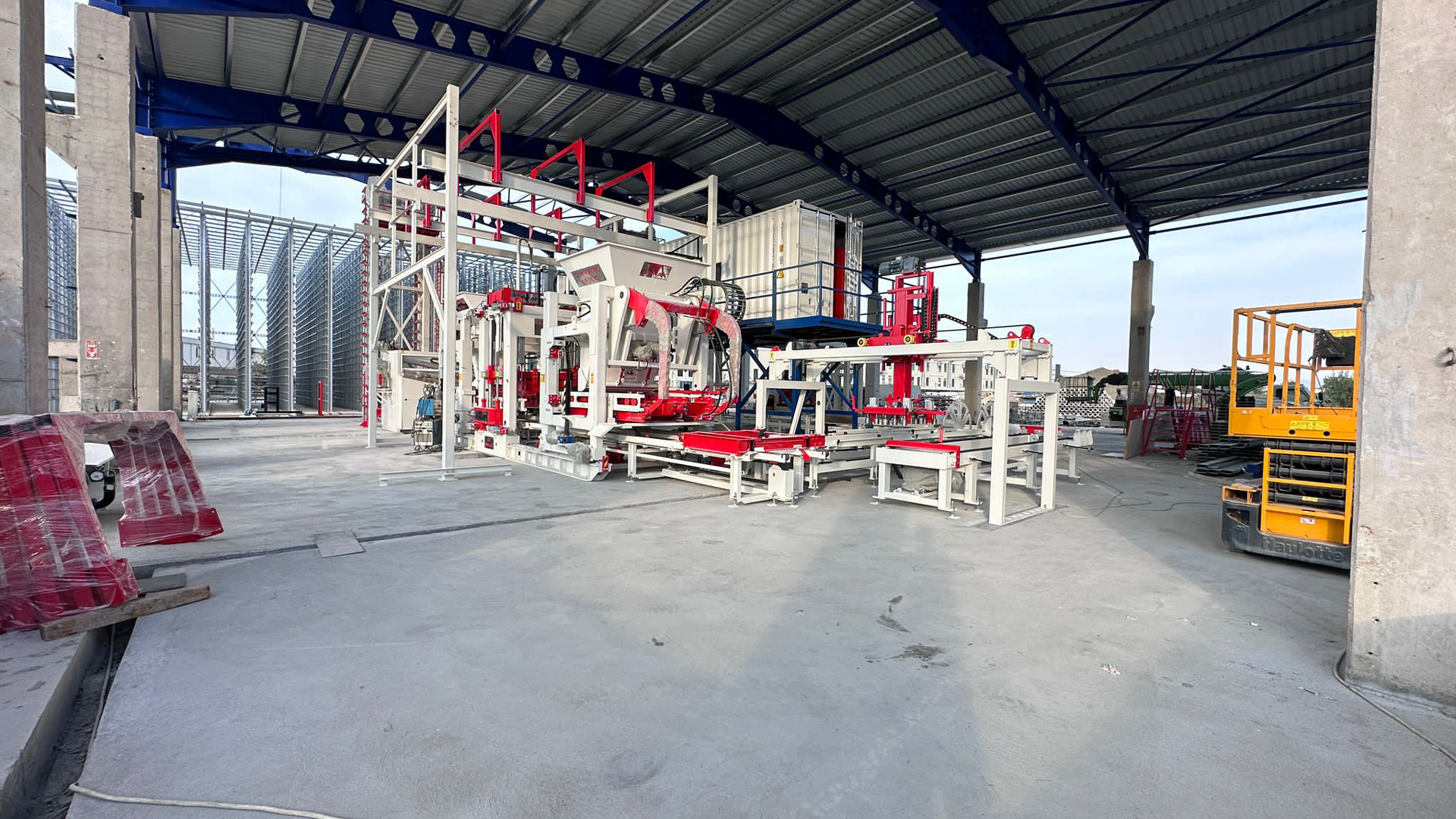
A complete production facility is a coordinated system in which raw material storage, concrete preparation, mixing, moulding, vibration, curing, product handling, packaging and storage must operate at compatible capacities.
A powerful block machine cannot achieve its expected output if the mixer cannot prepare enough concrete. A high-speed production line will eventually stop if the curing system has insufficient pallet capacity. Likewise, an efficient block machine provides limited benefit if finished products accumulate because the packaging system cannot keep pace.
For this reason, turnkey plant planning should begin with the complete production flow, not with an individual machine.
Ermak’s current product portfolio reflects this integrated approach. In addition to concrete block machines, the company manufactures concrete batching plants and Milano Mixers and offers moulds, curing systems and other production-line equipment. Ermak states that it has manufactured concrete block machines since 1990 and professional concrete batching plants and Milano Mixers since 2000.
The central question for an investor should therefore not be:
“What is the biggest concrete block machine I can buy?”
It should be:
“What production system can manufacture my target products at the required quality and capacity with a sustainable cost per unit?”
What Is a Turnkey Concrete Block Production Plant?
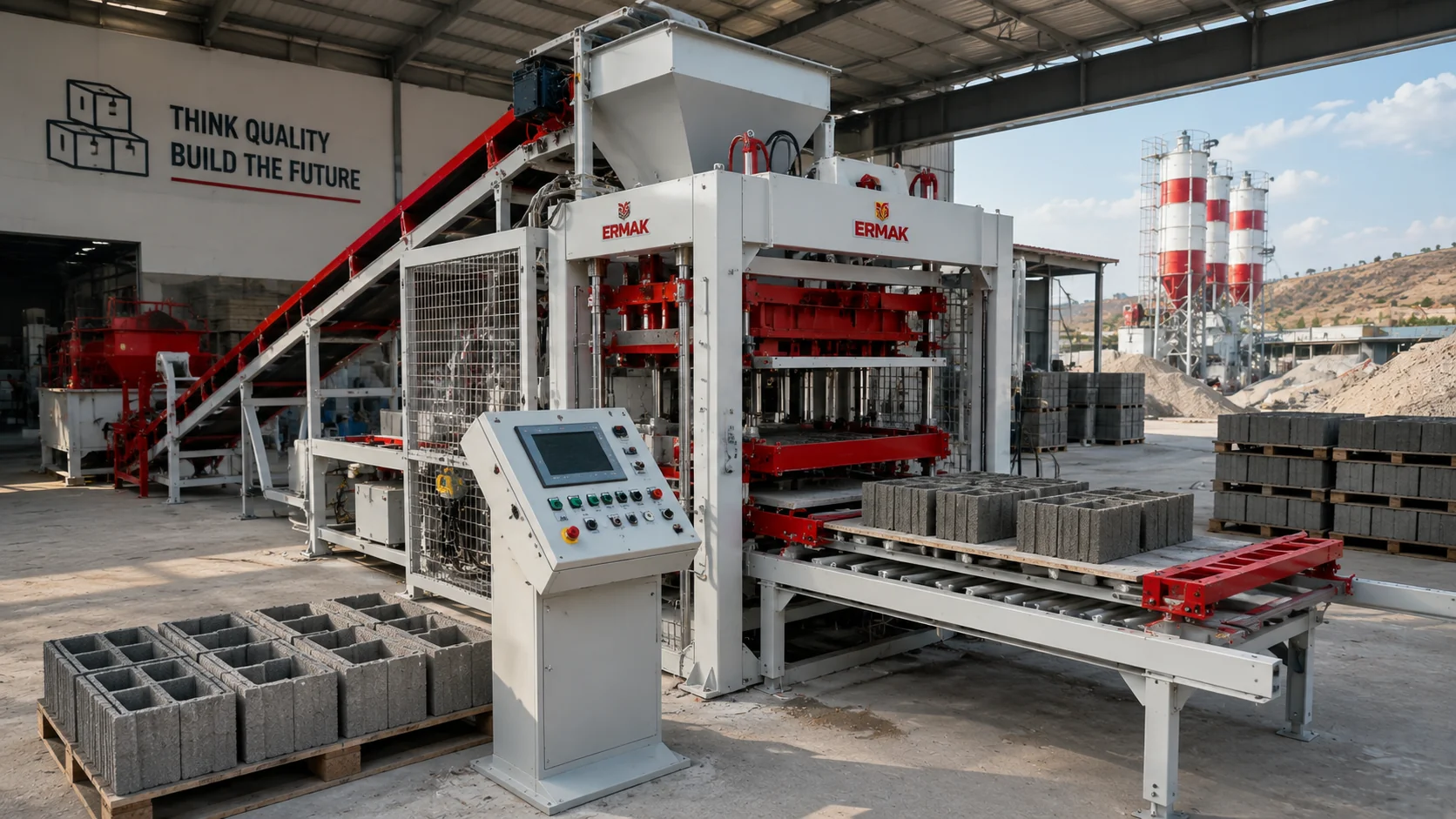
A turnkey concrete block production plant is a production facility designed as an integrated system rather than a collection of independent machines.
Depending on the required production level and automation configuration, a complete plant may include:
- Aggregate storage areas
- Aggregate bunkers
- Concrete batching plant
- Cement silos
- Cement screw conveyors
- Water dosing system
- Chemical admixture dosing
- Moisture control
- Concrete mixers
- Face-mix system
- Concrete block machine
- Concrete block moulds
- Production pallets
- Wet product conveyors
- Elevators and lowerators
- Curing rack systems
- Pallet transfer systems
- Dry product conveyors
- Cubing and stacking equipment
- Packaging systems
- Empty pallet return line
- Automation and control systems
- Electrical infrastructure
- Compressed-air systems
- Maintenance areas
Not every facility needs every component. The correct configuration depends on target capacity, product range, automation level and investment strategy.
A small regional hollow-block plant and a high-capacity paving-stone factory should not be designed according to the same template.
1. Start with the Products, Not the Machines
The first stage in turnkey plant planning is defining the products to be manufactured.
Depending on machine configuration, moulds and production height, a concrete block plant may manufacture:
- Hollow concrete blocks
- Solid blocks
- Lightweight aggregate blocks
- Bims blocks
- Interlocking paving stones
- Rectangular pavers
- Kerbstones
- Grass stones
- Drainage channels
- Rain gutters
- Landscaping elements
- Special precast concrete products
Ermak’s Power Plus model, for example, is specified for products between 40 and 500 mm in production height and is presented for paving stones, borders, BIMS blocks, hollow concrete blocks, grass stones, rain gutters, channels and other products.
This matters because product characteristics determine almost everything else in the plant.
Before equipment selection, determine:
- Product dimensions
- Product height
- Required compressive performance
- Single-layer or double-layer production
- Number of products per mould
- Daily production requirement
- Expected product mix
- Frequency of mould changes
- Future product expansion
A facility expected to manufacture only standard hollow blocks has different requirements from a plant that will switch between pavers, blocks and kerbstones throughout the week.
2. Define the Target Market
Production capacity should be based on realistic market demand.
Concrete products are heavy, and transportation can represent an important part of delivered cost. As a result, the practical sales radius and local demand should be considered when determining plant size.
A market study should evaluate:
- Local construction activity
- Residential projects
- Infrastructure investment
- Municipal projects
- Industrial construction
- Dealer networks
- Existing local manufacturers
- Competitor capacity
- Product prices
- Transport distances
- Seasonal demand
- Potential export markets
Producing more blocks is valuable only when the additional production can be sold profitably.
Installing a plant capable of producing three times the realistic market requirement can increase:
- Initial capital expenditure
- Electricity infrastructure
- Working capital requirements
- Raw material storage
- Finished product inventory
- Factory area
- Maintenance costs
without providing a corresponding increase in revenue.
Capacity planning should therefore begin with sales demand rather than machine catalogues.
3. Determine the Required Shift Capacity
After identifying the market and product range, calculate the actual production requirement.
For example, determine:
- Required daily output
- Number of operating days per year
- Number of shifts
- Hours per shift
- Seasonal production peaks
- Required safety margin
If the market requires 15,000 blocks per working day, the machine should not automatically be selected for exactly 15,000 theoretical units per shift.
Real production includes:
- Start-up procedures
- Cleaning
- Mould changes
- Recipe adjustments
- Maintenance
- Material interruptions
- Operator breaks
- Quality checks
- Minor stoppages
- Unexpected downtime
The plant should therefore be sized according to net effective capacity, not theoretical maximum capacity.
4. Understand What Machine Capacity Really Means
Concrete block machine capacity is generally stated for a defined product and working period.
The figure depends on:
- Product dimensions
- Mould cavity count
- Production pallet size
- Cycle time
- Material feeding
- Vibration time
- Pressing time
- Pallet movement
- Automation
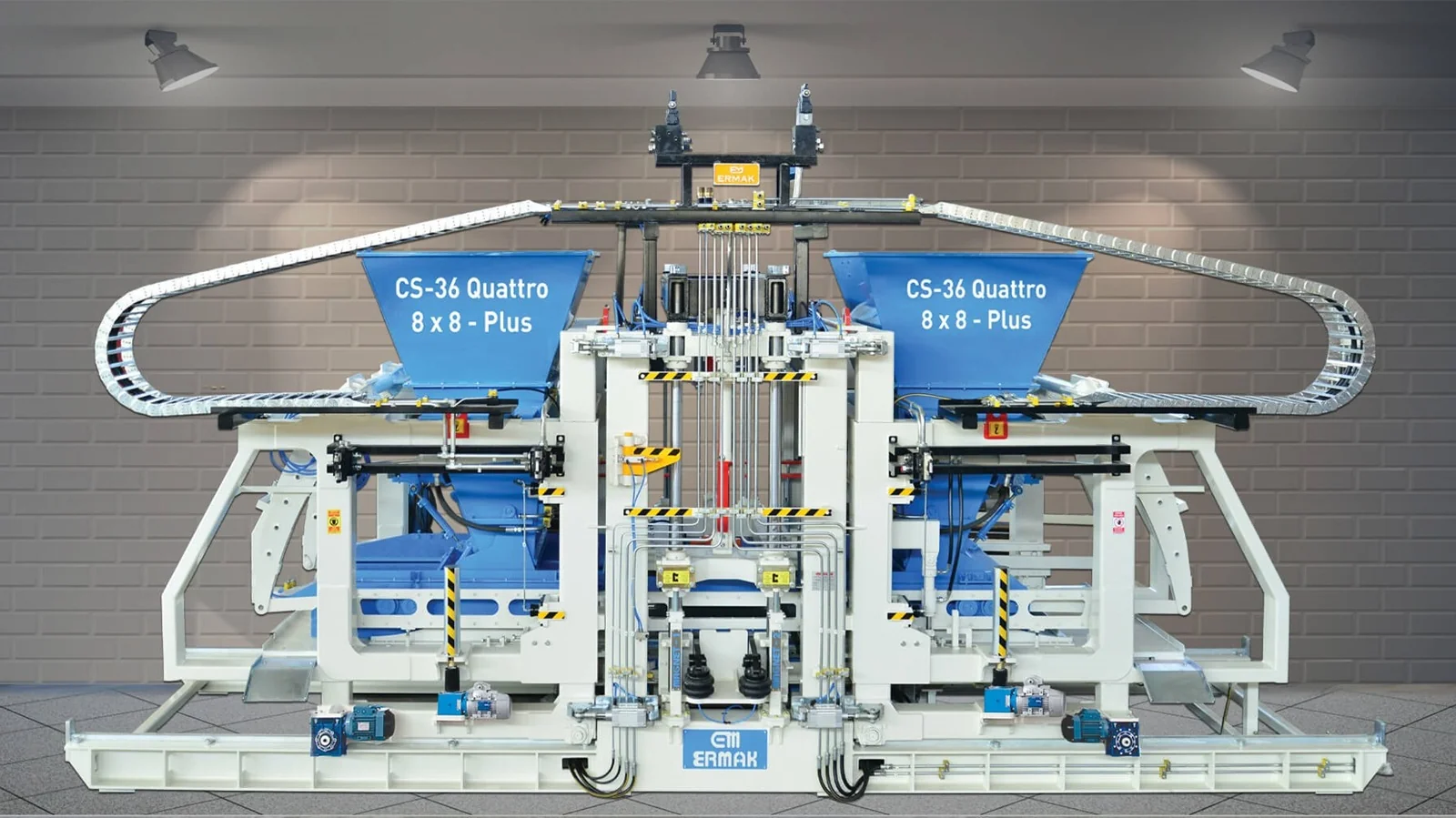
For example, Ermak currently lists its Power Plus at approximately 10,000–12,000 standard 20 × 40 × 20 cm blocks per eight hours, while its English-language homepage lists the CS-42 Quattro 8X8 Plus at approximately 25,000–30,000 blocks per eight hours and 1,500–1,800 m² of pavers per eight hours.
The difference illustrates why machine selection must follow target capacity.
There is no reason to purchase a 30,000-block system when the business can profitably sell only 8,000 blocks per day.
Conversely, installing a 10,000-block machine for a market requiring 25,000 units can create permanent delivery pressure and limit business growth.
5. Do Not Compare Capacities Without Comparing Products
A statement such as:
“This machine produces 25,000 pieces per shift.”
has limited value without additional information.
You should ask:
- Which product?
- What dimensions?
- How many cavities?
- What cycle time?
- How many hours?
- Is the batching plant included in the calculation?
- Are mould changes included?
- Is the figure theoretical or practical?
Paving-stone production is often expressed in square metres, while hollow-block capacity is commonly expressed in pieces.
Even two block products with the same external dimensions may have different mould configurations and concrete volumes.
Capacity comparisons must therefore use equivalent production conditions.
6. Select the Appropriate Concrete Block Machine
Once the product range and capacity have been established, the main machine can be selected.
Important technical criteria include:
- Production pallet size
- Production height range
- Number of products per cycle
- Cycle time
- Machine frame construction
- Vibration technology
- Pressing system
- Hydraulic or electric power
- Mould compatibility
- Mould changing system
- Automation
- Diagnostic functions
- Maintenance access
Ermak’s current machine portfolio covers significantly different capacity classes. The Power Plus uses a 950 × 1300 mm pallet and is rated at 10,000–12,000 standard blocks per eight hours, while an Android 18 product page lists a 1350 × 1400 mm pallet and 25,000–30,000 blocks per eight hours.
This demonstrates an important plant-planning principle:
Pallet size, machine size, mould size, handling systems and plant capacity are connected.
Changing one affects the others.
7. Vibration Technology Must Match the Products
Concrete block manufacturing generally uses stiff concrete that must be compacted efficiently inside the mould.
Vibration influences:
- Concrete distribution
- Product density
- Surface finish
- Edge quality
- Dimensional consistency
- Production cycle
- Product rejection rate
A poor vibration system can leave areas of the mould insufficiently compacted.
The objective is not simply maximum vibration power. Vibration must be controlled and distributed effectively across the mould area.
Ermak’s Quattro 8X8 Plus product information describes its VIBRO-180 system as having 180 kN of vibration force, automatic lubrication and a system designed for stable production. The company also states that the system has been used in its machines for approximately 20 years.
When evaluating a machine, examine:
- Vibration force
- Frequency control
- Motor arrangement
- Synchronisation
- Lubrication
- Bearing design
- Maintenance requirements
- Product-specific adjustment
8. Consider Mould Change Frequency
Many concrete-product manufacturers use one machine to produce several products.
A typical weekly production schedule could include:
- Hollow blocks
- Paving stones
- Kerbstones
- Grass stones
Every product change may require a mould change and new machine parameters.
If a mould change requires several hours, frequent product switching can significantly reduce usable production time.
Ermak describes fully automatic mould-change systems on some Quattro machines and states that production with a new mould can begin within approximately 15 minutes under the specified configuration.
For plants with a diversified product portfolio, mould-change time should therefore be included in capacity calculations.
Do not calculate:
8 hours × maximum cycle speed
if 90 minutes of the shift may regularly be lost to product changes.
9. Select the Correct Concrete Batching Plant
The batching plant supplies the main machine.
If it cannot prepare concrete fast enough, the block machine waits.
The batching plant should be selected according to:
- Hourly concrete demand
- Aggregate types
- Number of products
- Cement consumption
- Required recipes
- Mixer size
- Mixing time
- Moisture control
- Face-mix requirements
- Future expansion
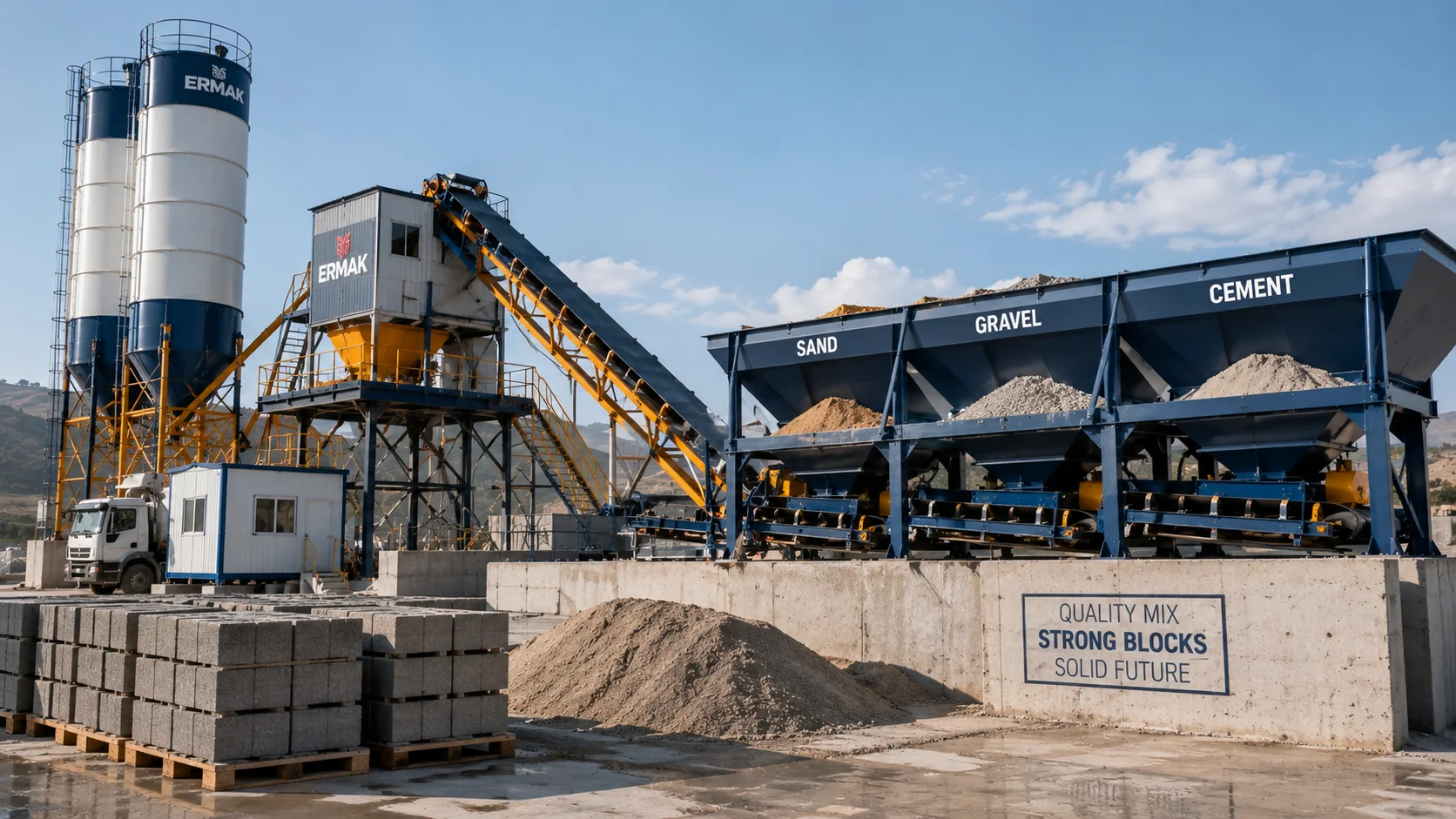
The batching system may include:
- Aggregate bunkers
- Weighing systems
- Cement silos
- Screw conveyors
- Water dosing
- Additive dosing
- Moisture measurement
- Mixer
- Buffer hopper
- Automation
Ermak states that it has manufactured professional concrete batching plants for around two decades and uses its own Milano Mixer systems in these plants. The company’s batching plant page also notes that standard or project-specific automation software can be used.
10. Calculate Mixer Capacity from the Complete Cycle
A common mistake is selecting a mixer according to its nominal volume without calculating its actual hourly output.
Real mixing capacity depends on:
- Aggregate loading
- Cement dosing
- Water dosing
- Dry mixing
- Wet mixing
- Discharge
- Preparation for the next batch
The relevant figure is:
Net concrete per batch × completed batches per hour
The mixer must continuously support the block machine.
If a high-capacity block machine needs 25 m³ of concrete per hour but the real mixer output is 18 m³/h, the block machine becomes an expensive waiting room.
The batching plant and mixer should therefore be calculated around the main machine’s actual material demand.
11. Plan Single-Layer and Double-Layer Production Separately
Double-layer paving stone production requires different planning from standard block production.
A double-layer product typically uses:
- Structural base concrete
- Fine face concrete
The face layer may contain:
- Different aggregate
- Different cement content
- Pigment
- Different water ratio
The plant may therefore require:
- Two mixers
- Separate aggregate storage
- Separate weighing
- Pigment dosing
- Face-mix hopper
- Dedicated automation
If coloured pavers are part of the business plan, this requirement should be included from the beginning.
Trying to add a face-mix system after the factory has been tightly constructed around a single mixer may require expensive structural modifications.
12. Aggregate Storage Must Support the Production Target
A high-capacity plant consumes large quantities of aggregates.
The plant should have sufficient storage for:
- Sand
- Crushed aggregate
- Fine aggregate
- Lightweight materials
- Decorative aggregate
- Face-mix aggregate
Storage must be sized according to:
- Daily concrete production
- Material consumption
- Delivery frequency
- Loader operation
- Weather conditions
- Required reserve stock
Insufficient aggregate storage can cause repeated interruptions.
Oversized storage, however, occupies valuable factory area and increases infrastructure costs.
The objective is reliable material availability rather than simply maximum bunker volume.
13. Cement Storage Should Be Based on Consumption and Logistics
Cement silo capacity should reflect:
- Daily cement consumption
- Number of shifts
- Cement delivery size
- Delivery frequency
- Distance from supplier
- Supply risk
A plant consuming large quantities of cement should not depend on a silo that requires constant replenishment.
At the same time, excessive storage may unnecessarily increase initial investment.
The cement transfer system must also be capable of supplying the mixer quickly enough.
A large mixer connected to an undersized screw conveyor can still create slow batch cycles.
Every component in the chain matters.
14. Moisture Control Is Critical for Consistent Products
Aggregate moisture changes throughout the day and with weather conditions.
If the batching system does not account for this variation, the actual water content of the concrete can change even when the programmed recipe remains identical.
Excessively wet concrete can contribute to:
- Product deformation
- Poor edges
- Mould sticking
- Dimensional inconsistency
Concrete that is too dry may contribute to:
- Poor filling
- Weak corners
- Porous surfaces
- Insufficient compaction
For plants targeting consistent industrial production, moisture control should be considered part of process control rather than an optional accessory.
Ermak’s batching-plant offering supports project-specific automation, making plant controls an important part of the overall production-line design.
15. Production Pallets Determine More Than Product Support
Production pallets carry freshly moulded products through the manufacturing process.
Their dimensions influence:
- Mould area
- Products per cycle
- Machine size
- Elevator dimensions
- Curing rack dimensions
- Transport systems
- Pallet return system
A larger production pallet can increase products per cycle, but it can also increase:
- Machine size
- Mould weight
- Vibration requirements
- Handling equipment size
- Curing infrastructure
- Pallet investment
This is one reason plant capacity cannot be considered independently from machine geometry.
16. Design the Curing System Around Pallet Flow
Fresh blocks and pavers require curing before packaging.
A high-capacity line can produce hundreds or thousands of production pallets during a working period.
The curing system must therefore be calculated using:
- Pallets produced per hour
- Number of shifts
- Required curing time
- Rack positions
- Product type
- Pallet return time
- Temperature and humidity strategy
If the plant produces 120 pallets per hour but the curing system can only process 80 pallets per hour over the required cycle, the main production machine will eventually be forced to stop.
The true capacity of a production line is often determined by its slowest section.
The machine may be capable of 30,000 blocks.
The plant is capable only of whatever its bottleneck can handle.
17. Wet Product Handling Should Minimise Manual Intervention
After moulding, fresh products are relatively vulnerable.
They must be moved without damaging:
- Corners
- Edges
- Surface texture
- Product alignment
Depending on plant configuration, wet product handling may include:
- Conveyor systems
- Elevators
- Pallet transfer vehicles
- Finger-car systems
- Curing racks
Ermak states that it began manufacturing finger-system plants in 2011 and reports more than 150 Ermak finger-machine facilities worldwide.
For higher-capacity turnkey plants, automated handling can reduce forklift traffic and provide a more controlled material flow between production and curing.
18. Dry Product Handling Must Match Production Capacity
After curing, products must be removed from production pallets and transferred toward packaging.
The dry side of the plant can include:
- Lowerator
- Dry product conveyor
- Cubing system
- Transfer robot
- Commercial pallet feeding
- Packaging
The dry side should process at least the volume generated by the production line.
Otherwise cured pallets accumulate and production pallets are not returned quickly enough to the block machine.
This can eventually interrupt production even though the block machine itself is operating correctly.
19. Packaging Is Part of Plant Capacity
Packaging is sometimes treated as the last small step of the factory.
In a high-capacity plant, it is anything but small.
The system must handle the finished production rate.
Packaging can include:
- Product cubing
- Commercial pallet transfer
- Strapping
- Stretch wrapping
- Labelling
- Forklift transfer
The required automation depends on:
- Product weight
- Production rate
- Number of product types
- Local labour costs
- Shipping method
A machine capable of producing 25,000 blocks per shift offers little benefit if the factory can package only 15,000.
The packaging line must therefore be included in the original capacity study.
20. Plan the Factory Layout Before Ordering Equipment
One of the most expensive mistakes in industrial plant installation is selecting equipment first and deciding its position later.
The factory layout should be designed before final machine orders.
The layout should identify:
- Aggregate storage
- Loader routes
- Batching plant
- Cement silos
- Main block machine
- Wet line
- Curing area
- Dry line
- Packaging
- Mould storage
- Maintenance workshop
- Spare parts
- Finished product storage
- Forklift routes
- Truck loading areas
The ideal production flow should be as linear and logical as possible.
Raw materials enter.
Concrete is prepared.
Products are moulded.
Products are cured.
Products are packaged.
Products leave.
Making a product travel backwards and forwards across the factory several times creates unnecessary forklift traffic, energy consumption and labour.
21. Leave Space for Maintenance
Compact plant layouts can look efficient on drawings but become frustrating in real operation if technicians cannot reach components.
Maintenance access should be provided around:
- Mixer
- Block machine
- Hydraulic unit
- Vibrators
- Conveyors
- Elevators
- Electrical cabinets
- Cement screws
- Mould changing area
Technicians should not have to dismantle unrelated equipment to replace a normal wear component.
Good maintenance access reduces the duration of planned and unplanned stoppages.
22. Calculate Electrical Infrastructure Before Installation
The complete plant’s electrical requirement can include:
- Main block machine
- Hydraulic systems
- Vibration motors
- Mixers
- Aggregate conveyors
- Cement screws
- Elevators
- Transfer systems
- Packaging equipment
- Air compressors
- Pumps
- Lighting
For reference, Ermak’s Android 18 product page lists 95 kW hydraulic power and a working pressure of 180–200 bar for that machine model alone.
That value is not the electricity requirement of a complete factory.
A full plant study should determine:
- Installed power
- Simultaneous demand
- Transformer capacity
- Main switchgear
- Cable sizing
- Power-factor correction
- Earthing
- Backup generation requirements
Electrical infrastructure should be completed before commissioning begins.
23. Calculate Water and Compressed-Air Requirements
Concrete production requires a reliable water supply for:
- Concrete recipes
- Cleaning
- Dust control
- General factory operation
Depending on the equipment configuration, compressed air may operate:
- Gates
- Valves
- Pneumatic cylinders
- Control equipment
The plant should therefore include suitable:
- Water tanks
- Pumps
- Pipework
- Air compressors
- Air dryers where necessary
- Distribution lines
Underestimating utility requirements can create surprisingly simple but costly production restrictions.
A multimillion-euro plant waiting for sufficient air pressure is not an advanced manufacturing problem. It is a planning problem.
24. Plan the Mould Inventory
A turnkey concrete block plant normally produces more than one product during its working life.
The mould inventory may include:
- Hollow block moulds
- Paver moulds
- Kerbstone moulds
- Grass-stone moulds
- Special project moulds
Ermak’s history states that the company established hardening and heat-treatment furnaces for moulds used in paving stone, kerbstone and hollow-block production in 2008, integrating mould manufacturing further into its production operations.
For each mould, the investor should consider:
- Product demand
- Products per cycle
- Mould-change time
- Storage
- Lifting equipment
- Maintenance
- Expected wear
Do not purchase ten moulds simply because ten products look attractive in a catalogue.
Purchase moulds according to a realistic sales plan.
25. Select the Right Automation Level
A turnkey plant can range from relatively simple production to highly automated systems.
Automation may cover:
- Batching
- Recipe management
- Block machine operation
- Pallet handling
- Curing transfer
- Dry-side handling
- Packaging
- Production monitoring
The correct automation level depends on:
- Production volume
- Labour cost
- Labour availability
- Number of shifts
- Required consistency
- Maintenance capability
- Investment budget
High automation can reduce manual handling and improve repeatability.
However, automation that is not needed or cannot be supported locally can increase investment and technical complexity.
Technology should solve an operating problem.
It should not be purchased merely because it looks impressive during a factory demonstration.
26. Consider Labour Requirements Early
Labour requirements change significantly with automation.
A more manual facility may require personnel for:
- Pallet movement
- Product transfer
- Stacking
- Packaging
- Forklift operation
A highly automated facility shifts labour requirements toward:
- Machine operation
- Quality control
- Maintenance
- Electrical and automation support
- Logistics
This means automation does not necessarily eliminate labour.
It changes the type of labour required.
The plant design should therefore reflect the local workforce:
- What does labour cost?
- Are skilled technicians available?
- Can operators be trained?
- Can automation components be serviced locally?
These questions can materially change which plant configuration is economically optimal.
27. Build Quality Control into the Production Process
A professional concrete block plant should monitor product quality continuously.
Depending on the product and applicable standards, quality control may include:
- Dimensions
- Height
- Weight
- Density
- Surface appearance
- Edge quality
- Compressive strength
- Water absorption
- Colour consistency
Batching recipes and production settings should ideally be recorded so deviations can be traced.
When product quality changes, the cause may come from:
- Aggregate moisture
- Cement dosage
- Mixer performance
- Mould wear
- Vibration settings
- Curing conditions
Without production records, troubleshooting becomes guesswork.
28. Establish a Preventive Maintenance Strategy
A turnkey plant should have a maintenance plan before the first production shift.
Maintenance areas may need inventory for:
- Bearings
- Sensors
- Hydraulic filters
- Hydraulic hoses
- Seals
- Vibration components
- Conveyor components
- Electrical parts
- Mixer wear components
Critical components should be identified according to:
- Failure probability
- Delivery time
- Production impact
A low-cost sensor that takes several weeks to obtain can be more operationally important than a very expensive component that never fails.
Spare-parts planning should therefore be based on downtime risk, not only part value.
29. Technical Service Should Be Part of Plant Selection
Turnkey plants operate for many years.
The manufacturer’s ability to support the installation after commissioning can therefore be as important as the original machine specifications.
Evaluate:
- Installation capability
- Commissioning
- Operator training
- Maintenance training
- Remote diagnostics
- Spare-parts stock
- Technical documentation
- International service
- Response time
- Support for future upgrades
Ermak states that it was founded in 1965, operates from its newer headquarters in Dilovası, Kocaeli, exports to more than 40 countries and provides after-sales service as part of its current company positioning.
For international investments in particular, service planning should be discussed before the machine leaves the factory.
30. Calculate the Total Investment, Not Just the Machine Price
The price of the concrete block machine is only one part of a turnkey project.
The investment budget may include:
- Block machine
- Concrete batching plant
- Mixers
- Aggregate bunkers
- Cement silos
- Moulds
- Production pallets
- Curing racks
- Product handling
- Packaging
- Electrical infrastructure
- Transformer
- Foundations
- Factory building
- Air compressor
- Forklifts
- Laboratory equipment
- Installation
- Commissioning
- Training
- Freight
- Customs
- Initial spare parts
- Working capital
This is why comparing two quotations solely by the final number can be misleading.
One quotation may include only the block machine.
Another may include a substantial portion of the production facility.
Compare identical scopes.
31. Calculate Total Cost of Ownership
The cheapest plant to purchase is not necessarily the cheapest plant to operate.
Long-term cost includes:
- Energy
- Labour
- Cement consumption
- Maintenance
- Spare parts
- Product rejects
- Mould replacement
- Pallet replacement
- Downtime
- Packaging
- Technical service
A better investment question is therefore not:
“How much does the machine cost?”
but:
“What will one saleable block cost me to manufacture over the life of the plant?”
That is where machine performance becomes business performance.
32. Plan Finished Product Storage
High-capacity concrete block plants produce large physical volumes.
Finished product storage should therefore be included in plant design.
The storage yard must consider:
- Daily production
- Curing requirements
- Product variety
- Sales turnover
- Seasonal stock
- Forklift routes
- Truck access
- Drainage
- Ground strength
If the plant produces faster than it ships, inventory can occupy the site surprisingly quickly.
Factory capacity without storage capacity can create its own bottleneck.
33. Design for Future Expansion
A well-planned turnkey plant should provide realistic expansion options.
Possible future additions may include:
- Additional aggregate bunker
- Additional cement silo
- Face-mix system
- Larger mixer
- Additional curing racks
- Improved packaging
- Second production line
- Surface-processing equipment
Expansion space should therefore be considered during the first site layout.
However, future-proofing does not mean buying everything today.
The more effective approach is:
Correct capacity today + infrastructure for logical expansion tomorrow.
34. Turnkey Concrete Block Plant Capacity Checklist
Before finalising the project, verify the following:
- Target products are defined.
- Product dimensions are confirmed.
- Market demand has been analysed.
- Required annual production has been calculated.
- Shift requirements are defined.
- Net capacity includes production losses.
- Block machine capacity matches demand.
- Production pallet dimensions are suitable.
- Mould requirements are identified.
- Mould-changing time is acceptable.
- Batching plant capacity matches concrete consumption.
- Mixer output supports the block machine.
- Aggregate storage is sufficient.
- Cement storage is sufficient.
- Moisture control has been considered.
- Single-layer or double-layer production is defined.
- Curing capacity matches pallet output.
- Wet-side handling matches machine speed.
- Dry-side handling matches production.
- Packaging capacity is sufficient.
- Factory layout is complete.
- Electrical infrastructure has been calculated.
- Water and compressed air are available.
- Maintenance access is adequate.
- Spare parts have been planned.
- Finished product storage is sufficient.
- Future expansion space is available.
- Installation and training are defined.
- After-sales support is confirmed.
- Total cost of ownership has been calculated.
Creating a Balanced Turnkey Production Plant
A successful turnkey concrete block production plant is not defined by a single impressive machine.
It is defined by balance.
The batching plant must supply the mixer.
The mixer must supply the block machine.
The block machine must match the curing capacity.
The curing system must match the dry side.
The dry side must match the packaging line.
The packaging line must match storage and dispatch.
When every section is designed around the same realistic capacity target, the factory can operate as one production system rather than several machines waiting for one another.
Ermak’s current portfolio includes concrete block machines across different capacity ranges together with concrete batching plants, Milano Mixers and associated production technologies. Its current English homepage lists machines ranging from smaller configurations to the CS-42 Quattro 8X8 Plus, rated at 25,000–30,000 standard blocks or 1,500–1,800 m² of pavers per eight-hour period under the specified production conditions.
For investors planning a new factory, the correct solution should therefore be determined according to the required products, target daily output, automation level, available site and future growth plans.
A turnkey project should not simply answer:
“Which machine fits inside the building?”
It should answer:
“How should the entire factory work?”
For detailed information about concrete block machines, batching plants, mixers and complete production-line configurations, Ermak can evaluate the project according to the targeted product range and production capacity.
Frequently Asked Questions
What is a turnkey concrete block production plant?
A turnkey concrete block production plant is an integrated facility in which concrete preparation, block production, product handling, curing and related production systems are planned as one coordinated project. Depending on scope, automation and packaging can also be integrated into the facility.
How do I determine the correct concrete block plant capacity?
Start with expected annual sales, working days and shifts. Then calculate required net production per shift and include realistic allowances for mould changes, maintenance, cleaning and other production interruptions.
How many blocks can a concrete block plant produce per day?
Capacity depends heavily on the machine and product. In Ermak’s current product portfolio, for example, Power Plus is listed at 10,000–12,000 standard 20 × 40 × 20 cm blocks per eight hours, while higher-capacity models are listed at up to approximately 25,000–30,000 blocks per eight hours under their stated conditions.
Does a turnkey plant include a concrete batching plant?
It can. The exact scope depends on the project quotation. For a complete production facility, however, batching and mixing must be planned together with the block machine. Ermak manufactures both concrete block machines and professional concrete batching plants with Milano Mixers.
Can the same plant produce blocks and paving stones?
Yes, if the block machine supports the required production heights and interchangeable moulds. Ermak’s Power Plus, for example, is specified for a 40–500 mm production-height range and multiple concrete products including pavers, borders and hollow blocks.
Is the largest block machine always the best investment?
No. The correct machine should match realistic market demand and the capacity of the batching, curing, handling and packaging systems. Excess capacity increases capital cost if it cannot be profitably utilised.
Why is curing capacity important?
Fresh products occupy production pallets until they have passed through the required curing and handling process. If curing capacity is smaller than production output, pallets accumulate and the main machine may eventually have to stop.
Should a turnkey plant be fully automatic?
Not necessarily. The appropriate automation level depends on production volume, labour cost, available technical skills, product diversity and investment budget.
How should two turnkey plant quotations be compared?
Compare the same scope. Check the block machine, batching plant, mixer, moulds, production pallets, curing, handling, packaging, automation, installation, training, warranty and spare parts separately before comparing total prices.
What is the most important rule in turnkey concrete block plant planning?
Do not optimise one machine independently. The real plant capacity is determined by the complete production system and, in practice, by its bottleneck.
PROTECTION OF PERSONAL DATA
WEBSITE COOKIE POLICY
Your personal data; It is one of the leading principles of our Organization to protect the privacy of visitors to the website (www.ermakmakine.com.tr) operated by the Ermak Makine (“Ermak Makine”) as the data controller. This Cookie Usage Policy (“Policy”) explains to all our website visitors and users which types of cookies are used and under what conditions.
Cookies are small text files stored on your device or network server by websites you visit on your computer or mobile device.
They are generally used to provide you with a personalized experience during your use of the website you visit, to improve the services offered and to improve your experience, and may contribute to ease of use while browsing a website. If you do not prefer the use of Cookies, you can delete or block Cookies in your browser settings. However, we would like to remind you that this may affect your use of our website. Unless you change your Cookie settings in your browser, we will assume that you accept the use of cookies on this website.
1. WHAT KIND OF DATA IS PROCESSED IN COOKIES?
Cookies on websites, depending on their type, collect data about your browsing and usage preferences on the device you visit the site. This data includes information about the pages you access, the services and products you review, your preferred language option and other preferences.
2. WHAT ARE COOKIES AND WHAT ARE THE PURPOSES OF USE?
Cookies are small text files stored on your device or network server through browsers by the websites you visit. These small text files, which contain your preferred language and other settings on the site, help us remember your preferences the next time you visit the site and make improvements to our services to improve your experience on the site. Thus, you can have a better and personalized usage experience on your next visit.
The main purposes of using cookies on our Website are listed below:
- To improve the services offered to you by increasing the functionality and performance of the website,
- To improve the Website and to offer new features through the Website and to personalize the features offered according to your preferences;
- To ensure the legal and commercial security of the Website, you and the Authority, and to prevent fraudulent transactions from being carried out through the Website;
- To fulfill its legal and contractual obligations, especially those arising from the Law No. 5651 on the Regulation of Publications on the Internet and Combating Crimes Committed through These Publications and the Regulation on the Procedures and Principles for the Regulation of Publications on the Internet.
3.TYPES OF COOKIES USED ON OUR WEBSITE
3.1. Session Cookies
Session cookies ensure that the website functions properly during your visit. They are used for purposes such as ensuring the security and continuity of our sites and you during your visit. Session cookies are temporary cookies, they are deleted when you close your browser and come back to our website, they are not permanent.
3.2. Persistent Cookies
These types of cookies are used to remember your preferences and are stored on your device via browsers. Persistent cookies remain stored even after you close your browser or restart your computer from which you visited our site. These cookies are kept in subfolders of your browser until they are deleted through your browser’s settings.
Some types of persistent cookies may be used to provide you with special suggestions, taking into account issues such as your purpose of using the Website.
Thanks to persistent cookies, if you visit our Website again with the same device, it is checked whether there is a cookie created by our Website on your device and if there is, it is understood that you have visited the site before and the content to be transmitted to you is determined accordingly and thus a better service is provided to you.
3.3. Mandatory/Technical Cookies
These cookies are essential for the website you visit to function properly. The purpose of such cookies is to provide necessary services by enabling the website to function. For example, it allows you to access secure parts of the website, to use its features, to navigate on it.
3.4. Analytical Cookies
They collect information about the way the website is used, the frequency and number of visits, and show how visitors navigate to the site. The purpose of using such cookies is to increase performance by improving the way the site functions and to determine the general trend direction. They do not contain data that could enable the identification of visitors. For example, they show the number of error messages displayed or the most visited pages.
3.5. Functional/Functional Cookies
It saves the choices made by the visitor within the site and remembers them on the next visit. The purpose of such cookies is to provide ease of use to visitors. For example, it prevents the site user from re-entering the user password on each page they visit.
3.6. Targeting/Advertising Cookies
They enable the measurement of the effectiveness of advertisements served to visitors and the calculation of the number of times the advertisements are viewed. The purpose of such cookies is to serve ads customized to the interests of visitors.
Likewise, they enable the detection of visitors’ interests specific to their browsing and the presentation of appropriate content. For example, it prevents the advertisement shown to the visitor from being shown again in a short time.
4. HOW TO MANAGE COOKIE PREFERENCES?
To change your preferences regarding the use of cookies or to block or delete cookies, simply change your browser settings.
Many browsers allow you to control cookies by giving you the option to accept or reject cookies, accept only certain types of cookies, or be alerted by the browser when a website requests to store cookies on your device.
It is also possible to delete cookies that have already been saved in your browser.
If you disable or refuse cookies, you may need to set some preferences manually, and some features and services on the website may not work properly because we cannot recognize and associate your account. You can change the settings of your browser by clicking on the relevant link in the table below.
5. ENFORCEMENT OF THE WEBSITE PRIVACY POLICY
Website Privacy Policy …./…./…./…. . is dated. In case all or certain articles of the Policy are renewed, the effective date of the Policy will be updated. The Privacy Policy is published on the website of the Authority (www.ermakmakine.com.tr) and made available to the relevant persons upon the request of personal data subjects.
Ermak Makine
Address Organize Sanayi Bölgesi Mah. 27.Sokak. No:1/1 Dilovası/Kocaeli
Telephone: (+90 262)263 02 70
E-mail: kvkk@ermakmakine.com.tr
Web Address: www.ermakmakine.com.tr
You can type below the product you want to search for