After-Sales Service and Spare Parts for Block Making Machines
When investing in a concrete block making machine, production capacity, cycle time, vibration technology and automation usually receive most of the attention. These specifications are important, but they represent only one part of the machine’s long-term value.
A concrete block machine is an industrial production system expected to operate for many years, often under demanding conditions involving vibration, concrete dust, hydraulic pressure, abrasive materials and repeated mechanical movement.
For this reason, the quality of after-sales service and spare parts support can be just as important as the original machine specification.
A machine capable of producing 20,000 blocks per shift provides little value when a relatively small unavailable component keeps the entire production line stopped for several days.
The real purchasing question is therefore not only:
“How fast can this machine produce?”
It should also be:
“How quickly can this machine return to production when something goes wrong?”
Ermak presents after-sales support as one of its core capabilities and states that it operates with experienced service and assembly teams. Its current corporate information also describes operations across approximately 20,000 m² of production area and a workforce of more than 180 people.
For investors, this makes service capability, spare parts planning and long-term technical support essential elements of the purchasing decision.
Why After-Sales Service Matters in Concrete Block Production
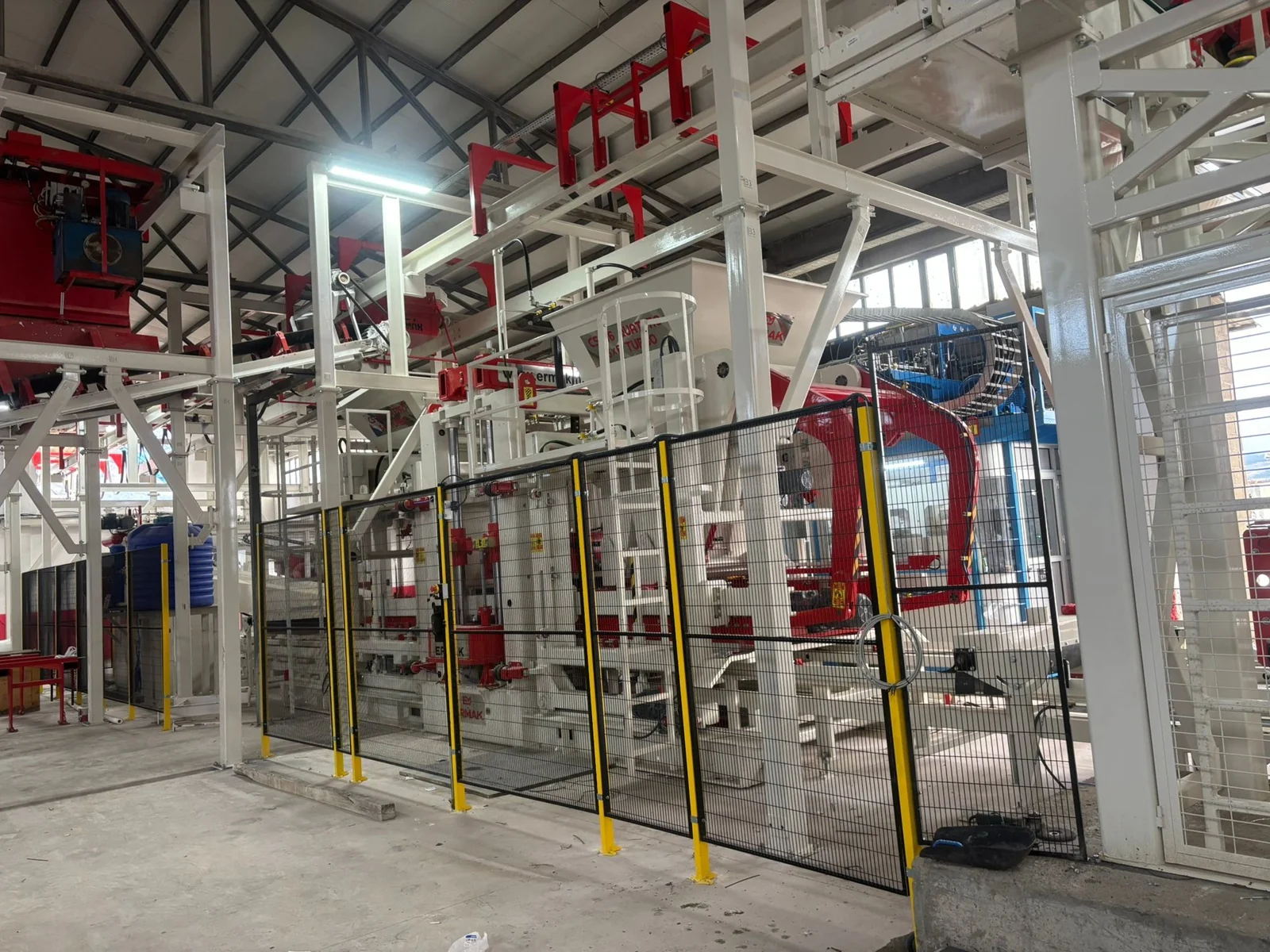
A concrete block production facility operates as an interconnected line.
Depending on its configuration, the system may include:
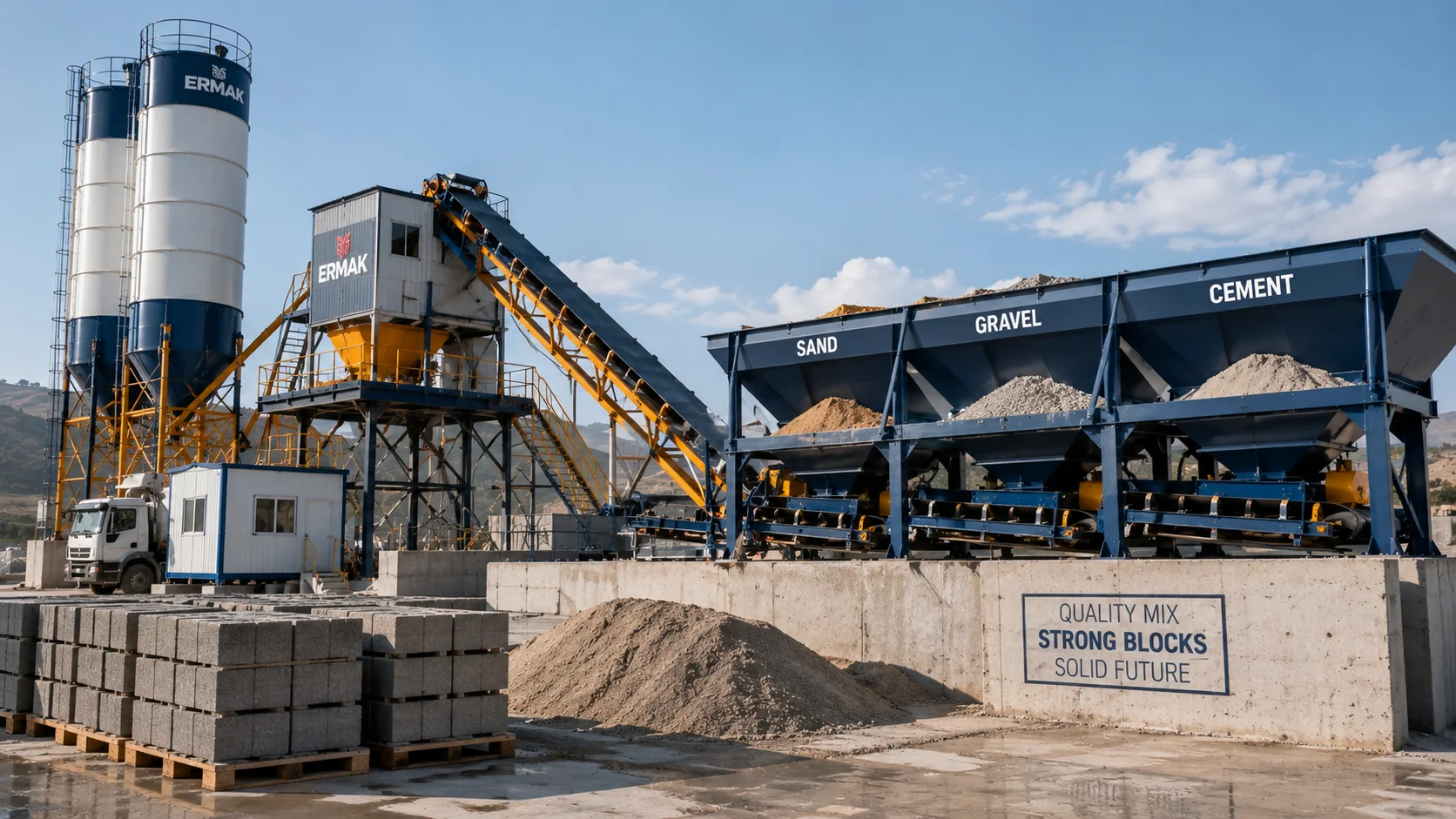
- Concrete batching plant
- Mixer
- Aggregate conveyors
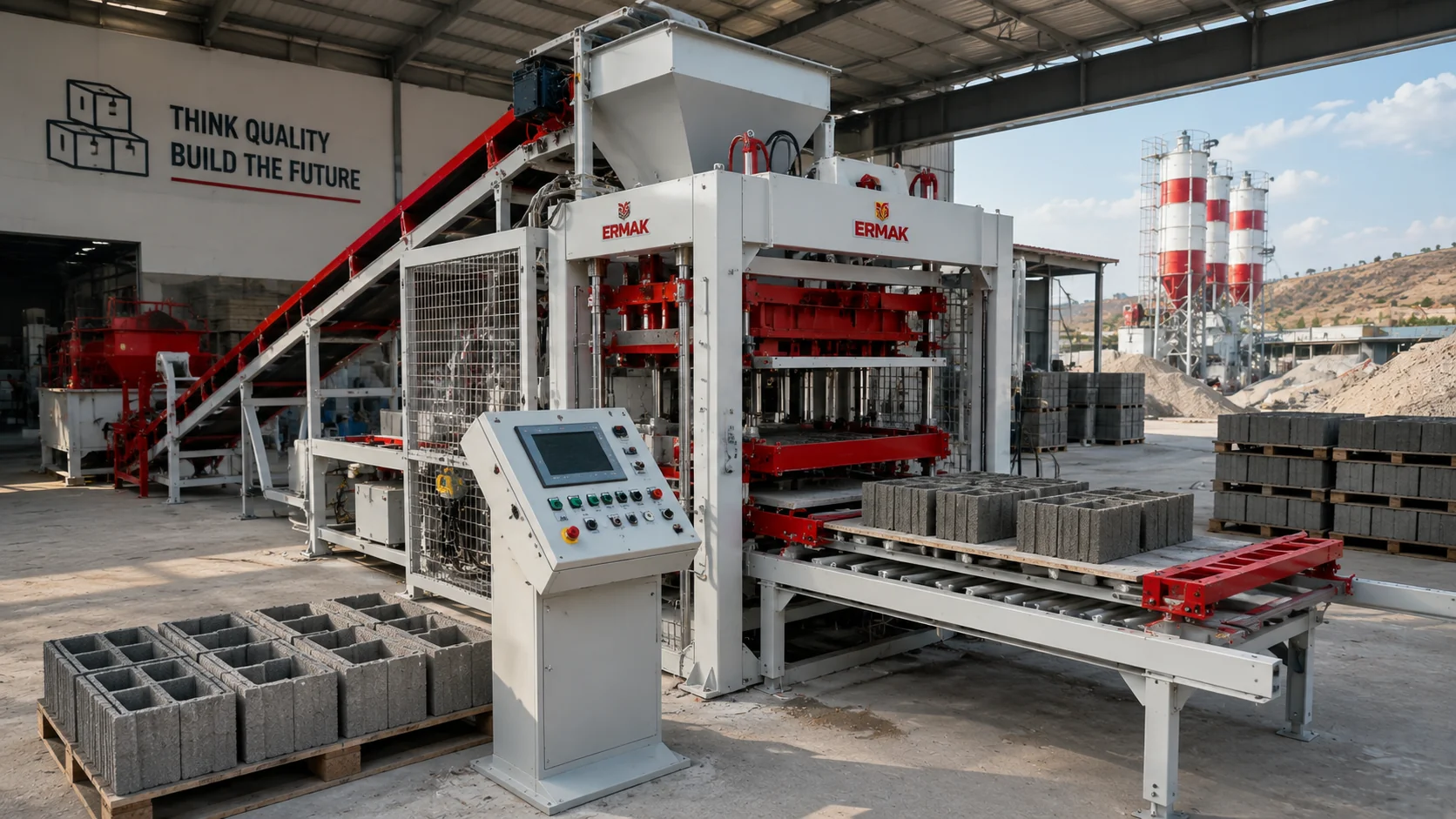
- Block making machine
- Hydraulic systems
- Vibration units
- Moulds
- Production pallets
- Wet-side conveyors
- Elevators
- Curing systems
- Dry-side equipment
- Cubing systems
- Packaging equipment
- PLC and automation systems
If one critical component stops, several other parts of the production line may also become unavailable.
This means that a machine failure does not create only a maintenance cost.
It can also create:
- Lost production
- Idle labour
- Delayed deliveries
- Interrupted curing schedules
- Missed project deadlines
- Additional logistics costs
- Customer dissatisfaction
- Overtime requirements after restart
The financial impact of downtime can therefore be considerably greater than the price of the failed component.
A proper after-sales strategy is designed to reduce both the frequency and duration of these interruptions.
The Purchase of a Block Machine Does Not End at Delivery
A common mistake in industrial equipment purchasing is treating delivery as the end of the supplier relationship.
For production machinery, it should be the beginning of a long technical relationship.
A complete after-sales process may involve:
- Installation
- Commissioning
- Initial production testing
- Operator training
- Maintenance training
- Production optimisation
- Preventive maintenance guidance
- Troubleshooting
- Spare parts supply
- Software and automation support
- Future upgrades
- Mould and product-development support
The exact service scope depends on the machine manufacturer and contract, so these items should be clarified before the purchase order is signed.
Ermak highlights fast after-sales service and experienced assembly and service teams in its current corporate presentation, while its website separately provides catalogues for machines, auxiliary equipment, concrete block moulds, batching plants, Milano Mixers and curing rack systems.
Installation Quality Affects Future Reliability
Good after-sales support begins during installation.
A machine may be manufactured correctly but still perform poorly if it is installed on:
- An unsuitable foundation
- An uneven surface
- Incorrect electrical infrastructure
- Poor hydraulic connections
- Insufficient compressed-air supply
- Incorrectly aligned conveyors
Installation affects vibration behaviour, alignment, machine stability and the long-term condition of mechanical parts.
During commissioning, technicians should normally verify areas such as:
- Machine levelling
- Frame alignment
- Mould alignment
- Hydraulic pressures
- Sensor positions
- Electrical connections
- Vibration settings
- Conveyor timing
- Safety circuits
- Automation communication
A commissioning process should not end simply because the machine can complete one production cycle.
The objective is to establish stable operation under realistic production conditions.
Operator Training Is Part of Machine Reliability
Even a highly automated concrete block machine still depends on people.
Operators must understand:
- Machine start-up
- Normal operating parameters
- Product recipe selection
- Mould changing
- Cleaning
- Lubrication
- Basic fault diagnosis
- Safety procedures
- Emergency shutdown
- Daily inspection
An operator who understands the machine can often detect abnormal behaviour before it becomes a major failure.
Early warning signs may include:
- Unusual vibration
- Different mechanical noise
- Increasing hydraulic temperature
- Oil leakage
- Irregular mould filling
- Sensor errors
- Slower cycle movements
- Product height variation
Ignoring such signals may turn a small maintenance task into an expensive repair.
Ermak’s current machine information also shows how important operator interfaces have become in modern equipment. Its own guidance for machine selection highlights sensor diagnostics, motor fault detection, alarm history and software diagnostics as useful capabilities to evaluate.
Maintenance Training Should Be Separate from Operator Training
Machine operation and machine maintenance are related, but they are not the same job.
Operators need to know how to run the plant correctly.
Maintenance technicians need deeper knowledge of systems such as:
- Hydraulics
- Mechanical assemblies
- Vibration systems
- Bearings
- Lubrication
- Electrical components
- Sensors
- PLC systems
- Frequency drives
- Conveyor systems
The maintenance team should understand not only how to replace a failed component but also why the component may have failed.
Repeated replacement without identifying the root cause can result in repeated downtime.
For example, a bearing that fails prematurely may be a symptom of:
- Incorrect lubrication
- Misalignment
- Contamination
- Excessive vibration
- Incorrect assembly
The spare part solves the immediate failure.
Correct maintenance solves the underlying problem.
Preventive Maintenance Is More Valuable Than Emergency Repair
There are two basic ways to maintain industrial machinery.
The first is:
Wait until it breaks.
The second is:
Inspect, maintain and replace critical components before failure stops production.
For a commercial block plant, the second approach is usually far more effective.
A preventive maintenance schedule may include daily, weekly, monthly and annual tasks.
Daily Checks
Typical daily inspections may include:
- Lubrication points
- Hydraulic oil level
- Visible leaks
- Air pressure
- Sensor cleanliness
- Conveyor condition
- Mould cleanliness
- Unusual sound or vibration
- Safety guards
- Emergency-stop systems
Weekly Checks
Weekly maintenance may include:
- Bolt and fastener inspection
- Conveyor alignment
- Chain tension
- Hydraulic hose inspection
- Vibration system inspection
- Electrical cabinet inspection
- Pallet handling components
- Mould and tamper-head condition
Periodic Maintenance
Longer-term maintenance may include:
- Hydraulic filter replacement
- Hydraulic oil analysis or replacement
- Bearing inspection
- Motor inspection
- Gearbox maintenance
- Calibration
- Electrical terminal checks
- Sensor replacement
- Wear-component measurement
- Software backup
The exact intervals should always follow the manufacturer’s machine-specific instructions.
Ermak’s current block-machine buying guide likewise recommends evaluating daily maintenance procedures, lubrication points, hydraulic filters, vibration maintenance, sensor replacement, mould cleaning and expected service intervals before purchasing a machine.
Spare Parts Availability Can Be More Important Than Spare Parts Price
When comparing machine manufacturers, buyers often ask:
“How much do the spare parts cost?”
That question matters, but another question can be even more important:
“How quickly can I get the part?”
Imagine that Component A costs €500 and can arrive tomorrow.
Component B costs €300 but requires three weeks to obtain.
If the entire factory remains stopped while waiting for Component B, the cheaper spare part can become enormously more expensive.
For this reason, spare parts should be evaluated according to:
- Price
- Availability
- Delivery time
- Expected lifetime
- Failure probability
- Production impact
A spare part is not expensive simply because its purchase price is high.
A cheap part that creates a long production shutdown can be the most expensive component in the factory.
Identify Critical Spare Parts Before Production Begins
Not every spare part needs to be kept in the factory warehouse.
But every plant should identify components that can stop production.
Critical spare parts may include items from systems such as:
- Sensors
- Hydraulic valves
- Hydraulic seals
- Filters
- Hoses
- Bearings
- Relays
- Contactors
- Frequency drives
- Conveyor components
- Vibration components
- Limit switches
- Proximity sensors
- Pneumatic valves
The exact list depends on the machine configuration.
A useful spare-parts strategy divides components into several categories.
High-Criticality Parts
These are components whose failure can stop the production line and which may have a long delivery time.
Keeping them in local stock can be worthwhile.
Normal Wear Parts
These components wear gradually and can usually be replaced according to a maintenance schedule.
Their consumption can be forecast.
Standard Commercial Components
Some items may be available from industrial suppliers in the country where the machine operates.
Local availability can reduce the amount of inventory required.
Low-Risk Components
Parts that rarely fail and can be supplied quickly may not justify local inventory.
This classification prevents two common mistakes:
- Keeping no important spare parts
- Buying an unnecessarily large warehouse of parts that may never be used
Standard Components Can Simplify International Maintenance
For machines installed internationally, component availability becomes particularly important.
Electrical, hydraulic and automation components from internationally supported industrial manufacturers may be easier to obtain locally.
When purchasing a machine, investors should ask:
- Which PLC brand is used?
- Which frequency drives are used?
- Which sensors are used?
- Which hydraulic valves are used?
- Which motors are installed?
- Are equivalent components available locally?
- Are proprietary parts required?
- Which components must come directly from the manufacturer?
A machine containing only proprietary components can create dependence on international shipping for even small repairs.
Using commonly supported components does not eliminate the need for manufacturer support, but it may simplify emergency maintenance.
Ermak’s own machine-selection guidance specifically recommends asking whether standard international components are used and whether spare parts can be shipped internationally.
Moulds Should Be Included in Spare Parts and Maintenance Planning
Concrete block moulds are not ordinary spare parts, but they are wear components within the production system.
During operation, the mould is exposed to:
- Abrasive aggregates
- Vibration
- Repeated mechanical movement
- Concrete pressure
- Continuous cleaning
Wear can gradually affect:
- Product dimensions
- Edge definition
- Internal block geometry
- Surface appearance
- Clearance between mould and tamper shoes
A plant should therefore monitor mould condition rather than waiting until the product visibly deteriorates.
The manufacturer should be able to support:
- New mould supply
- Replacement wear elements
- Dimensional inspection
- Mould revision where applicable
- New product development
Ermak manufactures concrete block moulds alongside its block-making equipment and currently provides a dedicated concrete block mould product category and catalogue.
Production Pallets Are Also Wear Components
Production pallets complete thousands of cycles during block manufacturing.
Over time, they may develop:
- Surface damage
- Bending
- Thickness variation
- Edge damage
- Moisture-related deformation, depending on material
A damaged pallet can affect:
- Product height
- Vibration transfer
- Conveyor movement
- Curing rack operation
- Pallet return
For this reason, production pallet condition should be part of scheduled inspection.
A plant should also maintain enough spare pallets so that a limited number of damaged units does not restrict production.
The number of spare pallets required depends on:
- Plant capacity
- Curing cycle
- Total pallet circulation
- Pallet material
- Replacement lead time
Vibration-System Parts Require Special Attention
The vibration unit is among the hardest-working sections of a concrete block machine.
It can contain:
- Motors
- Shafts
- Bearings
- Lubrication systems
- Mounting components
- Synchronisation equipment
Because vibration directly affects product compaction, deterioration may first appear as a quality problem rather than a complete machine failure.
Possible symptoms include:
- Different density across the pallet
- Longer compaction time
- Poor product surfaces
- Higher rejection rates
- Unusual noise
- Increased bearing temperature
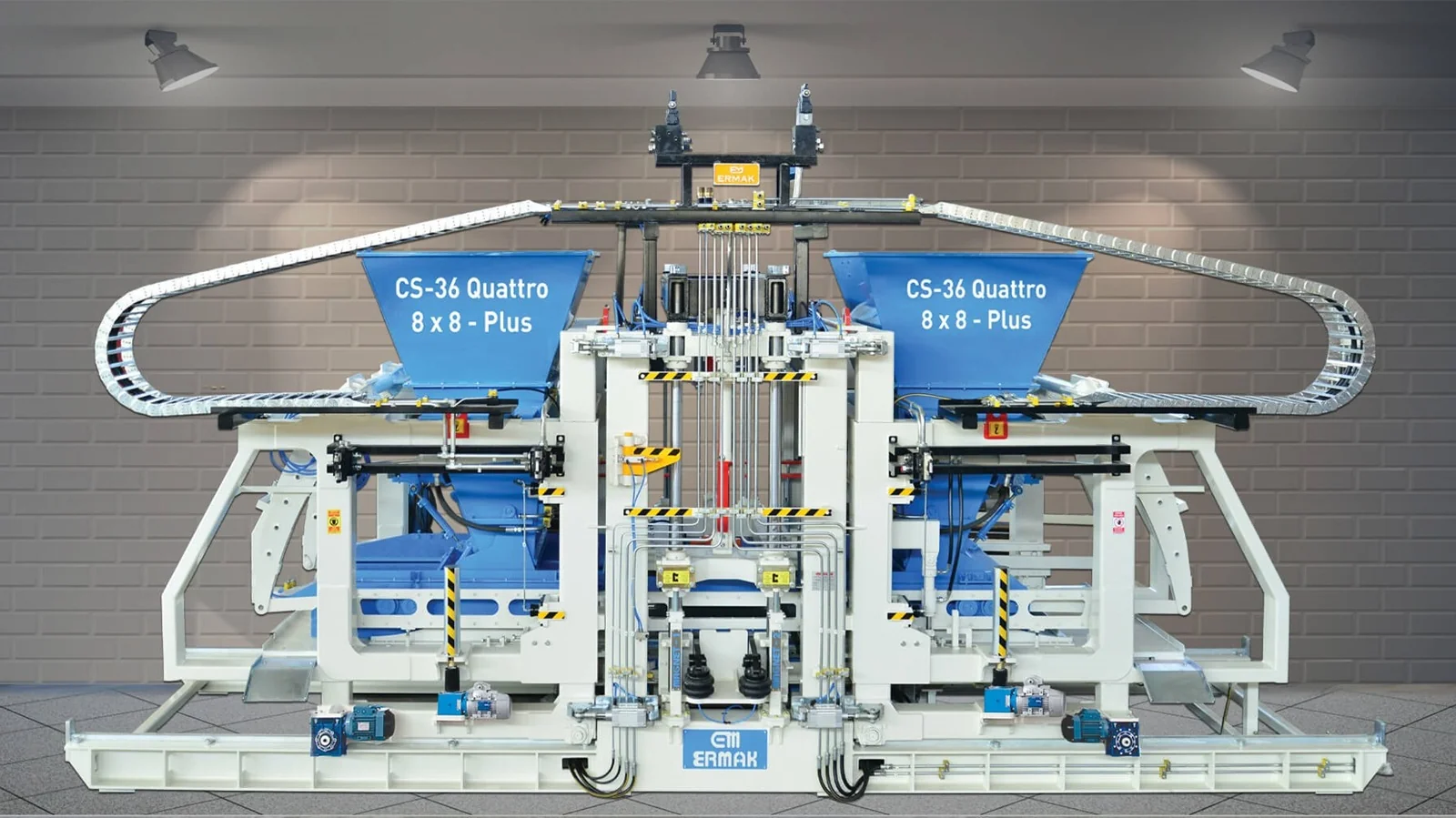
Ermak’s CS-36 Quattro 8X8 Plus, for example, is specified with the company’s VIBRO-180 system featuring 180 kN vibration force and automatic lubrication. Ermak states that this vibration-system family has been used in its machines for approximately 20 years.
For such systems, the spare-parts strategy should include the vibration unit’s machine-specific wear and service requirements.
Hydraulic Spare Parts Should Be Planned Proactively
Many block machines use hydraulic systems for:
- Mould movement
- Tamper-head movement
- Feeding equipment
- Pallet handling
- Auxiliary mechanisms
Hydraulic maintenance can involve:
- Oil
- Filters
- Hoses
- Seals
- Pumps
- Valves
- Pressure sensors
- Cooling systems
Small hydraulic leaks should not be ignored.
A minor leak can develop into:
- Oil loss
- Contamination
- Low system pressure
- Component overheating
- Unexpected machine shutdown
Hydraulic oil cleanliness is particularly important because contamination can damage several components rather than only one.
Plants should therefore follow proper filtration and oil-maintenance procedures instead of treating hydraulic oil as something that only requires attention after a failure.
Electrical and Automation Spare Parts
Modern block machines depend heavily on automation.
Important components may include:
- PLC
- HMI
- Frequency inverter
- Servo drive
- Power supply
- Relay
- Contactor
- Safety relay
- Proximity sensor
- Encoder
- Limit switch
A mechanical machine can sometimes continue operating despite a minor non-critical mechanical defect.
A failed €50 sensor, however, can stop a fully automated line completely.
That is one of the strange realities of modern industrial production: sometimes the smallest component controls the largest machine.
For this reason, critical automation components should be identified during commissioning.
The maintenance team should also receive current:
- Electrical diagrams
- I/O lists
- Component lists
- Alarm descriptions
- Relevant software backups
where these are included in the manufacturer’s support scope.
Diagnostic Systems Reduce Troubleshooting Time
Modern diagnostic systems can substantially shorten repair time.
Instead of searching manually through an entire production line, the control system may identify:
- Sensor faults
- Motor overloads
- Communication errors
- Safety interlock faults
- Drive alarms
- Missing signals
This is one reason the automation interface should be evaluated during machine selection.
Ermak’s current buying guide identifies alarm history, sensor diagnostics, motor fault detection, maintenance reminders and remote connection among useful control-system functions that buyers should consider.
The important point is not simply that a machine displays an alarm.
The alarm should help technicians identify the actual fault quickly.
Remote Technical Support Can Reduce Downtime
Not every problem requires a technician to travel to the factory.
For suitable automation systems, remote technical support may help diagnose:
- PLC faults
- Parameter problems
- Sensor status
- Communication problems
- Drive alarms
- Software settings
This can be especially valuable for international installations.
A technician travelling internationally may require flights, accommodation, visas or scheduling.
Remote diagnosis may determine whether:
- The problem can be solved immediately
- A local technician can perform the repair
- A replacement component is required
- A manufacturer service visit is necessary
However, remote support should not replace proper mechanical service when a physical inspection is required.
Its primary value is faster diagnosis.
Technical Documentation Is Part of After-Sales Support
A professional production plant should not depend entirely on the memory of one operator.
Machine documentation may include:
- Operating manual
- Maintenance manual
- Electrical diagram
- Hydraulic diagram
- Pneumatic diagram
- Spare-parts list
- Lubrication schedule
- Recommended maintenance intervals
- Safety instructions
- Mould-change procedures
These documents become increasingly important as employees change.
The technician who installed the machine today may not be the technician maintaining it five years later.
Good documentation preserves machine knowledge inside the company.
Spare Parts Records Should Be Organised
A simple spare-parts inventory system can prevent significant delays.
Each stored component should ideally have:
- Part name
- Part number
- Machine location
- Quantity
- Supplier
- Minimum stock quantity
- Lead time
- Replacement history
When a spare part is used, the inventory should be updated immediately.
Otherwise the classic maintenance disaster occurs:
Everyone believes there is a spare sensor in the cabinet.
The machine stops.
The box is opened.
The box is empty.
Good maintenance is often less glamorous than automation, but empty boxes have stopped many sophisticated factories.
Maintenance History Helps Identify Repeated Problems
Every major repair should be recorded.
Useful information includes:
- Date
- Machine hours
- Failure
- Failed component
- Root cause
- Replacement part
- Downtime
- Technician
- Corrective action
Over time, this information reveals patterns.
For example:
- The same sensor fails every six months.
- A bearing repeatedly overheats.
- One conveyor requires constant adjustment.
- Hydraulic filters become contaminated too quickly.
Instead of repeatedly repairing symptoms, the maintenance team can investigate the underlying cause.
This turns maintenance from emergency response into equipment management.
Spare Parts Planning Should Consider Lead Time
A useful way to determine whether a component should be stored locally is to combine:
Failure risk × production impact × delivery time
A rarely failing component that can be delivered the next morning may not require local inventory.
A moderately likely failure that takes four weeks to obtain probably deserves more attention.
International plants should also consider:
- Customs procedures
- Weekend delays
- Local holidays
- Air freight availability
- Import restrictions
A part that leaves the manufacturer within hours may still take days to reach the machine.
Therefore, spare-parts planning should be based on arrival time, not only dispatch time.
Original Spare Parts or Alternative Components?
Industrial plants sometimes use equivalent replacement components instead of original parts.
For generic industrial items, this may occasionally be technically acceptable if specifications are identical and the replacement is approved.
However, caution is necessary for components affecting:
- Machine safety
- Vibration
- Hydraulic pressure
- Control software
- Dimensional accuracy
- Structural integrity
Using an incorrect component because it physically fits can create additional failures.
For critical machine-specific parts, manufacturer-approved specifications should be followed.
A cheaper replacement part has no value if it damages a component worth twenty times more.
Planned Shutdowns Are Better Than Unplanned Shutdowns
Every factory needs maintenance time.
The objective is not to eliminate all downtime.
It is to convert uncontrolled downtime into planned downtime.
For example, a facility may schedule:
- Daily cleaning
- Weekly inspection
- Monthly maintenance
- Annual major service
during periods when production demand is lower.
Components approaching the end of their expected service life can then be replaced during scheduled stops.
This is usually far less expensive than waiting for the same component to fail during a critical customer order.
Seasonal Production Should Influence Maintenance Planning
Concrete-product markets in many regions experience seasonal changes.
If production demand is lower during certain months, these periods can be used for:
- Major machine service
- Mould refurbishment
- Conveyor maintenance
- Hydraulic maintenance
- Mixer wear-part replacement
- Electrical inspection
- Software backups
- Staff training
Maintenance should therefore be connected to the production calendar.
A plant should avoid discovering that its largest annual service is due exactly when orders reach their annual peak.
After-Sales Support Is Particularly Important for Export Projects
When a block making machine is installed in another country, several additional considerations become important:
- Language
- Time difference
- Local technical skills
- International freight
- Customs
- Electrical standards
- Component availability
- Remote communication
Before purchasing, international investors should clarify:
- How technical support is requested
- Which language support is available
- How spare parts are ordered
- Which critical parts should be stored locally
- Whether remote diagnostics are available for the selected system
- How service visits are organised
- What documentation is supplied
Ermak states that it provides after-sales support through its service network and describes its service and assembly teams as experienced elements of its organisation. Its site also presents the company as supplying customers internationally.
What Should Be Included in a Spare Parts Package?
There is no universal spare-parts package suitable for every concrete block machine.
The package should reflect:
- Machine model
- Automation level
- Operating hours
- Local component availability
- Shipping distance
- Number of shifts
A starting package may focus on categories such as:
Sensors and Electrical Components
Frequently used sensors, switches, relays and other critical control components.
Hydraulic Components
Filters, seals and machine-specific items recommended by the manufacturer.
Mechanical Wear Components
Bearings, conveyor components and other predictable wear parts.
Vibration Components
Machine-specific components recommended for the installed vibration system.
Mixer Wear Parts
If the project includes a batching plant and mixer, blades and wear liners should also be included in maintenance planning.
Conveyor Components
Belts, rollers, chains or other components depending on the installed system.
The correct package should be prepared from the final machine configuration rather than using a generic list.
Ask These Questions Before Purchasing a Block Making Machine
Before signing a contract, buyers should ask the manufacturer:
- What is included in commissioning?
- Is operator training included?
- Is maintenance training provided?
- Which spare parts are considered critical?
- Which parts should we keep locally?
- What are normal spare-parts lead times?
- Are internationally available components used?
- What technical documentation is supplied?
- Are electrical diagrams supplied?
- Are hydraulic diagrams supplied?
- How is technical support requested?
- Is remote diagnostics available for the selected machine configuration?
- How are international service visits organised?
- Is support available for moulds?
- Can additional moulds be supplied later?
- What preventive maintenance schedule is recommended?
- Which components have fixed replacement intervals?
- How should software and PLC backups be managed?
- Can older machine models continue to receive parts?
- What should be included in the initial spare-parts stock?
These questions should be answered before the machine enters production, not after the first breakdown.
After-Sales Service and Total Cost of Ownership
The true cost of a block making machine includes more than the original purchase price.
The total cost of ownership can include:
- Initial machine price
- Installation
- Energy consumption
- Labour
- Maintenance
- Spare parts
- Moulds
- Production pallets
- Technical service
- Product rejects
- Downtime
A lower-priced machine can become more expensive over time if:
- Spare parts are difficult to obtain.
- Failures are frequent.
- Service response is slow.
- Documentation is incomplete.
- Local technicians cannot troubleshoot it.
A more expensive machine with reliable support may provide a lower lifetime cost.
This is why spare parts and service should be evaluated before comparing final purchase prices.
Calculate the Cost of Downtime
A simple downtime calculation can change how spare-parts investment is viewed.
Assume a production line generates a certain contribution margin per working hour.
If the plant remains stopped for 20 hours while waiting for a component, the downtime cost may include:
Lost production + idle labour + delayed orders + restart costs
Now compare that figure with the cost of keeping the component in stock.
In many high-capacity plants, keeping several thousand euros of carefully selected critical parts can be far cheaper than losing multiple production shifts.
Spare-parts inventory should therefore be viewed as production insurance rather than dead stock.
Service Quality Should Be Evaluated Before Purchase
It is difficult to evaluate after-sales service from a quotation alone.
Potential buyers can investigate:
- Existing customer references
- Long-running installations
- Service-team structure
- Spare-parts organisation
- Technical documentation
- Response procedures
- Manufacturer history
Visiting an existing installation can be particularly useful.
Ask the machine owner:
- How often does the machine require unexpected service?
- How quickly can parts be supplied?
- Is technical support responsive?
- Are maintenance instructions clear?
- How has the machine performed after several years?
A five-year-old operating machine tells you something that a showroom machine cannot.
Long-Term Manufacturer Continuity Matters
Concrete block machinery is a long-term industrial investment.
The supplier’s ability to continue supporting machines over many years therefore matters.
Ermak states that it was established in Istanbul in 1965 and began producing paving-stone production machines in 1990. Its current company profile describes approximately 61 years of company history as of 2026 and continued production of block machines, mixers and associated construction machinery.
For an investor, manufacturer history does not guarantee that no machine will ever fail.
No industrial machine can make that promise.
What it can indicate is whether the manufacturer has experience maintaining relationships with machines and customers beyond the initial sale.
After-Sales Service Checklist for Block Making Machines
Before finalising a machine investment, verify that:
- Installation responsibilities are defined.
- Commissioning is included or clearly quoted.
- Operator training is planned.
- Maintenance training is planned.
- Preventive maintenance intervals are available.
- Critical spare parts have been identified.
- Recommended initial spare stock is prepared.
- Spare-parts delivery procedures are understood.
- Component part numbers are documented.
- Electrical diagrams are available.
- Hydraulic documentation is available where applicable.
- Automation diagnostics are understood.
- Software backup procedures are defined.
- Mould support is available.
- Production pallet replacement is planned.
- Vibration-system maintenance is understood.
- Hydraulic maintenance is scheduled.
- Service request procedures are defined.
- International logistics are considered.
- Maintenance records will be maintained.
- Total downtime risk has been evaluated.
Choosing a Block Machine for Long-Term Production
A concrete block making machine should not be evaluated only by what happens during a factory acceptance test.
The more important question is what happens after:
- 10,000 operating hours
- Multiple mould changes
- Several years of vibration
- Repeated maintenance cycles
- Operator changes
- Normal component wear
The strongest production investment is a machine that can not only produce efficiently but can also be maintained, repaired and supported throughout its working life.
Ermak currently manufactures concrete block machines together with concrete block moulds, concrete batching plants, Milano Mixers, curing rack systems and other equipment used within block production facilities. The company also presents after-sales service capability as a core part of its offer.
For investors comparing block making machines, after-sales support should therefore be treated as a technical specification.
Capacity tells you how much the machine can produce when everything is running.
Service and spare parts determine how much time it actually spends running.
For information about Ermak concrete block machines, spare parts, moulds and production-line solutions, investors can contact Ermak to discuss the required machine configuration, operating conditions and long-term service requirements.
Frequently Asked Questions
Why is after-sales service important for a concrete block machine?
Concrete block production lines contain mechanical, hydraulic, electrical and automation systems. A problem in one critical component can interrupt the entire line. Effective after-sales support can shorten diagnosis and repair time and help reduce production losses.
What spare parts should I keep for a block making machine?
The exact list depends on the model and configuration. It may include critical sensors, electrical components, hydraulic seals and filters, bearings, conveyor components and machine-specific wear parts. The final recommended list should come from the manufacturer.
Should I purchase spare parts when buying the machine?
For many industrial installations, an initial critical spare-parts package is sensible, especially when the factory is far from the manufacturer. The package should be based on component criticality, local availability and delivery time.
How often should a concrete block machine be maintained?
Maintenance intervals depend on machine design and operating conditions. Daily inspections, regular lubrication and scheduled mechanical, hydraulic and electrical maintenance are generally required. Machine-specific intervals should always follow the manufacturer’s documentation.
Can remote technical support solve machine problems?
Some automation and software-related faults may be diagnosed remotely when the installed control system supports that capability. Mechanical failures still require physical inspection or repair. Remote diagnostics are most valuable for identifying the cause of a problem quickly.
Why are machine drawings and technical documentation important?
Electrical, hydraulic and mechanical documentation helps maintenance technicians understand the equipment, identify components and troubleshoot faults. Documentation also becomes increasingly valuable when operators or maintenance staff change.
Are moulds considered spare parts?
Moulds are better described as production tooling and wear equipment rather than conventional spare parts. Their condition should nevertheless be monitored because mould wear directly affects product dimensions and quality. Ermak manufactures concrete block moulds alongside its block-machine range.
Why should vibration-system maintenance receive special attention?
Vibration directly affects concrete compaction and product quality. Wear or failure within the vibration system can reduce product density and consistency before causing a complete machine stop. Ermak’s current Quattro 8X8 Plus specifications, for example, identify a 180 kN VIBRO-180 system with automatic lubrication.
Is the cheapest spare part always the best option?
No. Part quality, compatibility and delivery time must also be considered. A cheaper component that causes further damage or requires a long production shutdown can have a much higher total cost.
How can a factory reduce unexpected downtime?
Preventive maintenance, operator training, critical spare-parts inventory, maintenance records, diagnostic systems and clear technical-support procedures can all reduce the duration and frequency of unplanned shutdowns.
What should I ask about after-sales service before buying a machine?
Ask about commissioning, operator training, maintenance training, spare-parts availability, delivery times, technical documentation, remote diagnostics, service response procedures and support for older machines. Ermak’s own machine-selection guidance similarly recommends evaluating spare parts, service intervals and technical-support capabilities before purchase.
PROTECTION OF PERSONAL DATA
WEBSITE COOKIE POLICY
Your personal data; It is one of the leading principles of our Organization to protect the privacy of visitors to the website (www.ermakmakine.com.tr) operated by the Ermak Makine (“Ermak Makine”) as the data controller. This Cookie Usage Policy (“Policy”) explains to all our website visitors and users which types of cookies are used and under what conditions.
Cookies are small text files stored on your device or network server by websites you visit on your computer or mobile device.
They are generally used to provide you with a personalized experience during your use of the website you visit, to improve the services offered and to improve your experience, and may contribute to ease of use while browsing a website. If you do not prefer the use of Cookies, you can delete or block Cookies in your browser settings. However, we would like to remind you that this may affect your use of our website. Unless you change your Cookie settings in your browser, we will assume that you accept the use of cookies on this website.
1. WHAT KIND OF DATA IS PROCESSED IN COOKIES?
Cookies on websites, depending on their type, collect data about your browsing and usage preferences on the device you visit the site. This data includes information about the pages you access, the services and products you review, your preferred language option and other preferences.
2. WHAT ARE COOKIES AND WHAT ARE THE PURPOSES OF USE?
Cookies are small text files stored on your device or network server through browsers by the websites you visit. These small text files, which contain your preferred language and other settings on the site, help us remember your preferences the next time you visit the site and make improvements to our services to improve your experience on the site. Thus, you can have a better and personalized usage experience on your next visit.
The main purposes of using cookies on our Website are listed below:
- To improve the services offered to you by increasing the functionality and performance of the website,
- To improve the Website and to offer new features through the Website and to personalize the features offered according to your preferences;
- To ensure the legal and commercial security of the Website, you and the Authority, and to prevent fraudulent transactions from being carried out through the Website;
- To fulfill its legal and contractual obligations, especially those arising from the Law No. 5651 on the Regulation of Publications on the Internet and Combating Crimes Committed through These Publications and the Regulation on the Procedures and Principles for the Regulation of Publications on the Internet.
3.TYPES OF COOKIES USED ON OUR WEBSITE
3.1. Session Cookies
Session cookies ensure that the website functions properly during your visit. They are used for purposes such as ensuring the security and continuity of our sites and you during your visit. Session cookies are temporary cookies, they are deleted when you close your browser and come back to our website, they are not permanent.
3.2. Persistent Cookies
These types of cookies are used to remember your preferences and are stored on your device via browsers. Persistent cookies remain stored even after you close your browser or restart your computer from which you visited our site. These cookies are kept in subfolders of your browser until they are deleted through your browser’s settings.
Some types of persistent cookies may be used to provide you with special suggestions, taking into account issues such as your purpose of using the Website.
Thanks to persistent cookies, if you visit our Website again with the same device, it is checked whether there is a cookie created by our Website on your device and if there is, it is understood that you have visited the site before and the content to be transmitted to you is determined accordingly and thus a better service is provided to you.
3.3. Mandatory/Technical Cookies
These cookies are essential for the website you visit to function properly. The purpose of such cookies is to provide necessary services by enabling the website to function. For example, it allows you to access secure parts of the website, to use its features, to navigate on it.
3.4. Analytical Cookies
They collect information about the way the website is used, the frequency and number of visits, and show how visitors navigate to the site. The purpose of using such cookies is to increase performance by improving the way the site functions and to determine the general trend direction. They do not contain data that could enable the identification of visitors. For example, they show the number of error messages displayed or the most visited pages.
3.5. Functional/Functional Cookies
It saves the choices made by the visitor within the site and remembers them on the next visit. The purpose of such cookies is to provide ease of use to visitors. For example, it prevents the site user from re-entering the user password on each page they visit.
3.6. Targeting/Advertising Cookies
They enable the measurement of the effectiveness of advertisements served to visitors and the calculation of the number of times the advertisements are viewed. The purpose of such cookies is to serve ads customized to the interests of visitors.
Likewise, they enable the detection of visitors’ interests specific to their browsing and the presentation of appropriate content. For example, it prevents the advertisement shown to the visitor from being shown again in a short time.
4. HOW TO MANAGE COOKIE PREFERENCES?
To change your preferences regarding the use of cookies or to block or delete cookies, simply change your browser settings.
Many browsers allow you to control cookies by giving you the option to accept or reject cookies, accept only certain types of cookies, or be alerted by the browser when a website requests to store cookies on your device.
It is also possible to delete cookies that have already been saved in your browser.
If you disable or refuse cookies, you may need to set some preferences manually, and some features and services on the website may not work properly because we cannot recognize and associate your account. You can change the settings of your browser by clicking on the relevant link in the table below.
5. ENFORCEMENT OF THE WEBSITE PRIVACY POLICY
Website Privacy Policy …./…./…./…. . is dated. In case all or certain articles of the Policy are renewed, the effective date of the Policy will be updated. The Privacy Policy is published on the website of the Authority (www.ermakmakine.com.tr) and made available to the relevant persons upon the request of personal data subjects.
Ermak Makine
Address Organize Sanayi Bölgesi Mah. 27.Sokak. No:1/1 Dilovası/Kocaeli
Telephone: (+90 262)263 02 70
E-mail: kvkk@ermakmakine.com.tr
Web Address: www.ermakmakine.com.tr
You can type below the product you want to search for