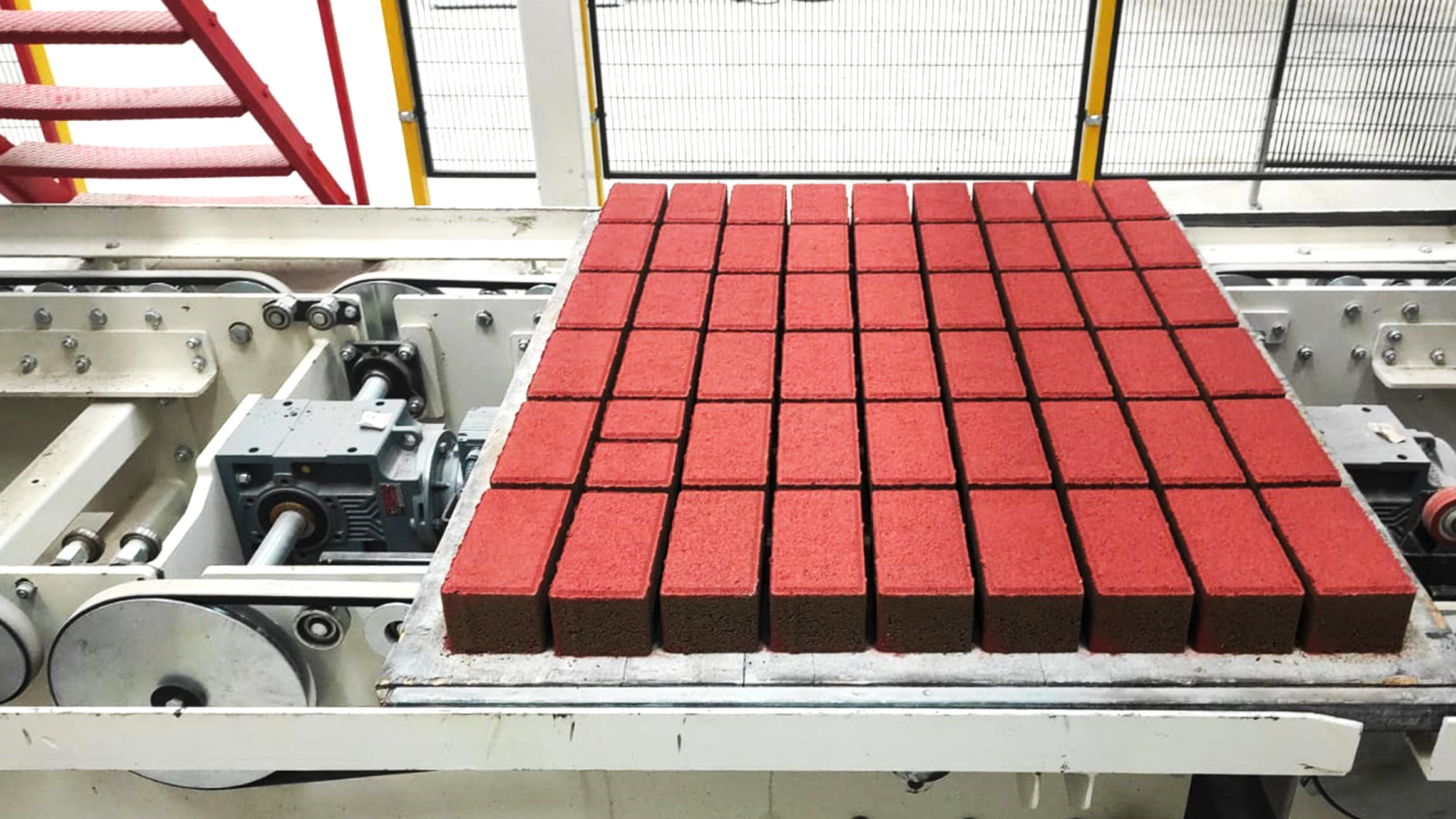
Consistent quality is one of the most important requirements in concrete paver production.
A production plant may achieve high output, short cycle times and advanced automation, but if the finished products vary in:
- Height
- Density
- Colour
- Surface texture
- Edge quality
- Mechanical performance
the plant will struggle to maintain reliable commercial quality.
This is especially important for paving stones because large quantities of individual units are installed together over one visible surface.
A small variation that may appear insignificant on a single paver can become obvious when thousands of pieces are laid side by side.
For this reason, quality in concrete paver manufacturing is not created by one machine component.
It is the result of a controlled production chain:
Raw materials + mix design + moisture + mixing + feeding + vibration + mould accuracy + pallet condition + curing + handling + quality control
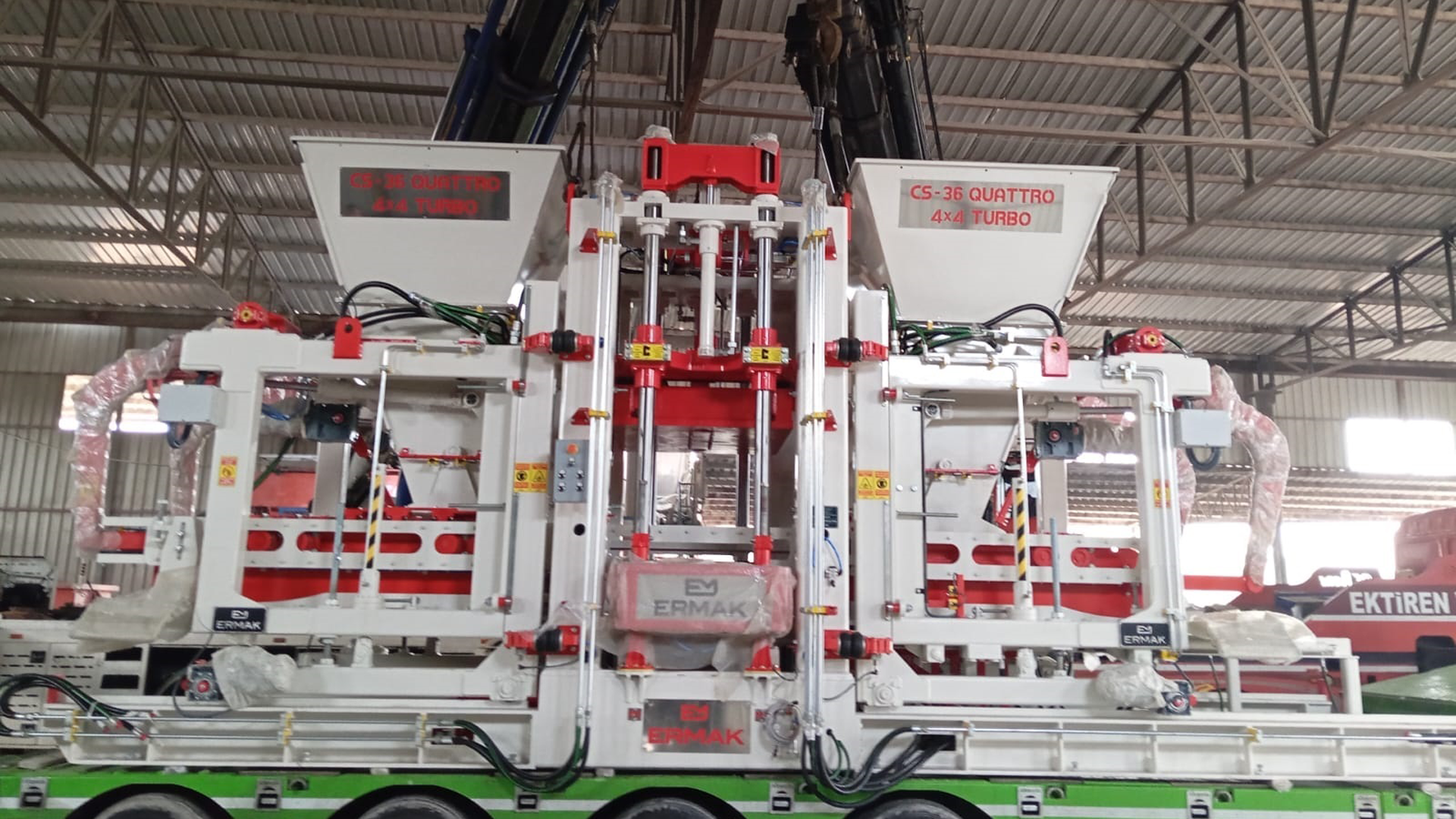
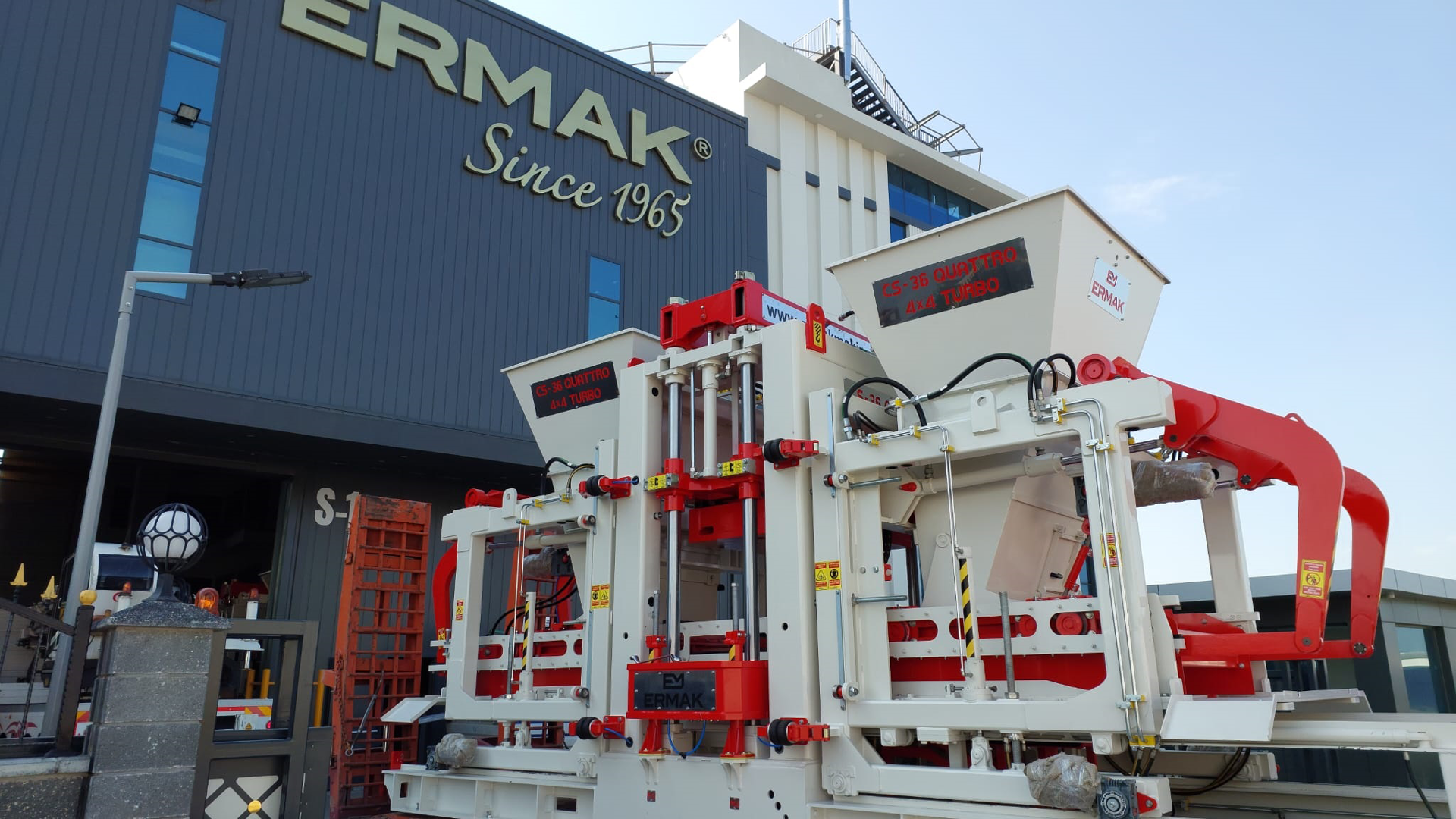
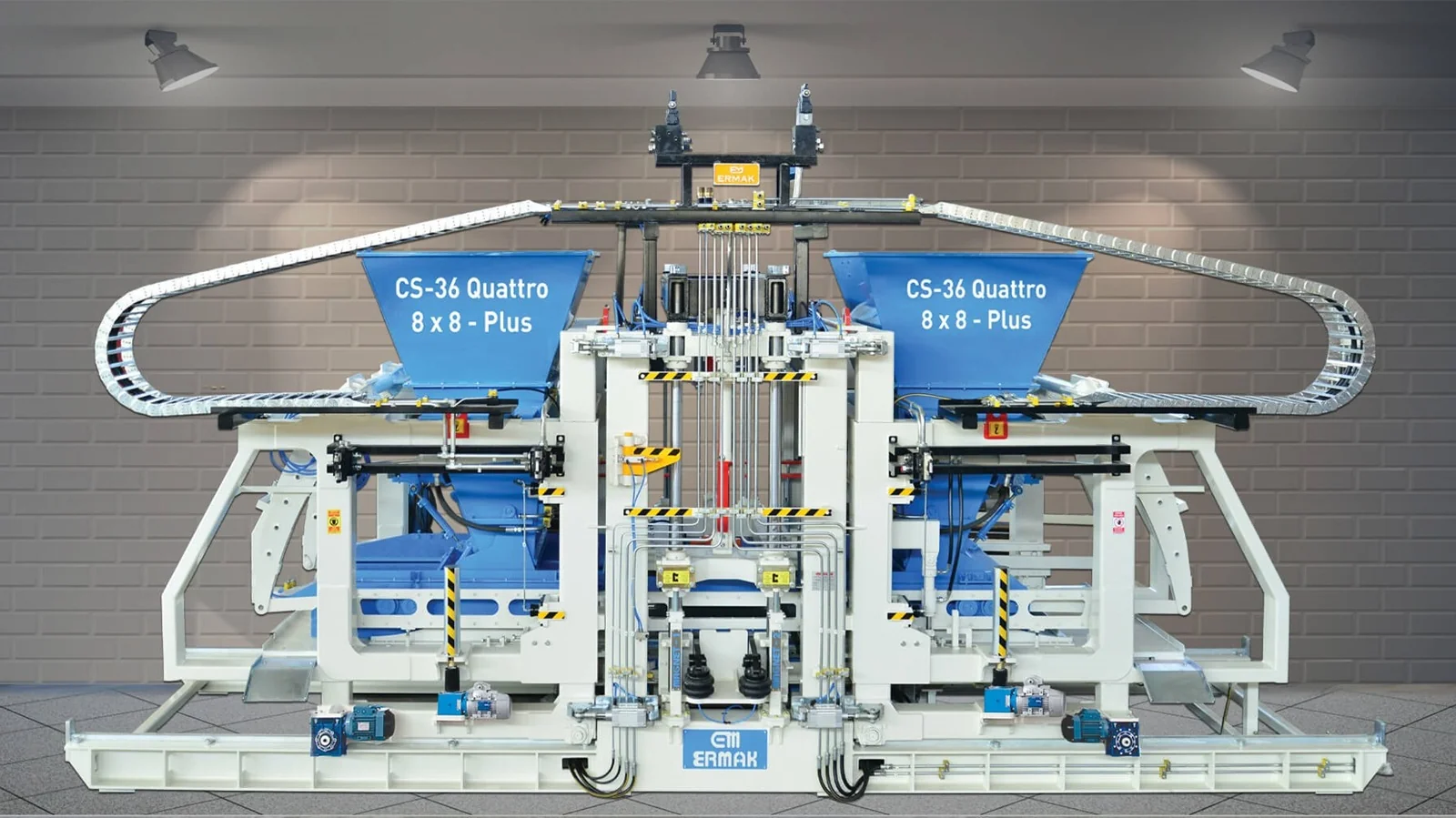
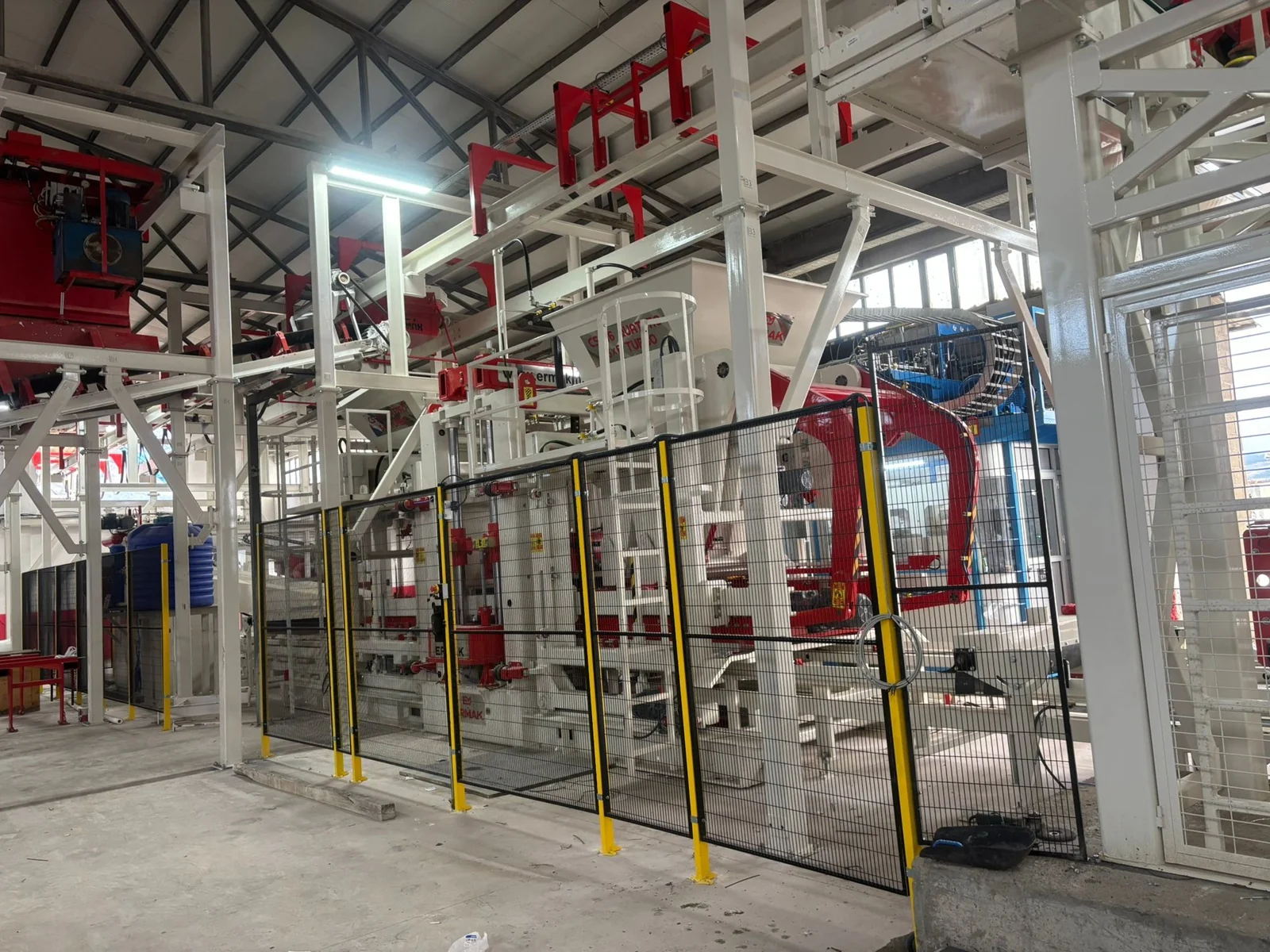
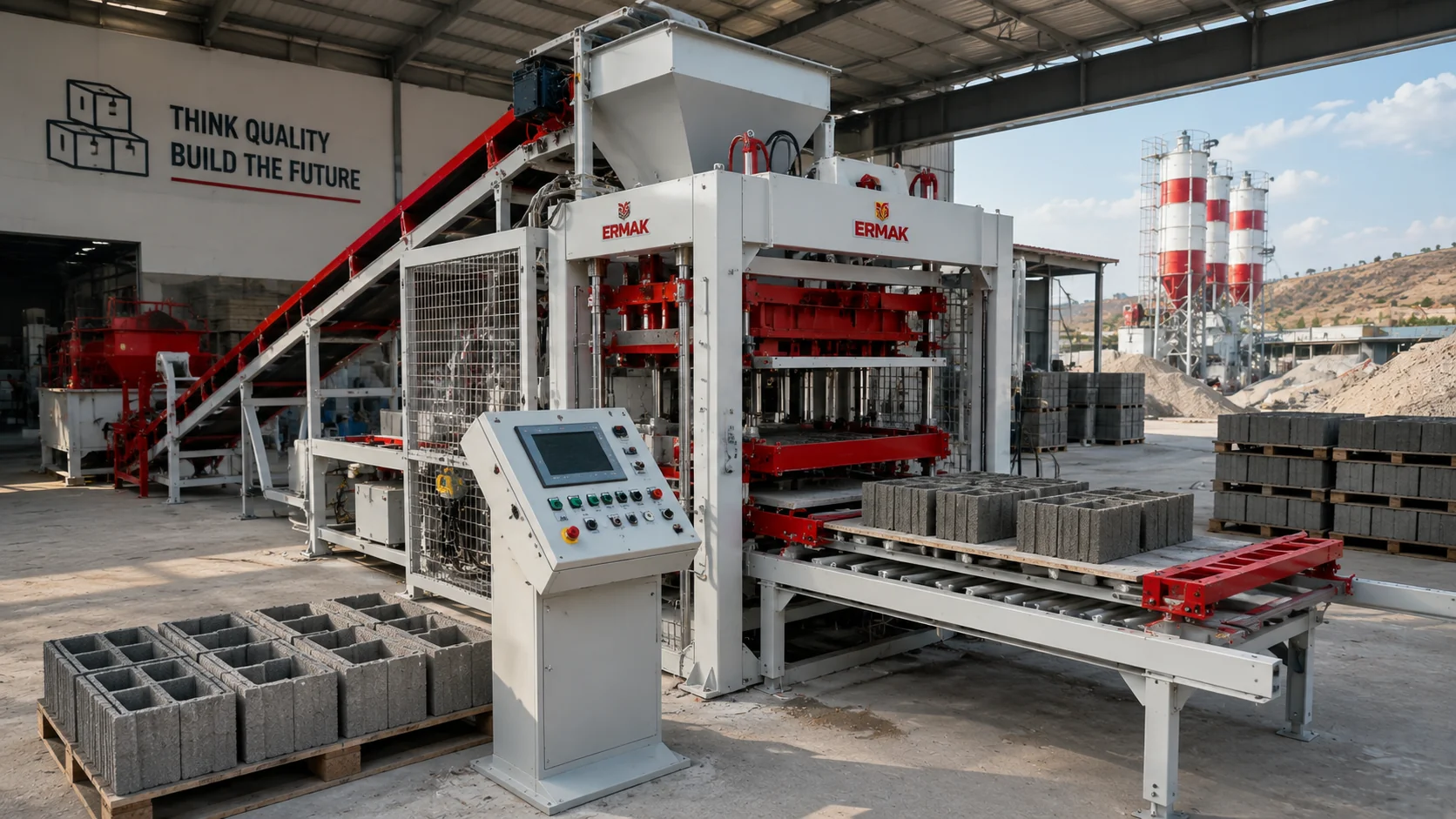
Ermak’s current turnkey production guidance similarly identifies vibration, mould configuration, concrete preparation and downstream production systems as interconnected factors in product consistency. Its Quattro 8X8 Plus machines are currently listed with paver capacities ranging from approximately 1,400–1,600 m² per eight hours on the CS-36 to 1,500–1,800 m² per eight hours on the CS-42, depending on machine configuration.
The real challenge is therefore not simply:
“How many square metres can we produce?”
It is:
“How many square metres can we produce with repeatable, saleable quality?”
What Defines a High-Quality Concrete Paver?
The exact requirements depend on:
- Product type
- Local standards
- Intended application
- Traffic load
- Climate
- Customer specification
However, high-quality paving stones generally require consistency in areas such as:
- Dimensions
- Product height
- Surface finish
- Edge geometry
- Colour
- Density
- Strength
- Water absorption
- Wear resistance
Visual appearance alone is not enough.
A paver can look attractive but still fail to achieve the required mechanical performance.
Similarly, a technically strong product may still be commercially unacceptable if:
- Colours vary significantly
- Edges are damaged
- Dimensions are inconsistent
The production process must therefore control both engineering performance and visual consistency.
1. Raw Material Quality Is the Foundation
Concrete paver quality begins before the concrete enters the mixer.
The main raw materials typically include:
- Cement
- Fine aggregate
- Coarse aggregate
- Water
- Admixtures
- Pigment, where required
The consistency of these materials strongly affects finished-product quality.
For example, a change in sand source may alter:
- Particle-size distribution
- Moisture
- Fine content
- Particle shape
Even if the programmed recipe remains unchanged, the actual concrete behaviour may change.
This is why stable sourcing and incoming-material control are important for industrial paver production.
2. Aggregate Grading Has a Major Effect on Compaction
Aggregate grading describes the distribution of different particle sizes in the mix.
A well-graded aggregate system can help smaller particles fill voids between larger particles.
This can contribute to:
- Better packing
- More efficient compaction
- More uniform density
- Improved surface finish
- Better cement efficiency
Poor grading can make the concrete more difficult to compact and may increase the amount of cement paste required to fill voids.
For this reason, sieve analysis should be considered part of recipe development and raw-material control.
3. Aggregate Shape Also Matters
Two aggregates with the same nominal size can behave differently.
Crushed aggregate may provide strong mechanical interlock but can have:
- Angular particles
- Rough surfaces
that affect water demand and compactability.
More rounded particles may behave differently during mixing and vibration.
Important properties therefore include:
- Particle shape
- Surface texture
- Water absorption
- Fine content
Whenever a major aggregate source changes, production trials should be performed before assuming that the old recipe will remain optimal.
4. Mix Design Must Match the Paver Product
There is no single universal concrete paver recipe.
The correct mix depends on:
- Product thickness
- Surface requirements
- Strength target
- Aggregate characteristics
- Machine type
- Vibration system
- Curing conditions
A paver intended for pedestrian landscaping may have different requirements from one intended for heavy vehicle traffic.
The recipe should therefore be developed around the finished-product requirement.
The goal is not simply to use:
More cement
or:
Less water
The goal is to create a mixture that can be:
- Filled quickly
- Compacted effectively
- Demoulded immediately
- Cured reliably
- Produced repeatedly
5. Moisture Control Is One of the Most Critical Variables
Concrete used in vibro-pressed paver production is typically relatively dry.
The mixture must be wet enough to compact properly but dry enough to maintain its shape after immediate demoulding.
If concrete is too dry:
- Mould filling may become difficult.
- Surface texture may become open.
- Corners may be weak.
- Vibration time may increase.
If concrete is too wet:
- Products may deform after demoulding.
- Edges may lose definition.
- Height may change.
- Concrete may stick to mould components.
Moisture therefore has a narrow practical operating window.
6. Aggregate Moisture Must Be Included in Water Calculation
The programmed water quantity is not necessarily the total water in the mix.
Sand and other aggregates may already contain moisture.
For example, if:
- 1,000 kg of sand
- Contains 4% moisture
that represents approximately:
40 kg of water
already entering the mixer.
If the control system adds the full recipe water without compensating for this moisture, the real mixture can become significantly wetter than intended.
This is why aggregate moisture measurement and water correction are important for consistent paver production.
7. Cement Content Must Be Optimised, Not Maximised
Using more cement is not automatically equal to better quality.
Excess cement increases:
- Raw-material cost
- Cost per square metre
without necessarily solving problems caused by:
- Poor grading
- Incorrect moisture
- Weak vibration
- Poor curing
Too little cement may reduce product performance.
The correct objective is therefore:
The cement quantity required to achieve the target product performance under stable production conditions.
This should be confirmed through test production and laboratory testing.
8. Coloured Pavers Require More Precise Recipe Control
Colour introduces another level of complexity.
Colour consistency can be influenced by:
- Pigment dosage
- Cement colour
- Aggregate colour
- Water content
- Mixing time
- Curing conditions
- Surface moisture
Even a small change in one of these parameters may become visible when products are laid over a large area.
For coloured pavers, recipes should ideally be:
- Stored
- Repeated automatically
- Controlled by batch
rather than adjusted from memory by different operators.
9. Pigment Dosing Should Be Repeatable
Pigment variation creates obvious product-to-product differences.
If one batch receives slightly more pigment and another slightly less, the individual difference may seem small in the factory.
After installation, however, the change may appear as:
- Bands
- Patches
- Different shades
across the pavement.
Automated pigment dosing can improve repeatability in high-volume production.
The same applies to any coloured face mix.
10. Single-Layer and Double-Layer Pavers Need Different Control
Concrete pavers may be produced as:
- Single-layer products
- Double-layer products
In double-layer production, the paver commonly includes:
- Base concrete
- Face concrete
The base layer primarily provides the structural body.
The face layer can be designed for:
- Colour
- Texture
- Appearance
- Surface wear
These two mixes may require different:
- Aggregates
- Cement
- Pigment
- Moisture
The timing between layers must also be controlled carefully.
11. Face-Mix Thickness Should Be Consistent
In double-layer pavers, the visible face layer should be applied uniformly.
If face-layer thickness varies:
- Colour intensity may change.
- Surface wear may become inconsistent.
- Visual appearance may differ.
This means quality control should not focus only on total paver height.
The relationship between:
should also remain stable.
12. Mixing Quality Is as Important as Mix Design
A perfect recipe on paper does not guarantee good pavers.
The mixer must distribute:
- Cement
- Aggregate
- Water
- Admixtures
- Pigments
uniformly.
Poor mixing can cause:
- Local moisture variation
- Cement concentration differences
- Colour inconsistency
- Variable compactability
The mixer is therefore a critical quality component.
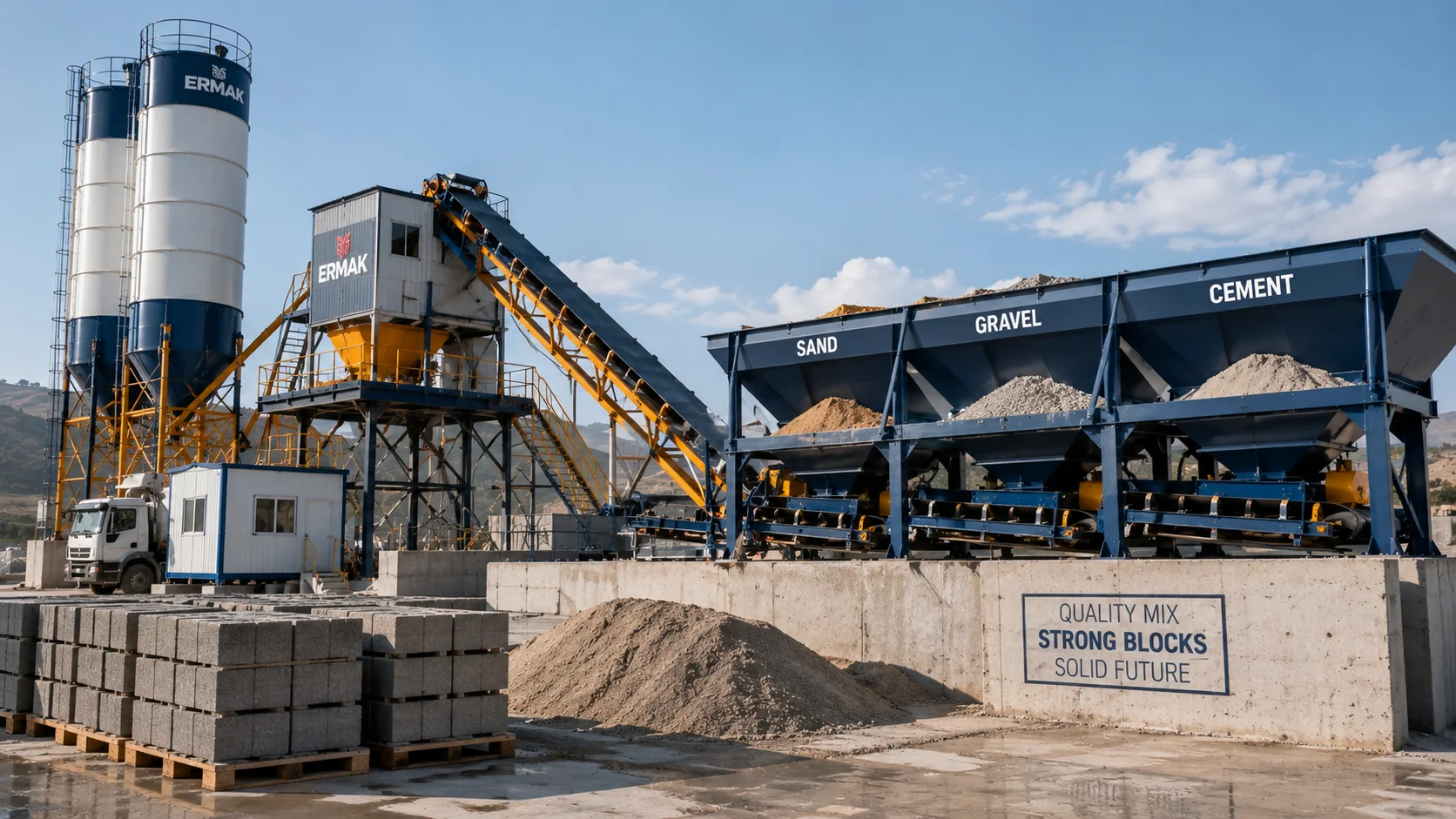
Ermak currently states that its concrete batching plants use Milano Mixer systems and can be configured with standard or project-specific automation.
13. Mixing Time Should Be Consistent
If one batch is mixed for:
and the next for:
without technical reason, the resulting concrete may behave differently.
This becomes especially important in coloured mixtures where pigment distribution is critical.
The correct mixing time should be established through trials and then kept stable through the automation system.
14. Overmixing Does Not Automatically Improve Quality
Once the concrete is adequately homogeneous, additional mixing may:
- Reduce plant capacity
- Increase energy use
- Increase mixer wear
without meaningful quality improvement.
The objective is:
Repeatable homogeneity at an efficient cycle time.
15. Concrete Feeding Must Be Uniform Across the Mould
The concrete must be distributed across the entire mould area.
Poor feeding can create:
- Underfilled cavities
- Weight variation
- Height variation
- Density differences
This becomes particularly important with larger production pallets.
The feeding system should provide enough material without creating large differences across the mould.
16. Vibration Is One of the Most Important Quality Factors
Vibration helps relatively dry concrete settle and compact within the paver mould.
It influences:
- Density
- Surface texture
- Edge definition
- Product height consistency
- Reject rate
Ermak’s turnkey guidance specifically identifies concrete distribution, density, surface finish, edge quality and dimensional consistency among the characteristics affected by vibration.
This makes vibration one of the central technologies in industrial paver production.
17. Maximum Vibration Is Not the Objective
A common misconception is:
“The more vibration, the better the paver.”
That is not necessarily true.
Vibration must be optimised according to:
- Concrete recipe
- Product height
- Mould geometry
- Production cycle
The goal is not maximum vibration force.
The goal is effective and uniform compaction.
18. Vibration Distribution Across the Pallet Matters
Total vibration force alone does not guarantee equal product quality.
If one area of the mould receives significantly different vibration from another, products from the same cycle can differ.
This may appear as:
- Density variation
- Different surface texture
- Weight variation
Large production pallets make uniform vibration distribution especially important.
Ermak’s CS-42 Quattro 8X8 Plus currently uses a 1350 × 1400 mm-class pallet and is listed at 1,500–1,800 m² of pavers per eight hours. The machine uses the VIBRO-180 system, which Ermak specifies at 180 kN vibration force with automatic lubrication.
19. Cycle Time Should Never Be Reduced at the Expense of Quality
Shorter cycle time increases theoretical capacity.
But if:
- Feeding becomes incomplete
- Vibration becomes insufficient
- Rejects increase
the commercial benefit may disappear.
Suppose:
Setting A
- 1,600 m² gross production
- 5% reject rate
Saleable output:
1,520 m²
Setting B
- 1,560 m² gross production
- 1% reject rate
Saleable output:
1,544.4 m²
The technically slower setting produces more saleable product.
This is why quality and capacity must always be measured together.
20. Mould Quality Determines Product Geometry
The mould directly defines:
- Length
- Width
- Shape
- Chamfers
- Edge geometry
- Surface pattern
A poor or worn mould can repeatedly produce defective products even if the main machine is performing correctly.
Mould quality therefore has a direct relationship with:
- Dimensional accuracy
- Visual quality
- Installation performance
The mould should be viewed as precision production tooling, not simply an accessory.
21. Mould Wear Must Be Monitored
Paver moulds operate under:
- Abrasive aggregate
- Vibration
- Repeated mechanical movement
As wear develops:
- Dimensions can drift.
- Chamfers may change.
- Tamper clearances can increase.
- Surface definition may deteriorate.
The important question is not:
“Can the mould still produce?”
It is:
“Can the mould still produce within the required tolerances?”
22. Fast Mould Change Helps Quality as Well as Capacity
Frequent manual mould changes can increase the risk of:
- Incorrect alignment
- Setup variation
- Long production interruptions
Ermak currently states that selected Quattro 8X8 Plus configurations can begin production with a new mould in a maximum of approximately 15 minutes using an automatic mould-change system.
The practical benefit is not only reduced downtime.
A repeatable mould-change process can also help make setup more consistent.
23. Tamper-Head Alignment Is Critical
The tamper head works together with the mould and vibration system.
If alignment is incorrect:
- Pressure distribution may become uneven.
- Product height may vary.
- Mechanical contact may occur.
This is why mould installation should always include alignment verification.
24. Production Pallet Condition Influences Quality
The pallet is part of the production system.
Pavers are formed directly on it.
A pallet that is:
can influence:
- Product height
- Vibration transfer
- Product stability
Pallet quality should therefore be checked regularly.
25. A Damaged Pallet Can Create False Machine Problems
A bent pallet may cause one side of a production cycle to behave differently.
The operator may suspect:
- Mould
- Vibration
- Hydraulic pressure
when the real cause is the pallet.
For quality troubleshooting, inspect:
Machine + mould + production pallet
together.
26. Curing Is Part of the Production Process
Paver quality is not complete when the mould lifts.
The cement must continue hydrating.
Curing conditions can affect:
- Strength development
- Surface quality
- Colour consistency
Important factors include:
- Temperature
- Humidity
- Time
Poor curing can destroy the benefits of a good concrete recipe and good compaction.
27. Uneven Curing Can Create Colour Variation
This is particularly important in coloured paving stones.
If one group of pavers is:
- Exposed to more heat
- Exposed to wind
- Allowed to dry faster
than another, visible colour variation may develop.
For consistent colour, products from the same production series should experience similar curing conditions.
28. Direct Sunlight Can Affect Fresh Products
Freshly moulded products should not be treated like fully cured concrete.
Rapid moisture loss can influence the curing process.
Depending on climate and plant design, curing systems should protect products from uncontrolled early drying.
This is especially important in:
environments.
29. Curing Capacity Must Match Machine Capacity
Quality can suffer if curing areas become overloaded.
Suppose the machine produces:
150 pallets/hour
but the curing system can accept only:
110 pallets/hour
Products may have to be:
- Stored temporarily
- Handled differently
- Exposed to different environmental conditions
This can create both capacity and quality variation.
Ermak’s turnkey plant guidance specifically identifies curing as one of the systems that must be matched to main machine capacity.
30. Handling After Curing Still Matters
A technically perfect paver can still become a reject during handling.
Common damage includes:
- Chipped corners
- Broken edges
- Surface scratches
These defects may be caused by:
- Aggressive cubing
- Poor conveyor transitions
- Forklift impacts
- Incorrect stacking
Quality management must therefore continue after curing.
31. Packaging Should Protect Product Quality
Packaging is not only a logistics function.
It should also prevent products from moving excessively during:
- Storage
- Truck loading
- Transport
Well-designed stacking patterns help distribute loads more evenly.
Poor packaging may lead to complaints even when the pavers left the production machine in perfect condition.
32. Forklift Handling Can Create Hidden Damage
Frequent forklift impacts can damage:
- Finished products
- Commercial pallets
- Production pallets
Operators should be trained to handle products according to their strength and curing condition.
Newly cured pavers should not automatically be treated as if they had reached full long-term strength.
33. Product Weight Is a Useful Quality-Control Indicator
Regular weighing can reveal changes in:
- Filling
- Concrete density
- Moisture
- Compaction
Suppose the target paver weighs:
X kg
If weight gradually falls while mould dimensions remain the same, investigate:
- Feeding
- Recipe
- Moisture
- Vibration
Product weight is simple to measure and can provide valuable process information.
34. Height Should Be Checked Frequently
Height variation can create installation problems.
If some pavers are higher than others:
- Finished surfaces can become uneven.
- Installation becomes more difficult.
Possible causes include:
- Mould wear
- Pallet condition
- Filling variation
- Tamper settings
- Concrete consistency
Height should therefore be measured at regular production intervals.
35. Length and Width Tolerances Matter
Pavers must fit together according to the intended laying pattern.
Dimensional variation can alter:
- Joint width
- Pattern alignment
- Installed appearance
This becomes particularly important in interlocking systems.
Mould wear should therefore be detected before it creates large batches of dimensionally inconsistent product.
36. Surface Inspection Should Be Standardised
Surface quality should not depend entirely on one operator’s personal opinion.
The factory can define visual acceptance criteria for:
- Pores
- Edge damage
- Colour
- Surface texture
Reference samples can help operators make more consistent decisions.
37. Strength Should Be Confirmed Through Testing
A visually excellent paver can still fail mechanical requirements.
Depending on applicable standards and product type, testing may include:
- Compressive performance
- Splitting tensile strength
- Other specified mechanical tests
The exact test regime should follow the relevant market and product standard.
Visual inspection is not a replacement for technical testing.
38. Water Absorption Should Be Monitored Where Relevant
Water absorption can provide information about:
- Porosity
- Compaction
- Concrete structure
High variability may indicate unstable production conditions.
Required limits depend on applicable product standards and market specifications.
39. Abrasion Resistance Can Be Important for Pavers
Paving stones are exposed to surface wear.
Depending on application, abrasion resistance may be particularly important in:
- Pedestrian areas
- Public spaces
- Vehicle traffic zones
Face-mix quality and curing can influence long-term surface performance.
40. Colour Quality Must Be Evaluated in Groups, Not One Piece at a Time
A single paver can appear acceptable.
But the real test is how hundreds of products look together.
Quality checks for coloured pavers should compare:
- Multiple pallets
- Different production batches
- Different curing positions
This helps detect systematic shade variation.
41. Recipe Traceability Helps Solve Quality Problems
If a customer reports a problem, the plant should ideally be able to identify:
- Production date
- Recipe
- Raw material batch
- Pigment batch
- Machine settings
This makes root-cause analysis much easier.
Without traceability, quality troubleshooting becomes guesswork.
42. Store Product-Specific Machine Parameters
Different paver products may require different:
- Feeding times
- Vibration times
- Pressing parameters
- Product-height settings
These settings should be documented or stored in the automation system where possible.
This reduces operator-to-operator variation.
43. Operator Training Is Part of Quality Control
Even highly automated equipment depends on trained personnel.
Operators should understand:
- Normal machine behaviour
- Concrete consistency
- Mould condition
- Alarm messages
- Product defects
An experienced operator can often identify process drift before it creates a large reject batch.
44. Maintenance Has a Direct Relationship with Quality
Machine maintenance is often viewed only as a way to prevent downtime.
But worn components can also reduce product consistency.
Possible examples include:
- Vibration bearing deterioration
- Sensor misalignment
- Hydraulic variation
- Worn conveyors
- Loose mechanical connections
A machine can still run while product quality slowly becomes worse.
45. Vibration-System Health Should Be Monitored Through Product Quality
If a plant sees:
- More surface defects
- Density differences
- Longer compaction time
- Higher reject rate
the vibration system may need inspection.
Quality data can therefore function as an early maintenance warning.
46. Quality Problems Should Be Investigated Systematically
When a defect appears, avoid immediately changing one random machine parameter.
Use a structured troubleshooting process.
For example, if paver surfaces become porous:
- Check raw materials.
- Check aggregate grading.
- Measure moisture.
- Check the mix.
- Check mixer performance.
- Inspect mould filling.
- Check vibration.
- Inspect mould condition.
- Inspect production pallets.
- Review curing.
This reduces unnecessary adjustments.
47. Reject Categories Should Be Recorded
Useful reject categories may include:
- Edge damage
- Surface defects
- Colour variation
- Height variation
- Cracks
- Incomplete filling
- Packaging damage
Once defects are categorised, management can identify the largest quality loss.
48. Reject Rate Should Be Measured in Square Metres
For paving-stone factories, a useful commercial KPI is:
Rejected m² / Total produced m²
For example:
- Gross production: 1,500 m²
- Rejects: 60 m²
Reject rate:
4%
Saleable production:
1,440 m²
If reject rate falls to 2%:
Saleable production becomes:
1,470 m²
Without increasing machine speed, the plant gains:
30 m² of saleable output per shift
Over 300 shifts:
9,000 m²/year
This demonstrates why quality improvement is also capacity improvement.
49. Quality Should Be Measured Together with Cycle Time
A machine operator should not be rewarded only for producing the shortest cycle.
A better dashboard includes:
- Cycle time
- Gross m²
- Reject %
- Saleable m²
For example:
| Setting |
Gross Output |
Reject Rate |
Saleable Output |
| A |
1,600 m² |
6% |
1,504 m² |
| B |
1,570 m² |
2% |
1,538.6 m² |
Setting B is slower but commercially better.
50. Consistency Across the Entire Shift Matters
Producing perfect pavers for the first hour is not enough.
A professional production system should maintain quality:
- At start-up
- Mid-shift
- After raw-material replenishment
- After temperature changes
- Near the end of the shift
Quality sampling should therefore be distributed throughout production.
51. Consistency Across Different Operators Matters
If one shift produces excellent products and the next shift does not, the process may be too operator-dependent.
This can indicate insufficient:
- Automation
- Standardisation
- Training
- Documentation
The ideal system should make correct production repeatable.
52. Consistency Across Different Days Matters
Daily variation can come from:
- Aggregate moisture
- Cement supply
- Pigment batch
- Weather
- Curing conditions
This is why quality data should be tracked historically.
One good shift does not prove process stability.
53. Ermak Quattro Machines and Paver Production
Ermak currently offers Quattro 8X8 Plus configurations for high-capacity paver production.
CS-36 Quattro 8X8 Plus
Current published specifications include:
- 1,400–1,600 m² pavers/8 hours
- 16,000–20,000 standard 20 × 40 × 20 cm blocks/8 hours
- 1150 × 1400 mm-class pallet
- 140 kW hydraulic power
- 180–200 bar working pressure
- VIBRO-180 vibration system
CS-42 Quattro 8X8 Plus
Current published specifications include:
- 1,500–1,800 m² pavers/8 hours
- 25,000–30,000 standard 20 × 40 × 20 cm blocks/8 hours
- 1350 × 1400 mm-class pallet
- 140 kW hydraulic power
- 180–200 bar working pressure
- VIBRO-180 system
Ermak also states that the CS-42 Quattro can manufacture a broad product range including paving stones, borders, BIMS blocks, hollow blocks, grass stones, rain gutters, channels and other concrete products.
These figures are useful for capacity planning, but consistent paver quality still depends on the entire production process.
54. High Capacity Is Valuable Only When Quality Is Repeatable
Suppose a machine can theoretically produce:
1,800 m²/shift
but unstable production creates:
Saleable output:
1,674 m²
Another plant produces:
1,750 m²
with:
Saleable output:
1,723.75 m²
The nominally lower-capacity operation actually produces more commercial product.
This is why capacity and quality should never be separated in investment decisions.
Concrete Paver Quality Checklist
Before approving continuous production, check:
- Aggregate quality is consistent.
- Aggregate grading is controlled.
- Aggregate moisture is measured.
- Cement is consistent.
- Water dosing is controlled.
- Pigment dosing is repeatable.
- Mix design is approved.
- Mixing time is standardised.
- Concrete feeding is uniform.
- Vibration settings match the product.
- Mould dimensions are within tolerance.
- Tamper-head alignment is correct.
- Production pallets are flat and undamaged.
- Product height is monitored.
- Product weight is monitored.
- Surface appearance is checked.
- Colour consistency is checked.
- Curing conditions are controlled.
- Handling does not damage products.
- Packaging protects edges.
- Reject rate is recorded.
- Mechanical test results meet requirements.
- Recipe and batch records are traceable.
- Machine parameters are documented.
- Maintenance condition is monitored.
The Key Principle: Control the Entire Production Process
Consistent paver quality does not come from one “perfect” machine setting.
It comes from controlling every stage:
Raw materials → batching → mixing → feeding → vibration → pressing → mould → pallet → curing → handling → packaging → quality control
If one stage becomes unstable, the final product may become unstable.
Ermak’s own turnkey plant guidance follows the same systems-based approach, treating batching, mixing, block production, curing and packaging as parts of one production line rather than separate machines.
For investors planning a new concrete paver production plant, machine capacity should therefore be evaluated together with:
- Product quality requirements
- Mould range
- Concrete preparation
- Vibration system
- Curing capacity
- Automation
- Quality-control procedures
The best paver plant is not simply the plant with the highest theoretical m² figure.
It is the plant that can produce consistent, saleable paving stones shift after shift.
For information about Ermak concrete block and paver machines, Quattro production systems, moulds, batching plants, Milano Mixers and complete line configurations, investors can evaluate the appropriate system according to target paver products and required daily capacity.
Frequently Asked Questions
What are the main factors affecting concrete paver quality?
The most important factors include raw materials, aggregate grading, concrete recipe, moisture, mixing, feeding, vibration, mould condition, pallet condition, curing, handling and quality control.
Why is moisture so important in concrete paver production?
Vibro-pressed paver concrete is relatively dry. Too little moisture can cause poor filling and porous surfaces, while excessive moisture can cause deformation and weak edge definition.
Does vibration affect paver quality?
Yes. Vibration influences concrete distribution, density, surface finish, edge quality and dimensional consistency. Ermak’s current turnkey plant guidance specifically identifies these factors as being influenced by vibration.
Does higher vibration always improve quality?
No. Vibration must be matched to the concrete recipe, mould and product. The goal is controlled and uniform compaction, not maximum vibration.
What is the Ermak VIBRO-180 system?
VIBRO-180 is the vibration system used on various Ermak Quattro machines. Ermak currently specifies it at 180 kN vibration force with automatic lubrication.
Why do pavers from the same mould sometimes have different heights?
Possible causes include uneven filling, moisture variation, vibration distribution, tamper-head alignment, mould wear or damaged production pallets.
Why do coloured pavers show shade differences?
Possible causes include pigment dosing variation, cement or aggregate colour changes, moisture variation, mixing inconsistency and different curing conditions.
Is mould quality important in paver production?
Yes. The mould determines product geometry, dimensions, chamfers and surface details. Mould wear can gradually create dimensional and visual inconsistencies.
How often should paver moulds be checked?
Inspection frequency depends on production volume and aggregate abrasiveness. The important point is to monitor dimensional wear regularly rather than waiting for the mould to fail completely.
Can production pallets affect product quality?
Yes. Bent or damaged pallets can influence product height, stability and vibration transfer.
Why is curing important for concrete pavers?
Curing allows cement hydration and strength development to continue. Uncontrolled curing can affect strength, surface appearance and colour consistency.
Can curing affect paver colour?
Yes. Products exposed to different moisture and temperature conditions may develop visible shade differences, particularly in coloured pavers.
How can reject rate be reduced?
Rejects should first be classified by cause. Then raw materials, moisture, mixing, vibration, moulds, pallets, curing and handling can be systematically investigated.
What is a good KPI for paver quality?
Useful KPIs include reject percentage, saleable m² per shift, product height variation, product weight variation, surface defect rate and colour consistency.
How much paver production capacity does the Ermak Quattro 8X8 Plus have?
Ermak currently lists the CS-36 Quattro 8X8 Plus at approximately 1,400–1,600 m² per eight hours and the CS-42 at approximately 1,500–1,800 m² per eight hours under the stated production conditions.
Is the highest production speed always the best setting?
No. A slightly slower cycle with significantly fewer rejects can produce more saleable square metres and lower cost per product.
What is the most important principle for consistent concrete paver production?
Standardise and control the complete production process rather than trying to correct every quality problem with one machine adjustment.