A concrete block production plant can have excellent machinery and still operate with unnecessarily high costs.
The reason is simple.
Operating cost is not determined by a single item.
It is the result of several factors working together:
- Cement consumption
- Aggregate efficiency
- Energy consumption
- Labour
- Reject rate
- Machine downtime
- Mould wear
- Production pallet life
- Spare parts
- Maintenance
- Packaging
- Capacity utilization
A factory producing 25,000 blocks per shift is not automatically more profitable than a factory producing 18,000.
The important question is:
How much does each saleable block cost to manufacture?
This distinction is critical.
A plant may achieve impressive gross production while simultaneously suffering from:
- High cement consumption
- Excessive electricity use
- Frequent stoppages
- High labour dependence
- Product rejects
- Expensive emergency maintenance
In that case, production capacity may look strong on paper while the actual operating margin remains weak.
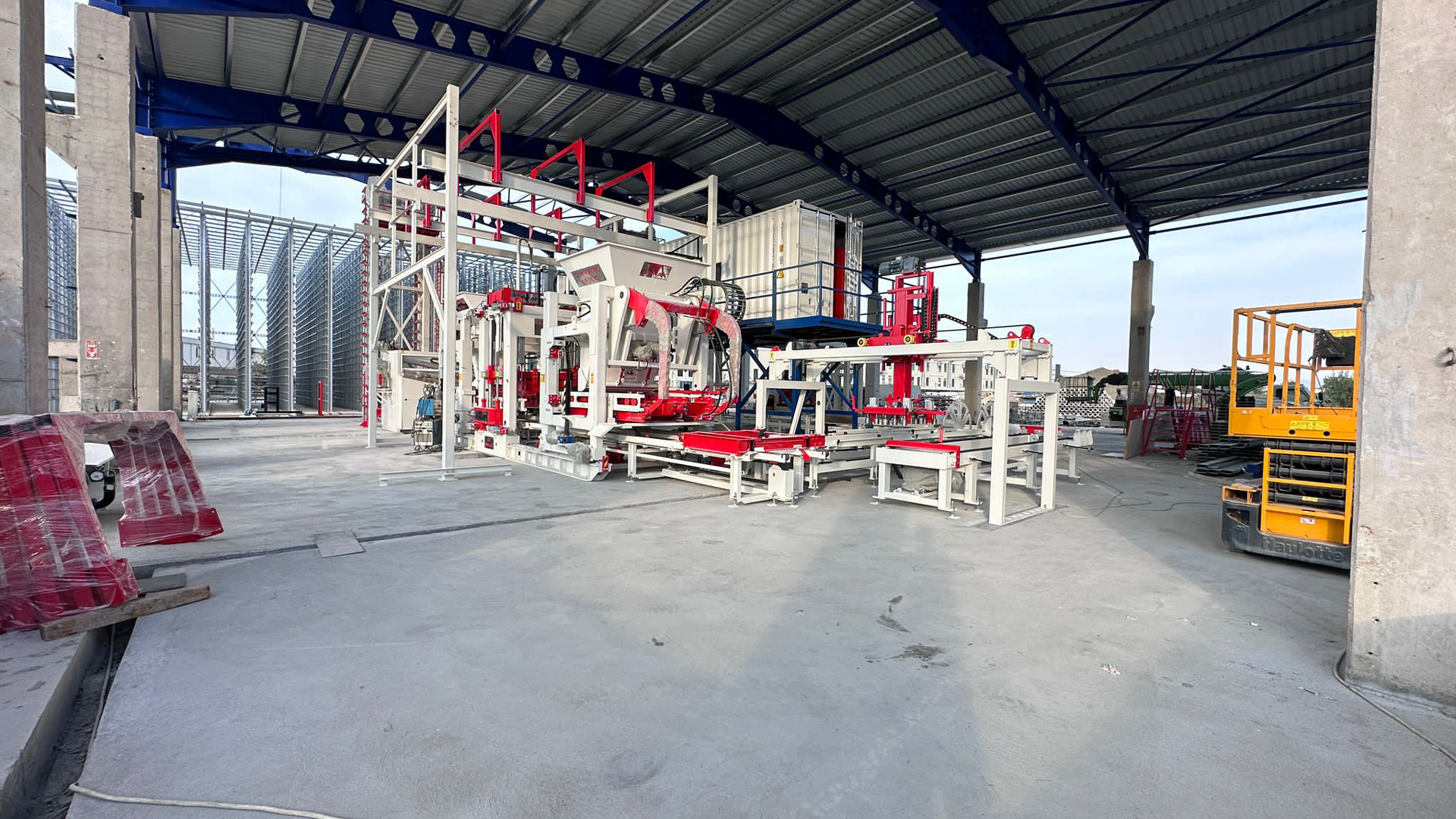
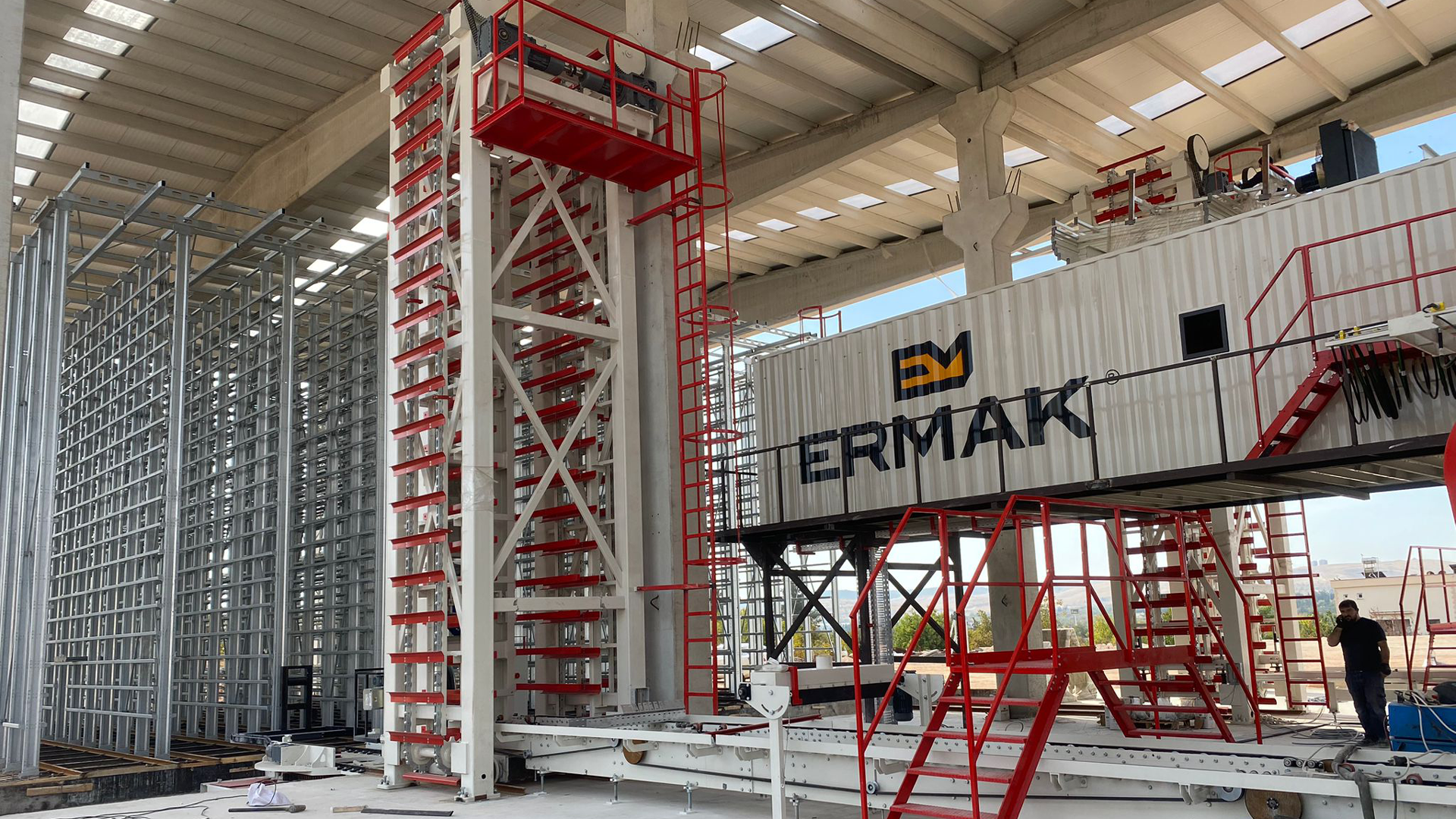
Ermak’s current plant-planning guidance similarly emphasizes that a concrete block facility should be evaluated as a complete production system rather than as one machine. Batching, mixing, block production, curing and packaging must operate at compatible capacities if the factory is expected to perform efficiently.
The most effective cost-reduction strategy is therefore not:
“Find the cheapest component.”
It is:
“Reduce the cost of each saleable product without sacrificing quality or production reliability.”
What Makes Up the Operating Cost of a Concrete Block Plant?
Typical operating expenses include:
- Cement
- Aggregate
- Water
- Pigment and additives
- Electricity
- Labour
- Maintenance
- Spare parts
- Moulds
- Production pallets
- Hydraulic oil and filters
- Mixer wear parts
- Conveyor wear components
- Packaging material
- Forklift operation
- Product rejects
- Downtime
Some of these costs are easy to see.
For example:
- Electricity bill
- Cement invoices
- Salaries
Others are less obvious.
A one-hour machine stoppage may never appear as a line item called “downtime cost,” but the plant still loses:
- Production
- Labour time
- Delivery capacity
- Utilization
For this reason, cost reduction requires measuring both visible and hidden losses.
The Best Cost KPI: Cost per Saleable Product
A useful production KPI is:
Total operating cost ÷ Saleable production
For hollow blocks, this may be expressed as:
Cost per 1,000 saleable blocks
For paving stones:
Cost per saleable m²
This approach prevents one of the most common mistakes in industrial cost analysis.
Suppose two production settings are compared.
Setting A
- Production: 20,000 blocks
- Rejects: 1,000
- Saleable output: 19,000
Setting B
- Production: 19,500 blocks
- Rejects: 200
- Saleable output: 19,300
Setting A produces more gross units.
Setting B produces more saleable units.
A plant should therefore optimise saleable output, not simply machine cycles.
1. Cement Consumption Should Be Optimised First
In many concrete-product plants, cement is one of the most expensive raw-material components.
Even a small reduction in cement usage per cubic metre can become significant when multiplied across annual production.
However, cement should never be reduced blindly.
The correct target is:
The lowest cement content that consistently achieves the required product performance.
Reducing cement too aggressively can create:
- Lower strength
- Edge breakage
- Higher rejects
- Customer complaints
Using excessive cement creates the opposite problem:
- Product may meet requirements
- But production becomes unnecessarily expensive
The ideal mix should balance:
- Aggregate grading
- Cement
- Moisture
- Compaction
- Curing
2. Better Aggregate Grading Can Reduce Cement Demand
Poor aggregate grading creates additional void space inside the concrete.
These voids often require more cement paste to fill.
A better particle-size distribution can help smaller particles occupy the gaps between larger particles.
This can contribute to:
- Higher packing density
- Better compaction
- More consistent products
- Better use of cement
For this reason, raw-material optimisation should begin with:
- Sieve analysis
- Aggregate cleanliness
- Particle shape
- Moisture measurement
rather than simply increasing cement whenever product quality changes.
3. Moisture Control Can Prevent Expensive Recipe Drift
Aggregate moisture can change rapidly.
For example:
- Rain can increase sand moisture.
- Hot weather can dry exposed stock.
- Different stockpiles can behave differently.
If the batching system ignores this variation, the actual water content of the concrete can change even though the programmed recipe remains identical.
Too much water can cause:
- Product deformation
- Poor edges
- Mould sticking
Too little water can cause:
- Poor filling
- Longer vibration
- Porous surfaces
- Higher reject rates
The financial effect includes much more than water itself.
Incorrect moisture can increase:
- Cement adjustments
- Machine time
- Rejects
- Cleaning
- Operator intervention
Therefore, moisture measurement should be viewed as a cost-control tool.
4. Improve Compaction Before Increasing Cement
When product density or strength is insufficient, a common reaction is:
“Add more cement.”
That may work, but it can also be the most expensive solution.
Before increasing cement, evaluate:
- Concrete recipe
- Aggregate grading
- Mixing
- Moisture
- Mould filling
- Vibration
- Pressing
Ermak’s current turnkey guidance identifies vibration as influencing product density, surface quality, dimensional consistency and rejection rate.
Better compaction can help the existing concrete recipe perform more effectively.
Ermak also makes a manufacturer-specific claim for some VIBRO-180-equipped machines that customers have achieved lower cement consumption under certain production conditions. Any such saving should be validated with the actual product, materials and required standard rather than treated as a universal guarantee.
5. Reject Rate Is One of the Most Expensive Hidden Costs
Every rejected block has already consumed:
- Aggregate
- Cement
- Water
- Electricity
- Mixer capacity
- Machine time
- Labour
- Curing space
Suppose a plant produces:
20,000 blocks/day
At 5% rejects:
1,000 blocks/day
are lost.
At 2% rejects:
400 blocks/day
are lost.
Difference:
600 additional saleable blocks/day
Over 300 production days:
180,000 blocks/year
This is why reducing reject rate can have a larger economic effect than negotiating a small discount on spare parts.
6. Track Reject Causes, Not Only Reject Percentage
A plant should classify rejects.
Examples:
- Broken corners
- Incomplete filling
- Height variation
- Surface defects
- Colour variation
- Cracking
- Transport damage
Once causes are classified, corrective action becomes easier.
For example:
High incomplete-filling rejects
Investigate:
- Concrete moisture
- Feeding
- Aggregate grading
- Vibration
High dimensional rejects
Investigate:
- Mould wear
- Tamper alignment
- Production pallets
- Machine settings
Without classification, management only sees:
“Reject rate = 4%”
but does not know what to improve.
7. Energy Cost Should Be Measured per Saleable Product
A high-capacity plant may consume more total electricity but still operate more efficiently per product.
For example:
Plant A
- 700 kWh/shift
- 10,000 saleable blocks
70 kWh / 1,000 blocks
Plant B
- 1,200 kWh/shift
- 20,000 saleable blocks
60 kWh / 1,000 blocks
Plant B uses more electricity overall.
But its energy cost per product is lower.
This is why machine comparisons should not be made from installed kW alone.
8. Reduce Idle Running
One of the simplest efficiency opportunities is reducing equipment operation while no product is being produced.
Examples include:
- Empty conveyors running
- Block machine waiting for concrete
- Mixer waiting for downstream equipment
- Compressor running against air leaks
- Packaging equipment operating during upstream stoppages
Automation can help equipment operate on demand rather than continuously.
This reduces:
- Electricity
- Wear
- Maintenance hours
The principle is simple:
A motor that produces nothing should not run unless the process requires it.
9. Match the Batching Plant to the Block Machine
A batching plant that is too small creates waiting time.
A batching plant that is dramatically oversized may operate inefficiently at low loads.
Ermak’s current concrete batching plant page states that the company manufactures its own Milano Mixer systems and can use either standard automation or project-specific control software.
The plant should be sized according to actual concrete demand.
If the block machine requires:
25 m³/hour
but the batching system can sustainably produce only:
18 m³/hour
the block machine will wait.
Every waiting minute increases cost per product.
10. Optimise Mixer Batch Size
Running a large mixer continuously with very small batches can increase energy cost per cubic metre.
Suppose a mixer is designed to produce:
1.0 m³ net/batch
but regularly operates at:
0.5 m³/batch
More cycles may be required to produce the same total concrete volume.
This increases:
- Motor operating time
- Discharge cycles
- Wear
Batch size should therefore match:
- Main machine demand
- Recipe size
- Production schedule
11. Do Not Overmix Concrete
Concrete must be mixed long enough to become homogeneous.
But unnecessary mixing time increases:
- Electricity consumption
- Mixer wear
- Concrete waiting time
- Total batch cycle
If the correct mix is achieved in 60 seconds, running for 100 seconds simply because “longer must be better” may be wasteful.
Mixing time should be established through:
- Quality checks
- Production trials
- Consistency measurements
The target is:
Sufficient mixing, not maximum mixing time.
12. Mixer Wear Components Affect Operating Cost
Mixer blades and wear liners gradually deteriorate.
When heavily worn:
- Mixing efficiency may fall.
- Mixing time may increase.
- Concrete homogeneity may worsen.
This can indirectly increase:
- Energy use
- Rejects
- Cement adjustments
Ermak identifies the mixer as one of the most important elements of its concrete batching plants and uses Milano Mixers in those systems.
Therefore, mixer maintenance should be considered part of raw-material cost control.
13. Use the Correct Machine Capacity
An oversized block machine may create unnecessary capital and operating costs if the market cannot utilise its output.
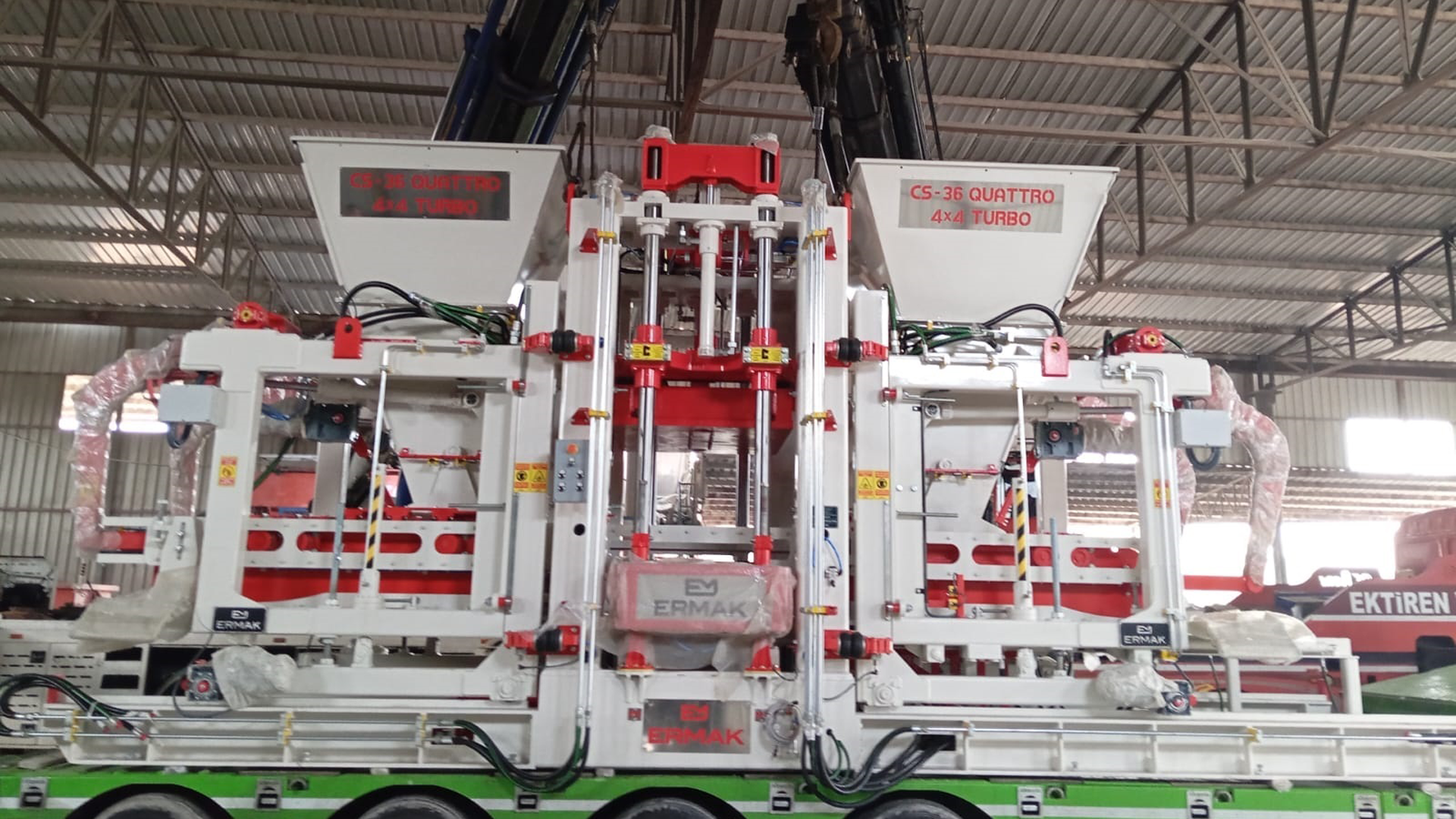
Ermak currently lists different production classes, for example:
- CS-25 Power Plus: 10,000–12,000 standard blocks/8 hours
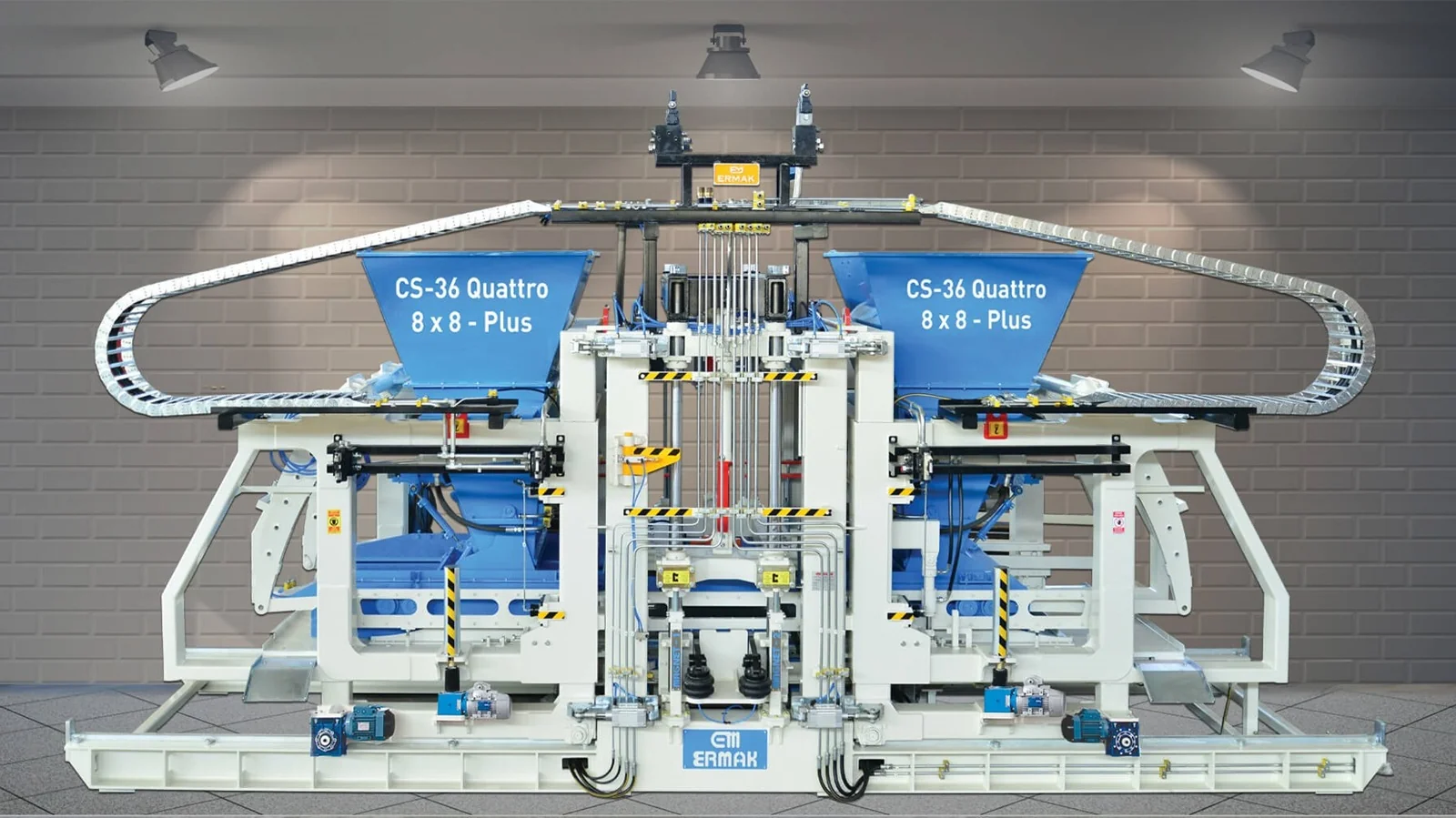
- CS-36 Quattro 8X8 Plus: 16,000–20,000/8 hours
- CS-42 Quattro 8X8 Plus: 25,000–30,000/8 hours
The correct machine is not necessarily the largest.
If the market needs only:
8,000 blocks/day
a 30,000-block system may carry unnecessary:
- Depreciation
- Electrical infrastructure
- Pallet inventory
- Curing capacity
- Maintenance cost
Capacity should match realistic demand plus a reasonable growth margin.
14. Improve Capacity Utilization
Operating a production line at very low utilization can increase cost per product.
Many fixed operating expenses continue even when output is low.
Examples:
- Operators
- Maintenance staff
- Facility overhead
- Compressors
- Electrical systems
Suppose one plant operates at:
35% of potential capacity
and another at:
80%
The second plant may distribute many fixed costs over a much larger quantity of products.
This is why sales planning and production planning are closely connected.
15. Reduce Mould Change Time
Mould change is non-productive time.
During the change:
- Main production stops.
- Employees are occupied.
- Some auxiliary equipment may remain active.
Ermak currently states that certain Quattro 8X8 Plus configurations can begin production with a new mould within approximately 15 minutes using a fully automatic mould-change system.
If another process takes 60 minutes, saving 45 minutes per change can become significant when product changes are frequent.
16. Group Production Runs
Frequent small-batch production increases:
- Mould changes
- Recipe changes
- Pigment cleaning
- Machine setup
- Quality checks
Where commercially possible, similar products should be grouped.
For example:
- Produce several grey products consecutively.
- Group coloured products.
- Schedule similar mould families together.
This reduces non-productive transitions.
17. Reduce Labour Cost Through Process Design
Reducing labour cost does not necessarily mean reducing staff.
A better approach is increasing output per labour hour.
Useful KPI:
Saleable products ÷ Total labour hours
For example:
Plant A
- 20,000 saleable blocks
- 10 workers × 8 hours
= 250 blocks/labour hour
Plant B
- 20,000 saleable blocks
- 5 workers × 8 hours
= 500 blocks/labour hour
Automation can improve this metric when applied to repetitive handling operations.
18. Automate the Right Operations
Automation may be useful for:
- Pallet transfer
- Wet-side handling
- Curing transfer
- Dry-side handling
- Cubing
- Packaging
Ermak describes one CS-36 Quattro system as fully automatic and states that the main machine can operate with one operator, with four workers for the complete facility in the stated configuration. This is a specific manufacturer claim for that installation concept and should not be applied universally.
The key lesson is:
Automation should be evaluated by labour savings, capacity improvement and quality consistency — not by appearance.
19. Avoid Over-Automation
More automation also means:
- More motors
- More sensors
- More drives
- More maintenance points
- More technical complexity
If labour is inexpensive and production volume is low, some automation may have a long payback period.
The right decision depends on:
- Local wage rates
- Production volume
- Technical staff availability
- Number of shifts
Technology should solve an economic problem.
20. Preventive Maintenance Is Cheaper Than Emergency Downtime
Ermak’s current after-sales guidance emphasizes preventive maintenance over waiting for failure, and recommends daily, weekly and periodic inspection routines.
Preventive maintenance can include:
- Lubrication
- Hydraulic inspection
- Filter replacement
- Sensor cleaning
- Conveyor alignment
- Chain inspection
- Vibration-system checks
- Electrical cabinet inspection
The goal is to identify deterioration before it becomes a complete line stoppage.
21. Downtime Should Be Measured in Money
Suppose a production line generates:
€700 contribution margin per operating hour
and suffers a:
10-hour breakdown
Production contribution lost:
€7,000
If the failure could have been prevented with a €300 spare part, the economic logic becomes obvious.
This is why maintenance decisions should not be based solely on spare-part price.
22. Track MTBF and MTTR
Two useful maintenance KPIs are:
MTBF — Mean Time Between Failures
Higher MTBF means failures occur less frequently.
MTTR — Mean Time To Repair
Lower MTTR means the plant returns to production faster.
Operating cost improves when:
- Failures are less frequent.
- Repairs are faster.
Ermak’s after-sales guidance emphasizes spare-parts availability, technical documentation and diagnostics as important tools for reducing downtime.
23. Keep Critical Spare Parts in Stock
Not every component should be stored locally.
Criticality can be evaluated as:
Failure probability × Production impact × Delivery time
Typical critical categories may include:
- Sensors
- Hydraulic filters
- Hydraulic seals
- Bearings
- Relays
- Contactors
- Vibration components
- Conveyor parts
A low-cost sensor that takes two weeks to obtain can create a much larger cost than its purchase price.
24. Spare Parts Availability Matters More Than Small Price Differences
Suppose:
Part A
- Price: €450
- Delivery: next day
Part B
- Price: €300
- Delivery: 15 days
If either part stops the entire plant, the cheaper part may be operationally more expensive.
Ermak’s current after-sales content makes the same point: spare parts should be assessed by availability and lead time as well as price.
25. Monitor Mould Wear Before Rejects Rise
Moulds affect:
- Dimensions
- Surface geometry
- Product edges
- Number of products per cycle
Worn moulds can gradually increase rejects.
The dangerous part is that deterioration may be slow.
Production continues, but:
- Product dimensions drift.
- Edge quality worsens.
- Customer complaints rise.
Regular dimensional inspection can identify mould wear earlier.
26. Extend Mould Life Through Correct Use
Mould life depends on:
- Aggregate abrasiveness
- Cleaning
- Machine alignment
- Vibration
- Maintenance
- Storage
Good mould management includes:
- Cleaning after production
- Correct lifting
- Proper storage
- Regular inspection
- Avoiding mechanical damage during changeover
The cheapest mould is not necessarily the lowest-cost mould.
Cost should be evaluated as:
Mould cost ÷ Saleable products produced during its service life
27. Production Pallet Condition Affects Cost
A damaged pallet can cause:
- Height variation
- Poor vibration transfer
- Conveying problems
- Rejects
Ermak’s current after-sales guidance specifically identifies production-pallet condition as a factor that can affect product height, vibration transfer and handling.
Replacing damaged pallets at the correct time can therefore reduce quality losses.
28. Do Not Replace Pallets Too Early Either
Cost control works in both directions.
Replacing a functional pallet unnecessarily wastes money.
Pallets should be evaluated using:
- Flatness
- Thickness
- Surface condition
- Structural integrity
rather than age alone.
Condition-based decisions are often more economical than arbitrary replacement.
29. Use Quality Control as a Cost-Reduction Tool
Quality control is often treated as a final inspection.
It is more valuable when used as a process-control system.
Track:
- Product weight
- Height
- Dimensions
- Surface defects
- Reject rate
- Strength
- Water absorption
Changes can provide early warnings.
For example:
Product weight gradually falling
may indicate:
- Feeding changes
- Moisture changes
- Recipe drift
Correcting the process early prevents larger losses.
30. Track Cement Consumption per 1,000 Products
Instead of monitoring total cement tonnes only, calculate:
kg cement / 1,000 saleable blocks
This helps separate:
- Production-volume changes
- Recipe-efficiency changes
For example:
Month A
- 100 tonnes cement
- 500,000 saleable blocks
= 200 kg / 1,000 blocks
Month B
- 105 tonnes cement
- 550,000 blocks
≈ 191 kg / 1,000 blocks
Month B uses more cement overall but is more efficient per product.
31. Track Energy per 1,000 Products
Use the same method for electricity.
Recommended KPI:
kWh / 1,000 saleable blocks
or:
kWh / m² saleable paver
This allows management to detect:
- Mechanical deterioration
- More idle running
- Increased reject rate
- Inefficient scheduling
even when electricity tariffs change.
32. Track Labour per 1,000 Products
Another useful KPI is:
Labour hours / 1,000 saleable products
This reveals whether:
- Automation works
- Staffing is balanced
- Production planning is effective
Labour cost should be measured relative to output, not simply total payroll.
33. Track Maintenance Cost per Production Unit
Annual spare-parts cost alone can be misleading.
A higher-capacity plant naturally may spend more on maintenance.
A more useful metric is:
Maintenance cost / 1,000 saleable products
This creates fairer year-to-year comparisons.
34. Reduce Compressed-Air Leaks
Compressed air is frequently an overlooked operating expense.
Leaks in:
- Hoses
- Fittings
- Pneumatic valves
cause compressors to run longer.
The plant pays for electricity to produce air that performs no useful work.
Periodic leak inspection is therefore a simple cost-reduction measure.
35. Avoid Excessive Compressed-Air Pressure
Operating air pressure should follow equipment requirements.
Producing more pressure than necessary may increase compressor energy consumption.
The solution is not simply lowering plant pressure arbitrarily.
The correct process is:
- Verify equipment requirements.
- Measure actual pressure at use points.
- Correct excessive pressure drop.
- Optimise compressor settings safely.
36. Conveyor Maintenance Can Reduce Energy and Downtime
Misaligned belts and damaged bearings create friction.
This can increase:
- Motor load
- Electricity consumption
- Wear
- Breakdown risk
Conveyor maintenance should include:
- Belt alignment
- Chain tension
- Bearing condition
- Rollers
Ermak’s after-sales guidance includes conveyor alignment and chain tension among recommended maintenance areas.
37. Packaging Should Match Production Capacity
If a plant manufactures:
25,000 blocks per shift
but packages only:
18,000
finished product will accumulate.
Eventually:
- Production pallets are not returned.
- Curing areas fill.
- Main production slows.
Ermak’s plant-planning guidance emphasises that downstream packaging should match upstream production capacity.
Cost reduction therefore requires balancing the whole line.
38. Internal Logistics Should Be Designed to Minimise Handling
Every unnecessary forklift movement costs:
- Labour
- Fuel or electricity
- Time
- Equipment wear
A poor factory layout may move the same product several times before shipment.
A better layout creates a logical flow:
Raw materials → batching → block machine → curing → packaging → storage → shipping
Each unnecessary movement should be questioned.
39. Finished Product Storage Should Not Become a Hidden Cost
Excess production creates inventory.
Inventory requires:
- Storage area
- Forklift handling
- Working capital
- Damage risk
This is why running a high-capacity machine continuously does not automatically maximise profit.
Production should follow:
- Sales demand
- Delivery schedule
- Seasonal stock requirements
not simply available machine capacity.
40. Reduce Working Capital Tied Up in Raw Materials
Oversized stocks of:
- Cement
- Aggregate
- Pigment
- Spare parts
tie up capital.
But insufficient stock risks production stoppage.
The objective is not minimum inventory.
It is optimal inventory.
For critical items, calculate:
- Daily usage
- Supplier lead time
- Safety stock
A reliable supply strategy can reduce both emergency purchases and excessive warehouse inventory.
41. Standardise Recipes
Operators should not independently adjust raw material quantities every shift.
Approved recipes should ideally be stored in plant automation.
Ermak states that its batching plants can use standard automation or project-specific software.
Standardised recipes improve:
- Cement control
- Moisture management
- Product consistency
- Traceability
This reduces expensive “operator-to-operator” variation.
42. Standardise Machine Parameters
The same logic applies to:
- Filling time
- Vibration
- Pressing
- Product height
Product-specific settings should be documented.
This reduces setup time after mould changes and helps maintain consistent output.
43. Train Operators to Detect Abnormal Conditions Early
An experienced operator can identify:
- New mechanical noises
- Hydraulic temperature changes
- Increasing sensor faults
- Product quality drift
before a complete breakdown occurs.
Ermak’s current after-sales guidance treats operator and maintenance training as separate but essential parts of machine reliability.
Training cost is usually much smaller than repeated emergency downtime.
44. Do Not Use Cheap Components That Increase Failure Risk
Cost reduction does not mean buying the cheapest:
- Bearing
- Sensor
- Hydraulic seal
- Filter
available.
A low-quality component may have:
- Shorter service life
- Poor tolerance
- Lower reliability
If it stops production repeatedly, the total cost becomes much higher.
For critical parts, evaluate:
Purchase price + expected life + downtime risk
45. Plan Maintenance During Low-Demand Periods
Ermak’s after-sales guidance recommends connecting major maintenance activities with the production calendar, using lower-demand periods where possible.
This can include:
- Hydraulic service
- Mould refurbishment
- Mixer wear-part replacement
- Conveyor overhaul
- Electrical inspection
The factory still experiences maintenance downtime.
But it happens when the commercial impact is lower.
46. Optimise Product Mix
Not every product generates the same margin.
One product may have:
- High production speed
- Low cement consumption
- Strong demand
Another may require:
- Frequent mould changes
- More pigment
- Lower production rate
Cost accounting should therefore analyse profitability by product.
The highest selling price does not automatically mean the highest profit per machine hour.
47. Calculate Contribution per Machine Hour
A useful strategic KPI is:
Contribution margin generated per production hour
For example:
Product A
- 2,500 blocks/hour
- €0.10 contribution/block
= €250/hour
Product B
- 1,800 blocks/hour
- €0.18 contribution/block
= €324/hour
Product B has lower capacity but higher economic output per machine hour.
This can improve production scheduling decisions.
48. Calculate the Cost of Mould Changes
A mould change creates:
- Lost machine time
- Labour
- Lifting equipment use
- Trial production
- Possible rejects during setup
If one mould change costs the plant:
45 minutes
and gross contribution is:
€500/hour
the production opportunity cost is approximately:
€375 per change
This makes quick-change technology more economically meaningful.
Ermak states that some Quattro systems can start production with a new mould within approximately 15 minutes.
49. Avoid Buying More Capacity Than the Market Can Use
Ermak’s current products range from approximately 10,000–12,000 standard blocks per eight hours on the CS-25 Power Plus to 25,000–30,000 on the CS-42 Quattro 8X8 Plus.
The higher-capacity machine may be excellent for one investor and economically unnecessary for another.
Unused capacity still requires:
- Capital
- Space
- Infrastructure
A plant should be designed around profitable demand.
50. Do Not Buy Too Little Capacity Either
Undersizing has its own costs.
If market demand requires 25,000 blocks/day but the machine produces 12,000:
- Additional shifts may be required.
- Labour increases.
- Maintenance hours increase.
- Delivery pressure rises.
A correctly sized machine can reduce total operating cost even if its initial purchase price is higher.
51. Evaluate Total Cost of Ownership Before Purchase
Purchase price is only one cost.
A proper machine comparison should include:
- Energy
- Labour
- Maintenance
- Spare parts
- Mould costs
- Pallet costs
- Reject rate
- Downtime
- Expected production
Ermak’s current after-sales content makes the same broader point: long-term value depends on reliability, spare parts and service as well as initial machine specifications.
52. A Simple Operating Cost Model
A plant can begin with:
Total operating cost = Raw materials + Energy + Labour + Maintenance + Packaging + Reject losses + Downtime losses
Then calculate:
Unit operating cost = Total operating cost ÷ Saleable production
This number can be tracked:
- Daily
- Monthly
- By product
- By mould
- By shift
The objective should be gradual improvement.
53. Build a Monthly Cost Dashboard
A useful management dashboard may contain:
| KPI |
Month 1 |
Month 2 |
Month 3 |
| Saleable blocks |
500,000 |
530,000 |
550,000 |
| Reject rate |
4.0% |
3.1% |
2.4% |
| Cement / 1,000 blocks |
205 kg |
198 kg |
194 kg |
| kWh / 1,000 blocks |
66 |
62 |
59 |
| Labour hours / 1,000 blocks |
0.17 |
0.15 |
0.14 |
| Unplanned downtime |
14 h |
9 h |
6 h |
Even if total monthly expenses increase because production rises, unit efficiency may improve significantly.
54. Focus on the Largest Cost First
Do not implement 30 small improvement projects without knowing which cost matters most.
First calculate the cost structure.
Example:
- Cement: 38%
- Labour: 20%
- Energy: 12%
- Maintenance: 8%
- Rejects: 7%
- Other: 15%
In this hypothetical plant, a 5% improvement in cement efficiency may be more valuable than a 20% reduction in office lighting.
Priority should follow economic impact.
55. Do Not Reduce Costs by Sacrificing Quality
This is the most important rule.
Reducing:
- Cement below required levels
- Vibration time excessively
- Maintenance
- Quality inspection
may reduce today’s expense but increase tomorrow’s:
- Rejects
- Complaints
- Warranty claims
- Breakdown costs
Cost reduction must protect:
- Product standards
- Safety
- Reliability
The goal is efficiency, not simply lower spending.
56. Ermak Machines and Operating-Cost Planning
Ermak’s current portfolio offers different machine capacity classes, allowing the plant configuration to be matched more closely to target production.
For example:
CS-36 Quattro 8X8 Plus
Current specifications include:
- 16,000–20,000 standard blocks/8 hours
- 1,400–1,600 m² pavers/8 hours
- 140 kW hydraulic power
- 1150 × 1400 mm-class production pallet
CS-42 Quattro 8X8 Plus
Current specifications include:
- 25,000–30,000 standard blocks/8 hours
- 1,500–1,800 m² pavers/8 hours
- 140 kW hydraulic power
- 1350 × 1400 mm-class pallet
These figures show why operating-cost analysis should not be based on hydraulic kW alone.
The CS-36 and CS-42 may have the same published hydraulic power figure while operating with different:
- Pallet sizes
- Mould configurations
- Production capacities
The correct comparison is based on:
Cost per saleable unit
not one isolated technical specification.
Operating Cost Reduction Checklist
A concrete block plant aiming to lower operating costs should ask:
- Is cement consumption measured per product?
- Is aggregate grading controlled?
- Is aggregate moisture measured?
- Is reject rate tracked by cause?
- Is energy measured per 1,000 saleable products?
- Is labour productivity measured?
- Is the mixer operating efficiently?
- Is mixing time optimised?
- Does batching capacity match the block machine?
- Are machines running unnecessarily while idle?
- Are mould changes taking too long?
- Are production runs unnecessarily fragmented?
- Is automation reducing real costs?
- Are vibration settings optimised?
- Are moulds inspected for wear?
- Are damaged production pallets removed?
- Is preventive maintenance scheduled?
- Are MTBF and MTTR improving?
- Are critical spare parts stocked?
- Are compressed-air leaks checked?
- Are conveyors maintained?
- Is packaging keeping up with production?
- Is internal forklift movement minimised?
- Is excess finished inventory accumulating?
- Is actual unit cost tracked by product?
The Lowest-Cost Plant Is Not the Cheapest Plant
A low-cost concrete block factory is not necessarily a factory with:
- The cheapest machine
- The fewest workers
- The lowest electricity bill
- The lowest cement content
It is a factory that converts raw materials into saleable products with minimum total waste.
That means:
- Low rejects
- Efficient cement use
- Efficient energy use
- High machine availability
- Appropriate labour productivity
- Controlled maintenance
- Balanced plant capacity
Ermak’s current production and service materials support this broader systems approach: machine capacity, batching, mixing, vibration, maintenance and after-sales support are treated as interconnected elements rather than isolated components.
For investors planning a new concrete block plant, operating-cost reduction should begin before the machinery is ordered.
Capacity should be matched to demand.
The batching system should be matched to the machine.
Automation should be selected according to actual labour economics.
Maintenance and spare parts should be planned before production starts.
Because the most effective time to reduce operating cost is not after the factory has become expensive to run.
It is during the design of the factory itself.
For information about Ermak concrete block machines, batching plants, Milano Mixers, moulds and complete production-line configurations, investors can evaluate the appropriate system according to target products, daily production and long-term operating-cost objectives.
Frequently Asked Questions
What is the biggest operating cost in concrete block production?
It varies by country and product, but raw materials — especially cement — are often among the most significant cost elements. Labour, energy, rejects, maintenance and downtime can also have a major effect.
How can cement consumption be reduced safely?
Start by optimising aggregate grading, moisture, mixing, vibration and compaction. Cement should only be reduced after testing confirms that the finished product still meets required performance standards.
Does better vibration reduce operating costs?
It can contribute by improving compaction consistency, reducing rejects and supporting recipe optimisation. Ermak’s current production guidance identifies vibration as affecting density, surface quality and rejection rate.
How can a concrete block plant reduce electricity cost?
Measure kWh per saleable product, reduce idle running, optimise mixer and vibration times, maintain hydraulic and conveyor systems and match production equipment capacities.
Is a fully automatic plant cheaper to operate?
Not always. Automation can reduce labour and improve production consistency, but it also adds equipment and maintenance complexity. The economic result depends on production volume, local labour costs and utilization.
How does reject rate affect cost?
A rejected product has already consumed material, energy, machine time and labour. Reducing reject rate directly increases saleable output from the same operating resources.
How does preventive maintenance reduce operating costs?
It can reduce breakdown frequency and downtime. Ermak’s current after-sales guidance recommends preventive maintenance routines rather than waiting for complete component failure.
Which spare parts should a block plant keep in stock?
The exact list depends on the machine. Critical sensors, hydraulic components, filters, bearings, electrical components and vibration-system parts may be considered based on failure risk, production impact and delivery lead time.
Why does machine utilization matter?
A large portion of labour, maintenance and facility overhead continues even at low production. Higher appropriate utilization spreads these costs across more products.
Does a higher-capacity machine always have lower operating cost?
No. It may be more efficient per product, but only if the plant can utilise the capacity. Oversized equipment can increase capital and operating requirements without increasing revenue.
Can mould change time affect operating cost?
Yes. Mould changes create non-productive time. Ermak states that certain Quattro systems can begin production with a new mould within approximately 15 minutes under the stated configuration.
How should energy efficiency be compared between two block machines?
Use kWh per 1,000 saleable blocks or kWh per saleable m² of pavers, rather than comparing installed kW alone.
What KPI should management monitor most closely?
A strong top-level KPI is total operating cost per saleable unit. It can then be supported by cement consumption, energy, labour, reject rate, downtime and maintenance KPIs.
Why is plant balancing important for operating cost?
If batching, mixing, curing or packaging is slower than the block machine, equipment spends time waiting. Ermak’s turnkey plant guidance emphasizes matching these systems around the same production target.
What is the most important principle for reducing block plant operating costs?
Do not optimise one cost in isolation. Reduce total cost per saleable product while maintaining required quality, safety and production reliability.