Consistent quality is one...
One of the first questions investors ask when evaluating a concrete block machine is:
“How many blocks can this machine produce per day?”
The question appears simple, but a reliable answer requires more than reading a capacity figure from a machine catalogue.
Concrete block machine output depends on several variables, including:
This means there is an important difference between:
Theoretical machine capacity
and
Actual saleable production capacity.
Theoretical capacity assumes that the machine operates continuously under ideal conditions.
Real production includes cleaning, maintenance, material changes, mould changes, operator interventions, quality checks and unexpected interruptions.
For an investor preparing a feasibility study, the second figure is much more important.
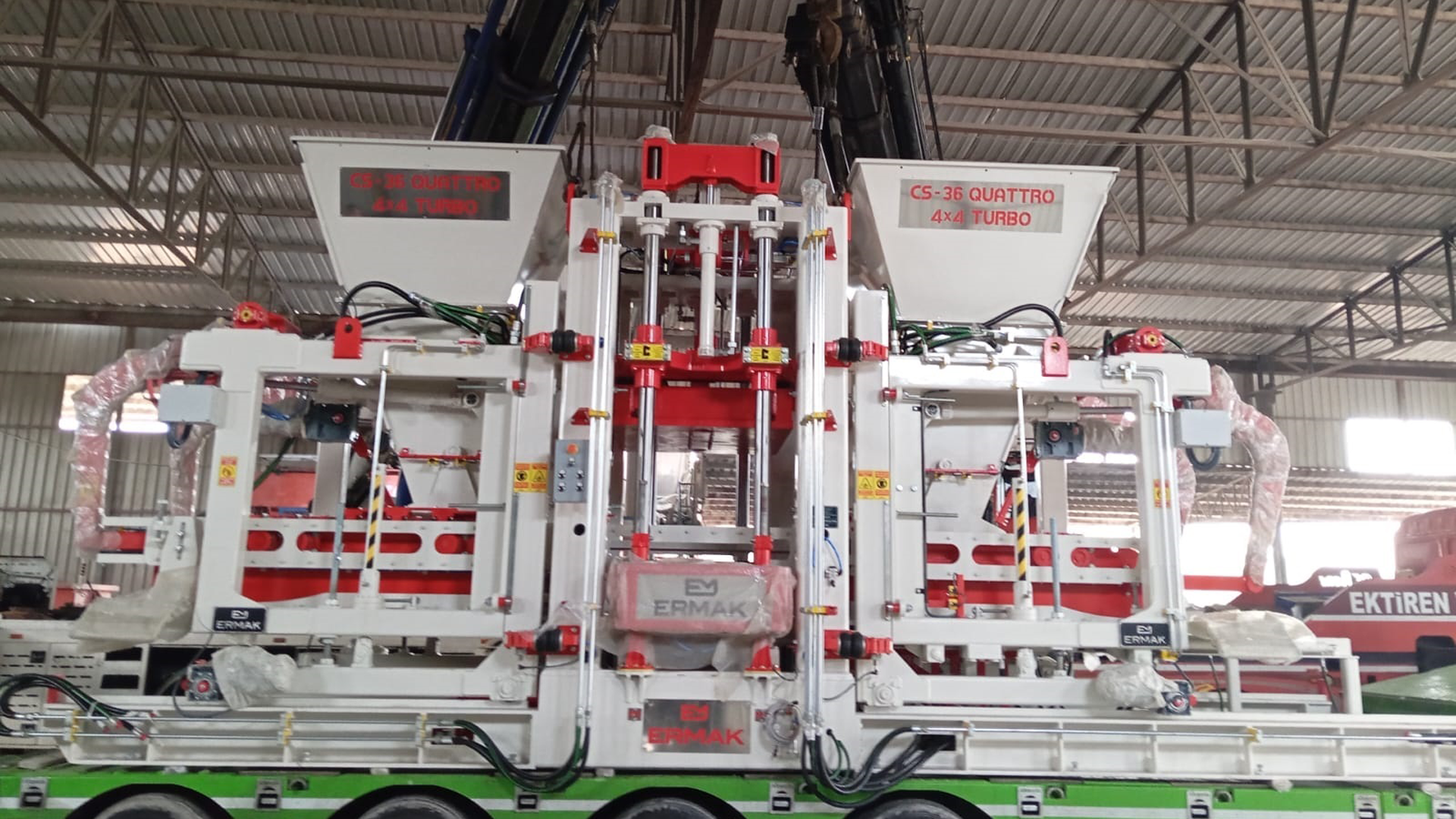
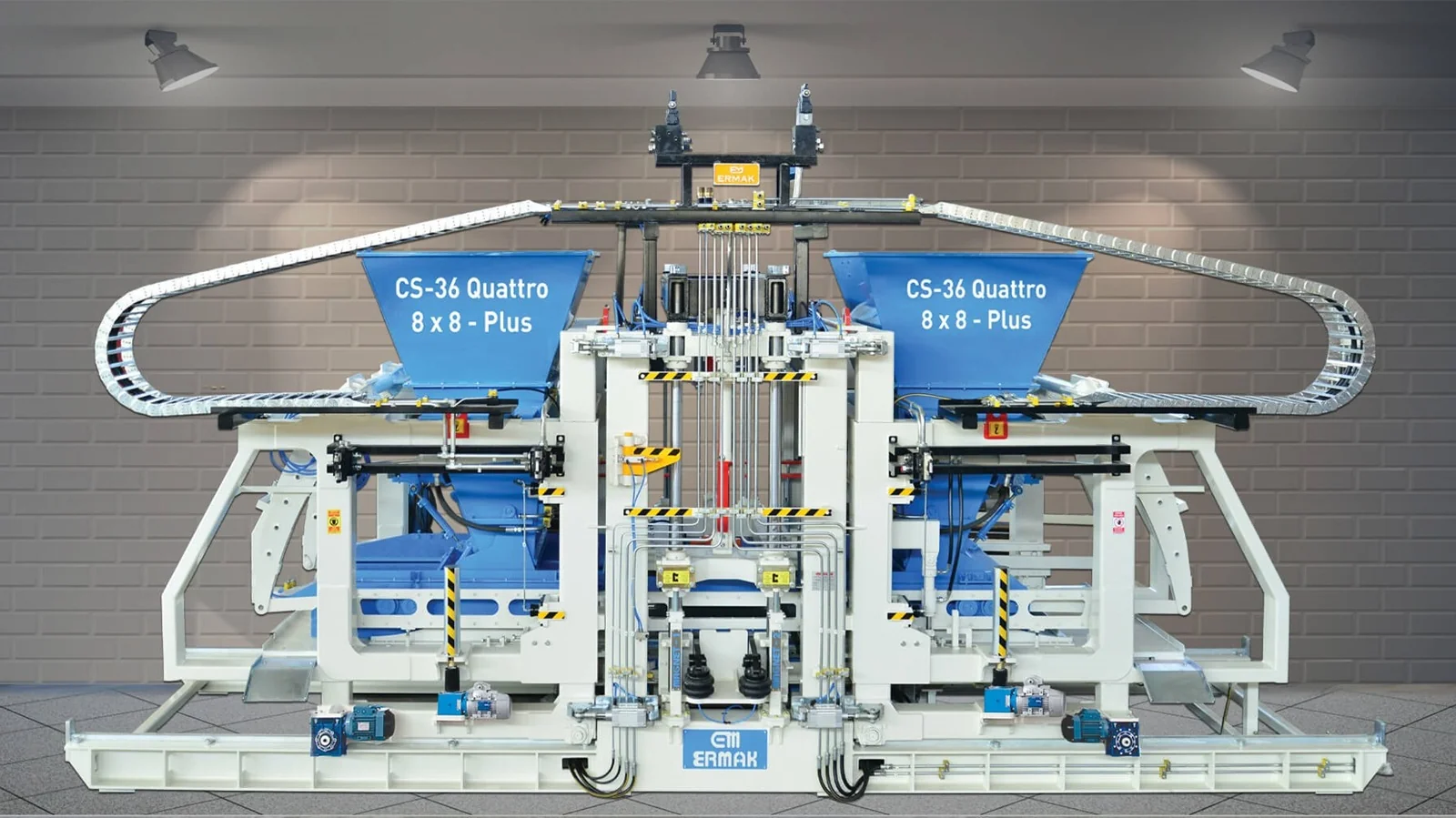
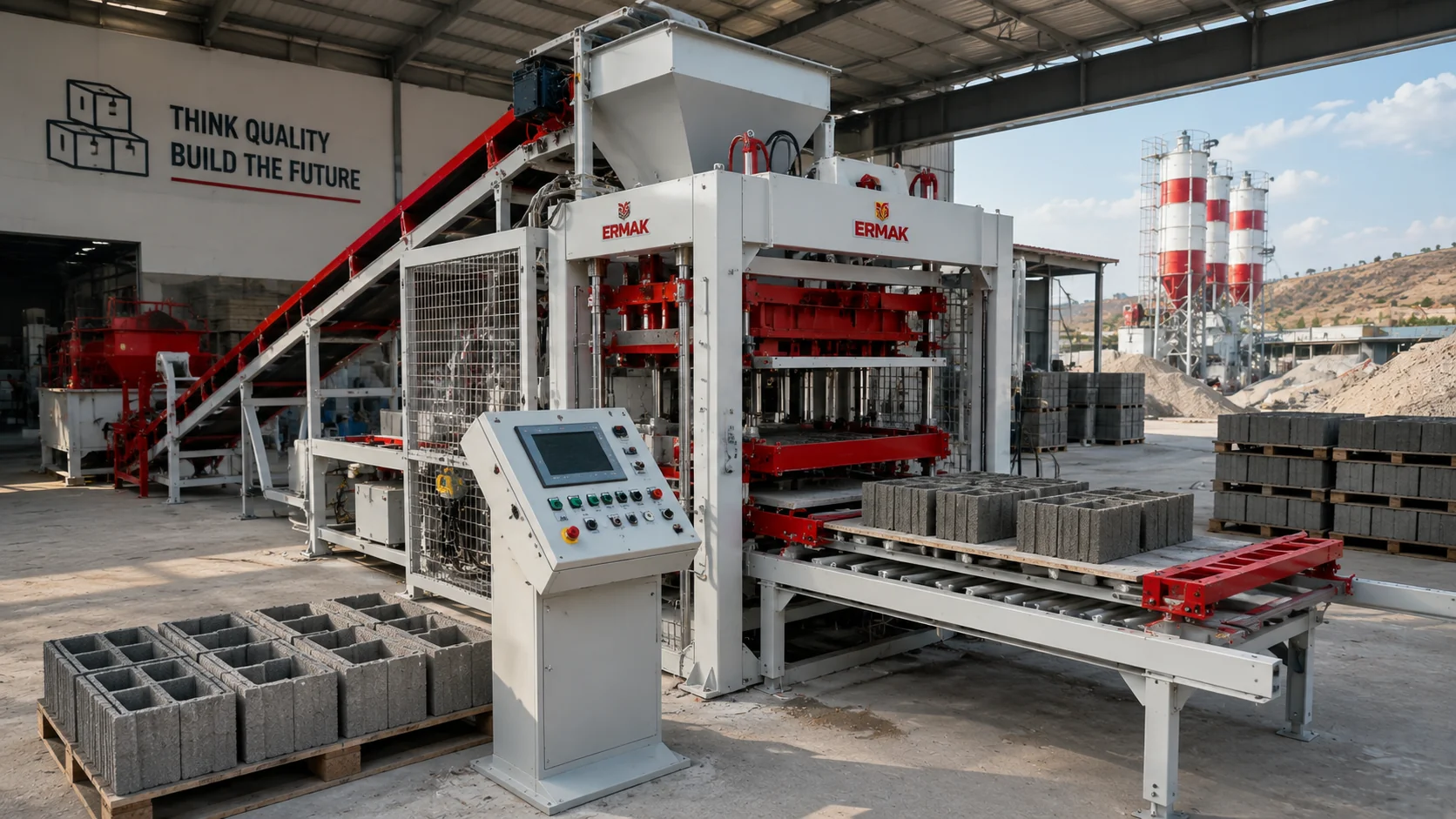
Ermak’s current product range demonstrates how capacity varies significantly by machine class. For standard 20 × 40 × 20 cm blocks, the CS-25 Power Plus is currently listed at approximately 10,000–12,000 pieces per eight hours, while the CS-36 Quattro 8X8 Plus is listed at 16,000–20,000 and the CS-42 Quattro 8X8 Plus at 25,000–30,000 pieces per eight hours.
So how should concrete block machine production capacity actually be calculated?
Concrete block machine capacity describes the quantity of a specific product that can be manufactured during a defined period.
For hollow blocks and similar products, capacity is commonly expressed as:
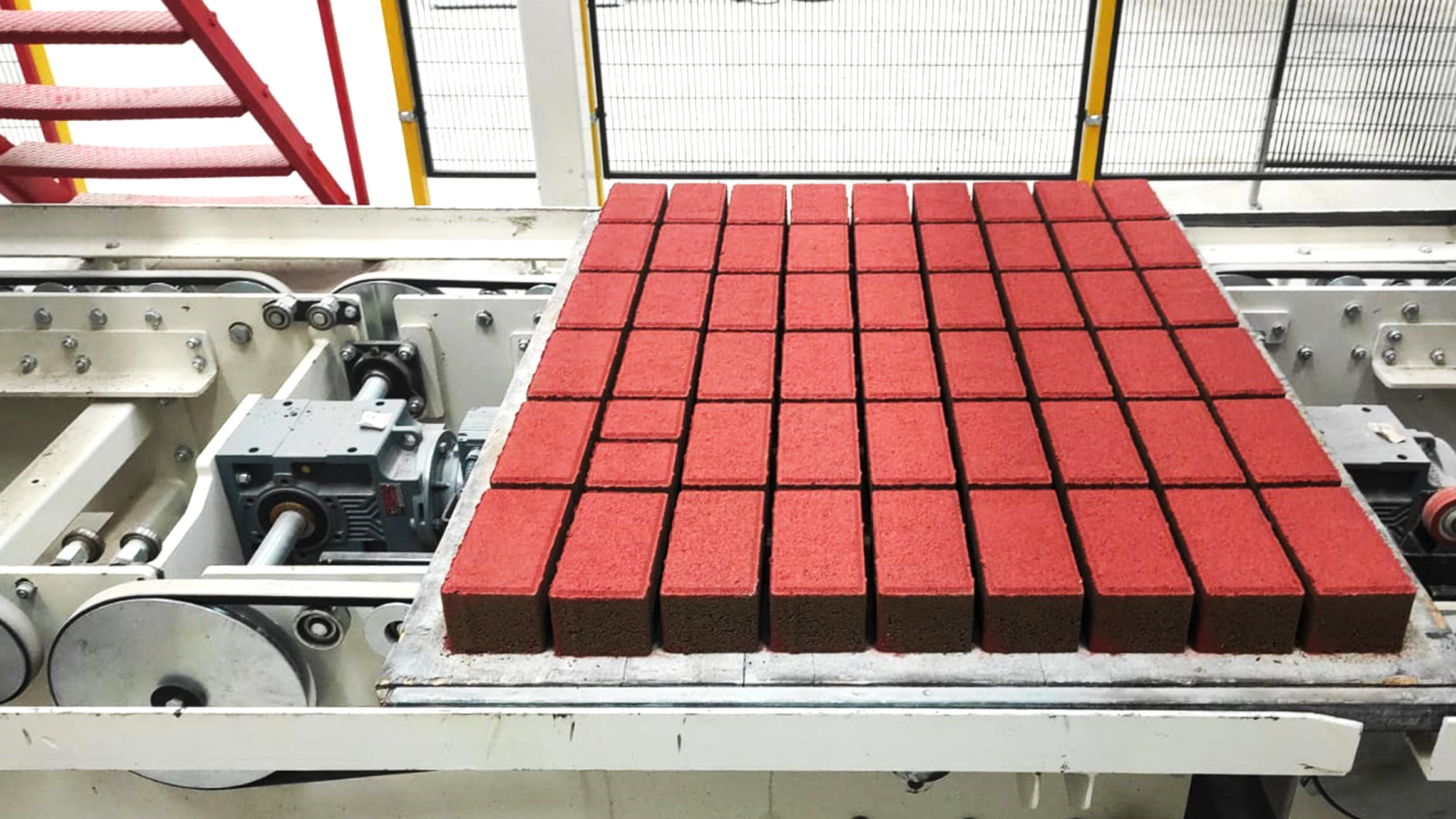
For paving stones, output is often expressed as:
This distinction is important.
A statement such as:
“The machine produces 25,000 pieces per shift.”
has limited value unless the supplier also specifies:
Ermak’s CS-42 Quattro 8X8 Plus, for example, is currently listed at 25,000–30,000 standard 20 × 40 × 20 cm blocks per eight hours and 1,500–1,800 m² of pavers per eight hours. The same machine uses a 1350 × 1400 mm-class production pallet.
This immediately shows why capacity must always be connected to a defined product.
The simplest theoretical calculation requires two main figures:
The basic formula is:
Hourly theoretical capacity = Products per cycle × Cycles per hour
Cycles per hour can be calculated as:
3,600 seconds ÷ Cycle time in seconds
For example, assume that a machine:
Theoretical cycles per hour:
3,600 ÷ 18 = 200 cycles/hour
Theoretical hourly output:
200 × 18 = 3,600 blocks/hour
For an eight-hour shift:
3,600 × 8 = 28,800 blocks
So the theoretical production capacity is:
28,800 blocks per eight hours
But this does not necessarily mean that the factory will ship 28,800 saleable blocks at the end of every shift.
That is where real capacity calculation begins.
A concrete block factory does not normally operate for eight hours without interruption.
Real production includes:
Assume the theoretical capacity is 28,800 blocks per shift.
If actual operating efficiency is 82%:
28,800 × 0.82 = 23,616 blocks
Now assume that 2% of the products are rejected during quality control:
23,616 × 0.98 = 23,144 saleable blocks
Theoretical production was:
28,800
but saleable production is approximately:
23,144
That difference can have a major impact on:
This is why feasibility studies should not simply multiply catalogue capacity by annual working days.
A more realistic formula can be written as:
Net saleable capacity = Theoretical capacity × Availability × Performance × Quality rate
This follows the general logic of Overall Equipment Effectiveness — OEE.
For example:
Calculation:
28,800 × 0.90 × 0.95 × 0.98
approximately equals:
24,130 saleable blocks
This calculation is far more useful for production planning than theoretical maximum output alone.
A production cycle includes more than vibration.
Depending on the machine design, one cycle may involve:
Even a small difference in cycle time can produce a large difference over a complete shift.
Assume both machines use a 12-cavity mould.
3,600 ÷ 15 = 240 cycles/hour
240 × 12 = 2,880 blocks/hour
3,600 ÷ 18 = 200 cycles/hour
200 × 12 = 2,400 blocks/hour
Difference:
480 blocks/hour
Over eight theoretical hours:
480 × 8 = 3,840 blocks
A difference of only three seconds per cycle can therefore represent thousands of products per shift.
A machine should not be evaluated according to cycle time alone.
Reducing cycle time may require shortening:
If these stages become too short, product quality may deteriorate.
This can increase:
For example:
Saleable output:
27,900 blocks
Saleable output:
26,730 blocks
The faster setting still wins in this simplified example, but the difference is much smaller than theoretical figures suggest.
Now include cement consumption, customer complaints, packaging losses and maintenance load, and the economic result may change again.
Therefore the correct objective is:
The highest sustainable saleable output, not simply the shortest possible cycle.
Two machines operating at the same cycle time can have completely different production capacities if their mould sizes differ.
Suppose:
Output:
2,400 blocks/hour
Output:
3,600 blocks/hour
The cycle time is identical.
The difference comes from the number of products that fit into one mould cycle.
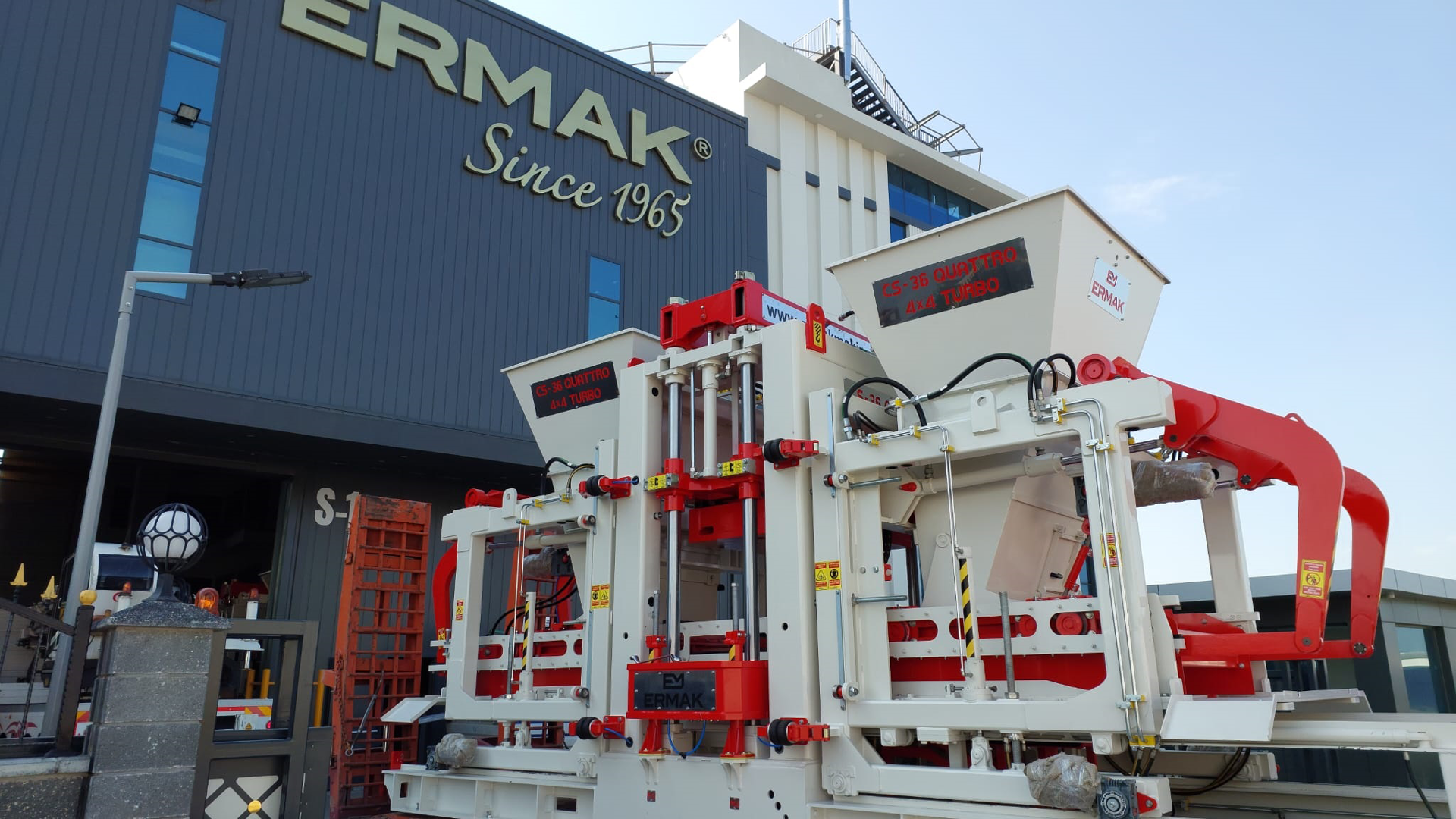
Ermak’s current CS-36 Quattro 8X8 Plus is described as a 12-block configuration, while the CS-42 Quattro 8X8 Plus is described as an 18-block configuration. Their published standard block capacities are respectively 16,000–20,000 and 25,000–30,000 pieces per eight hours.
This is why asking only for cycle time can produce a misleading comparison.
The production pallet defines the available working area below the mould.
A larger pallet can allow more product cavities per cycle, depending on product dimensions and mould design.
Ermak’s current product range provides a useful example:
| Machine | Production Pallet | Standard 20 × 40 × 20 Block Capacity |
|---|---|---|
| CS-25 Power Plus | 950 × 1300 mm | 10,000–12,000 pcs/8 h |
| CS-36 Quattro 8X8 Plus | 1150 × 1400 mm | 16,000–20,000 pcs/8 h |
| CS-42 Quattro 8X8 Plus | 1350 × 1400 mm | 25,000–30,000 pcs/8 h |
These values are currently listed in Ermak’s English product portfolio.
However, a larger pallet does not automatically guarantee better production economics.
Larger systems can require:
Pallet size should therefore be considered as part of the complete plant design.
A machine does not produce every concrete product at the same rate.
Product dimensions affect:
A 20 × 40 × 20 cm hollow block and a small paving stone cannot be compared using the same “pieces per hour” figure.
This is one reason paver capacity is often stated in square metres rather than pieces.
A machine may manufacture hundreds of small pavers per hour but fewer large blocks.
Therefore capacity comparison must always use the same product.
Taller products generally require more concrete and may require different:
Ermak’s CS-42 Quattro 8X8 Plus is currently specified for block production heights of 40–400 mm, while another CS-42 product description notes the ability to manufacture various products within a wider overall product range.
The important point is that a machine’s minimum and maximum production height do not mean every height will be produced at the same cycle time.
Before compaction begins, the mould must receive enough concrete.
If the feeding system is slow:
If feeding is too fast but uneven:
This can create differences in:
The feeding system therefore has to balance speed and uniformity.
This is especially important on large moulds where concrete must spread across a wide pallet area.
Vibration is part of the production cycle.
Its purpose is to compact relatively dry concrete inside the mould.
Shorter vibration can reduce cycle time, but insufficient vibration can increase rejects.
Longer vibration can improve compaction up to a point, but unnecessary vibration can:
Ermak’s Quattro 8X8 Plus uses its VIBRO-180 system, which the company currently specifies at 180 kN vibration force with automatic lubrication.
For production-capacity calculations, vibration should therefore be viewed not as an isolated technical specification but as part of the total effective cycle.
A factory manufacturing only one product all day may achieve a very different net capacity from a factory changing products several times per shift.
Every mould change can require:
Ermak states that the automatic mould-change system used on certain Quattro machines can allow production with the new mould to begin within a maximum of approximately 15 minutes under the stated conditions.
Why does this matter?
Assume an older process takes 60 minutes per mould change.
A faster system takes 15 minutes.
Time saved:
45 minutes per change
If a factory performs 20 changes per month:
45 × 20 = 900 minutes
or:
15 production hours
Those 15 hours can translate into a significant amount of annual output.
Even without changing the mould, changing products can require:
For example, a paver plant producing:
may lose considerably more production time than a factory producing one long batch.
This is why plant managers should distinguish between:
Machine capacity
and:
Production-schedule capacity.
The more fragmented the production schedule, the lower net output may become.
A concrete block machine cannot produce without concrete.
If the main machine requires more concrete than the batching plant can provide, the machine waits.
Assume:
The complete line cannot sustainably operate at 25 m³/hour equivalent production.
Its material supply is limited to approximately 19 m³/hour.
Ermak’s existing turnkey plant guidance makes the same point: batching, mixing, block production, curing and packaging should all be planned around compatible capacities.
This is one of the most important rules in plant engineering:
The slowest critical process sets the sustainable plant capacity.
Mixer capacity should not be calculated from nominal volume alone.
Assume a mixer produces:
and the complete batch cycle includes:
with a total time of 120 seconds.
Cycles per hour:
3,600 ÷ 120 = 30
Net hourly output:
30 × 1 = 30 m³/hour
Now assume the same mixer takes 150 seconds because loading and discharge are slow:
3,600 ÷ 150 = 24 batches/hour
Net capacity becomes:
24 m³/hour
The mixer nameplate did not change.
The real hourly output did.
This illustrates why machine and mixer cycle studies must be performed together.
Double-layer paving-stone production typically requires:
and potentially:
This can change the production cycle and material flow.
A machine that can achieve a certain output in single-layer block production may operate differently when producing coloured double-layer paving stones.
Product-specific capacity should therefore always be requested.
Production pallets circulate through the plant:
Block machine → Wet side → Curing → Dry side → Packaging → Pallet return → Block machine
If the plant does not have enough pallets, the machine can run out of empty pallets even when all equipment is mechanically functioning.
Required pallet quantity depends on:
For example, if:
a simplified minimum circulation requirement is:
120 × 10 = 1,200 pallets
Additional reserve may also be needed.
A shortage of production pallets can therefore become a capacity bottleneck.
Fresh concrete products require curing.
If the block machine produces:
120 pallets/hour
but the curing system can accept only:
90 pallets/hour
the production line will eventually stop.
It does not matter that the machine itself can mechanically continue at 120 pallets/hour.
The plant has nowhere to put the products.
Ermak’s turnkey plant guidance explicitly treats curing capacity as one of the systems that must be matched to the main machine.
This is why complete plant capacity should never be calculated from the block machine alone.
After curing, the products must leave the curing system.
The dry side can include:
If the dry side operates more slowly than the wet side, cured products accumulate.
Eventually:
This is another example of a downstream system controlling upstream capacity.
Imagine that the block machine produces:
25,000 blocks per shift
but the packaging line can handle only:
18,000 blocks per shift.
The factory cannot sustainably dispatch 25,000 blocks every shift.
Finished products will accumulate.
This is why turnkey plant design should include:
Ermak’s existing turnkey plant article similarly emphasizes that packaging should be treated as part of overall plant capacity rather than as an afterthought.
Even if the machines are correctly balanced, internal logistics can limit output.
Examples include:
A fully automated block machine may sit idle because the finished-product area is full.
This is not a machine-capacity problem.
It is a factory-flow problem.
Availability measures how much of scheduled production time the machine is actually available.
If an eight-hour shift contains:
Total lost time:
90 minutes
Actual available production time:
480 – 90 = 390 minutes
Availability:
390 ÷ 480 = 81.25%
Even if the machine performs perfectly while running, net output is reduced by the time it is unavailable.
A machine may technically be running but not at its ideal rate.
Examples:
Assume ideal cycle time is 15 seconds.
Real average cycle time is 17 seconds.
The machine is not “stopped,” but performance is lower.
This difference should be included in realistic capacity studies.
Suppose a factory produces:
20,000 blocks
but:
600 blocks
are rejected.
Saleable production:
19,400 blocks
Reject rate:
3%
If investors calculate revenue using 20,000 blocks, the production model is overstated.
The relevant capacity for business planning is:
saleable products, not total moulding cycles.
Assume a machine has:
3,600 ÷ 18 = 200 cycles
200 × 18 = 3,600 blocks
3,600 × 8 = 28,800 blocks
Now apply:
28,800 × 0.90 × 0.96 × 0.98
approximately equals:
24,385 blocks per shift
Theoretical capacity:
28,800
Estimated saleable capacity:
approximately 24,400
That difference is substantial.
Once net shift capacity is known, monthly capacity becomes easier to estimate.
Assume:
Monthly production:
20,000 × 26 = 520,000 blocks
For two shifts:
20,000 × 2 × 26 = 1,040,000 blocks
However, simply adding a second shift does not always double output exactly.
Additional operating hours can increase:
The supporting systems must be capable of operating across the longer schedule.
Annual capacity should use realistic working days.
For example:
Annual output:
20,000 × 300 = 6,000,000 blocks/year
With two shifts:
12,000,000 blocks/year
in simplified terms.
However, annual planning should allow for:
A 365-day theoretical calculation is rarely useful for normal investment planning unless the plant genuinely intends to operate continuously.
Paver output is usually more useful when expressed in square metres.
The basic formula is:
Area produced per cycle × Cycles per hour
Suppose one production pallet produces:
1.0 m²
of finished paving area per cycle.
Cycle time:
20 seconds
Cycles per hour:
3,600 ÷ 20 = 180 cycles
Theoretical output:
180 m²/hour
Eight-hour theoretical output:
1,440 m²
Real net output should again be adjusted for:
Ermak currently lists the CS-36 Quattro 8X8 Plus at 1,400–1,600 m² of pavers per eight hours and the CS-42 at 1,500–1,800 m² per eight hours under their stated production conditions.
A machine might be advertised as:
These figures describe different products using different units.
Neither number alone tells you that one product is produced “faster.”
The correct comparison depends on:
Capacity must always be interpreted within the business model.
A supplier may provide a minimum mechanical cycle time.
Investors should ask whether this figure represents:
A 12-second mechanical cycle shown during a demonstration may not necessarily equal a sustainable 12-second production cycle with:
Reference plants are valuable because they show long-term production performance rather than only demonstration speed.
A production report should ideally contain both:
Output
and:
Quality
For example:
| Shift | Total Produced | Rejects | Saleable Output |
|---|---|---|---|
| Shift 1 | 20,000 | 300 | 19,700 |
| Shift 2 | 21,000 | 1,200 | 19,800 |
Shift 2 technically produced more products.
But saleable output increased by only:
100 blocks
while rejects increased significantly.
This example shows why production management should not reward cycle count alone.
Another useful KPI is:
Saleable blocks ÷ Total labour hours
For example:
250 blocks/labour hour
625 blocks/labour hour
This metric can be particularly useful when comparing different automation levels.
A higher-capacity machine may use more electricity in total.
However, it may use less energy per product.
For example:
70 kWh / 1,000 blocks
60 kWh / 1,000 blocks
Machine B consumes more electricity overall but less per saleable block.
Capacity, energy and product quality should therefore be analysed together.
Investors should not select equipment only for today’s production.
However, purchasing an extremely oversized machine “just in case” can also be expensive.
A better approach is:
Current demand + realistic growth margin
For example, if current profitable demand is:
10,000 blocks/day
and the three-year target is:
14,000 blocks/day
a machine with some reserve capacity may make sense.
A system designed for 30,000 blocks/day may require:
without generating additional revenue.
Unused capacity is still paid-for capacity.
A useful plant capacity table might look like this:
| Process | Sustainable Capacity |
|---|---|
| Batching plant | 28,000 blocks/day equivalent |
| Mixer | 27,000 blocks/day equivalent |
| Block machine | 25,000 blocks/day |
| Curing system | 23,000 blocks/day |
| Packaging | 20,000 blocks/day |
What is the sustainable plant capacity?
Not 28,000.
Not 25,000.
Approximately:
20,000 blocks/day
because packaging is the bottleneck.
Ermak’s turnkey plant guidance makes the same broader point: batching, mixing, block production, curing and packaging must be balanced if the factory is expected to operate as one complete production system.
Ermak’s current English product portfolio includes several capacity classes.
Current published figures include:
These figures illustrate how production pallet size, mould configuration and machine class influence output.
They also demonstrate why the correct machine should be selected according to required plant capacity, not simply maximum available capacity.
Before accepting any production-capacity claim, ask:
These questions turn a marketing number into a technical capacity study.
Some of the most common errors include:
Most of these mistakes come from treating the block machine as the entire factory.
It is not.
The most commercially meaningful production formula is not:
Maximum cycles × Products per cycle
It is closer to:
Effective cycles × Products per cycle × Quality rate
and even that figure must fit the plant’s:
capacity.
In other words, the goal is not to answer:
“How many times can the press move?”
The goal is to answer:
“How many products can the factory manufacture, cure, package and sell?”
Before finalising an investment, confirm:
A concrete block machine should not be selected simply because it has the highest number in a brochure.
The correct capacity should match:
Ermak’s current portfolio ranges from the CS-25 Power Plus at approximately 10,000–12,000 standard blocks per eight hours to higher-capacity CS-42 Quattro 8X8 Plus configurations at 25,000–30,000 standard blocks per eight hours.
The right solution is not automatically the smallest or the largest.
It is the system that can deliver the required quantity of saleable products with the best balance of:
A well-designed concrete block factory therefore begins with a realistic capacity study before equipment is ordered.
Because in concrete block manufacturing, machine capacity is a specification — plant capacity is a system result.
For investors planning a new concrete block, hollow-block or paving-stone production facility, Ermak can evaluate machine size, batching requirements, mould configuration and complete line capacity according to the targeted products and daily output.
The basic theoretical formula is:
Products per cycle × 3,600 ÷ Cycle time in seconds
This gives theoretical hourly production. Real production should then be adjusted for availability, performance losses and rejected products.
Theoretical capacity assumes continuous production under ideal conditions. Actual capacity includes cleaning, maintenance, mould changes, operator delays, material interruptions and rejects.
It depends on the machine and product. Ermak currently lists the CS-25 Power Plus at approximately 10,000–12,000 standard blocks per eight hours, CS-36 Quattro 8X8 Plus at 16,000–20,000 and CS-42 Quattro 8X8 Plus at 25,000–30,000 pieces under their stated conditions.
It is one of the main variables, but not the only one. Mould cavity count, pallet size, product dimensions, feeding, vibration, downtime and reject rate also influence actual output.
More cavities allow more products to be produced per machine cycle. For example, Ermak currently describes the CS-36 Quattro 8X8 Plus as a 12-block configuration and the CS-42 as an 18-block configuration.
Yes. A larger production pallet can allow a larger mould and more products per cycle, depending on product geometry. Ermak’s current models use different pallet sizes across different capacity classes.
You can use it as a theoretical upper reference, but a realistic annual forecast should first adjust capacity for availability, operating performance, mould changes, maintenance and rejected products.
Multiply gross production by the saleable quality rate. For example, if output is 20,000 products and reject rate is 3%, saleable output is approximately 19,400 products.
Yes. If the batching plant and mixer cannot supply enough concrete, the block machine will wait. The complete production line should therefore be balanced around the required output.
Yes. If fresh pallets are produced faster than the curing system can accept them, production will eventually stop even if the block machine itself has more capacity.
Yes. A packaging line that is slower than the production line can cause finished products and production pallets to accumulate, eventually restricting the entire factory.
Not always. Longer operation increases maintenance demand, pallet circulation, staffing requirements and material logistics. Actual output should be calculated from measured shift performance.
One of the most useful is saleable products per shift. Additional useful indicators include products per machine hour, reject rate, OEE, blocks per labour hour and energy consumption per 1,000 saleable products.
No. The correct machine should match realistic sales demand and the capacity of the rest of the plant. Excess capacity increases investment without necessarily increasing profit.
Always compare the same product, same operating period and same production conditions. A capacity figure without product dimensions, mould configuration and cycle assumptions is incomplete.
Your personal data; It is one of the leading principles of our Organization to protect the privacy of visitors to the website (www.ermakmakine.com.tr) operated by the Ermak Makine (“Ermak Makine”) as the data controller. This Cookie Usage Policy (“Policy”) explains to all our website visitors and users which types of cookies are used and under what conditions.
Cookies are small text files stored on your device or network server by websites you visit on your computer or mobile device.
They are generally used to provide you with a personalized experience during your use of the website you visit, to improve the services offered and to improve your experience, and may contribute to ease of use while browsing a website. If you do not prefer the use of Cookies, you can delete or block Cookies in your browser settings. However, we would like to remind you that this may affect your use of our website. Unless you change your Cookie settings in your browser, we will assume that you accept the use of cookies on this website.
Cookies on websites, depending on their type, collect data about your browsing and usage preferences on the device you visit the site. This data includes information about the pages you access, the services and products you review, your preferred language option and other preferences.
Cookies are small text files stored on your device or network server through browsers by the websites you visit. These small text files, which contain your preferred language and other settings on the site, help us remember your preferences the next time you visit the site and make improvements to our services to improve your experience on the site. Thus, you can have a better and personalized usage experience on your next visit.
The main purposes of using cookies on our Website are listed below:
Session cookies ensure that the website functions properly during your visit. They are used for purposes such as ensuring the security and continuity of our sites and you during your visit. Session cookies are temporary cookies, they are deleted when you close your browser and come back to our website, they are not permanent.
These types of cookies are used to remember your preferences and are stored on your device via browsers. Persistent cookies remain stored even after you close your browser or restart your computer from which you visited our site. These cookies are kept in subfolders of your browser until they are deleted through your browser’s settings.
Some types of persistent cookies may be used to provide you with special suggestions, taking into account issues such as your purpose of using the Website.
Thanks to persistent cookies, if you visit our Website again with the same device, it is checked whether there is a cookie created by our Website on your device and if there is, it is understood that you have visited the site before and the content to be transmitted to you is determined accordingly and thus a better service is provided to you.
These cookies are essential for the website you visit to function properly. The purpose of such cookies is to provide necessary services by enabling the website to function. For example, it allows you to access secure parts of the website, to use its features, to navigate on it.
They collect information about the way the website is used, the frequency and number of visits, and show how visitors navigate to the site. The purpose of using such cookies is to increase performance by improving the way the site functions and to determine the general trend direction. They do not contain data that could enable the identification of visitors. For example, they show the number of error messages displayed or the most visited pages.
It saves the choices made by the visitor within the site and remembers them on the next visit. The purpose of such cookies is to provide ease of use to visitors. For example, it prevents the site user from re-entering the user password on each page they visit.
They enable the measurement of the effectiveness of advertisements served to visitors and the calculation of the number of times the advertisements are viewed. The purpose of such cookies is to serve ads customized to the interests of visitors.
Likewise, they enable the detection of visitors’ interests specific to their browsing and the presentation of appropriate content. For example, it prevents the advertisement shown to the visitor from being shown again in a short time.
To change your preferences regarding the use of cookies or to block or delete cookies, simply change your browser settings.
Many browsers allow you to control cookies by giving you the option to accept or reject cookies, accept only certain types of cookies, or be alerted by the browser when a website requests to store cookies on your device.
It is also possible to delete cookies that have already been saved in your browser.
If you disable or refuse cookies, you may need to set some preferences manually, and some features and services on the website may not work properly because we cannot recognize and associate your account. You can change the settings of your browser by clicking on the relevant link in the table below.
Website Privacy Policy …./…./…./…. . is dated. In case all or certain articles of the Policy are renewed, the effective date of the Policy will be updated. The Privacy Policy is published on the website of the Authority (www.ermakmakine.com.tr) and made available to the relevant persons upon the request of personal data subjects.
Ermak Makine
Address Organize Sanayi Bölgesi Mah. 27.Sokak. No:1/1 Dilovası/Kocaeli
Telephone: (+90 262)263 02 70
E-mail: kvkk@ermakmakine.com.tr
Web Address: www.ermakmakine.com.tr
You can type below the product you want to search for